Negative Luxury Spa Reviews: When and How to Respond
A single critical review can feel out of proportion to the hundreds of quiet details behind a five-star spa experience. The guest may describe a rushed welcome, a noisy relaxation lounge, an uncomfortable treatment, an unexpected charge or a result that did not match the promise. The team may remember a late arrival, a declined consultation, a safety restriction or a request no responsible therapist could meet. The important question is not simply who is right. It is what a future guest learns about the property from the way management responds.
For luxury spas, silence can look elegant, but it can also look indifferent. A public argument is worse. The strongest position sits between those extremes: discreet, fact-checked service recovery that protects privacy and demonstrates control. This guide connects hospitality research, customer psychology and practical reputation management for resort spas, hotel spas, destination retreats and premium urban wellness clubs. It complements our guide to five-star spa experience design and the World Luxury Spa editorial standards.

The real audience is the guest who has not booked yet
A public review exchange has at least three audiences: the dissatisfied guest, the spa team and the much larger group of prospective clients reading without commenting. The original reviewer may never change their opinion. The prospective guest is still deciding whether the property is attentive, safe, discreet and professionally managed.
That distinction changes the purpose of the reply. The goal is not to win the last word or prove that the spa has perfect records. It is to reduce uncertainty. When a reader sees a complaint about hygiene, therapist boundaries, noise, waiting time, privacy or billing, they are asking a practical question: if something goes wrong during my visit, will this team listen and act?
The question carries unusual weight in wellness. A guest may be partially undressed, physically vulnerable, sharing health information or trusting a therapist with a painful or sensitive area. Unlike a hotel room, much of the service cannot be inspected before purchase. A calm management response becomes a visible sample of the care a future guest hopes to receive in private.
Why negative reviews feel more consequential in luxury wellness
The premium promise raises the expectation gap
Satisfaction is shaped by the distance between expectation and perceived performance. Architecture, photography, awards, price, influencer content, menu language and previous reviews build a mental promise before arrival. The more elevated the promise, the less tolerance a guest may have for a chaotic handover, a cold robe, a sales-heavy checkout or a treatment that feels generic.
This is why reputation management begins before a review exists. State the actual treatment time, whether consultation is included, what facilities are available, how late arrivals are handled, which outcomes are realistic and which contraindications may change the service. Words such as “transformative”, “healing”, “detoxifying” or “life-changing” can create expectations no ethical operator can guarantee. Precision is not unromantic; in a deluxe spa, it is part of the luxury.
Specific criticism becomes a risk signal
Prospective guests do not read critical reviews only to count failures. They use them to diagnose risk. A detailed account of poor draping, visible consultation notes or a crowded wet area may influence a decision more than several vague five-star compliments because it describes a failure the reader can imagine happening to them.
Wellness research supports the idea that satisfaction is multi-dimensional. A recent study of wellness and retreat guests found that professional and tangible attributes such as spa quality, ambience and service efficiency mattered strongly to international guests, while courtesy and empathy carried different weight across cultural groups. A global luxury spa therefore cannot rely on one universal script. It must combine professional evidence with human care.
Fairness matters as much as compensation
After a service failure, guests judge several kinds of fairness. Was the concern heard without interruption? Was the explanation credible? Was the process respectful? Was the proposed remedy proportionate? A complimentary add-on without empathy can feel transactional. A beautifully phrased apology without action can feel empty. The recovery must balance respectful treatment, a clear process and a suitable outcome.
What research says about management responses
An experimental hospitality study by Beverley Sparks, Kevin So and Graham Bradley compared negative reviews with and without a management response. The presence of a reply improved prospective customers’ inferences about the hotel’s trustworthiness and concern for guests. A human voice and a timely response were also received more favourably. The study was conducted in hospitality rather than spa operations, but the trust mechanism is directly relevant to experiential services sold before they can be fully evaluated.
Davide Proserpio and Georgios Zervas studied management responses in the hotel sector at scale. They estimated that responding was associated with a 0.12-star increase in ratings and a 12% increase in review volume. Hotels also received fewer short negative reviews, although the remaining negative reviews tended to be longer and more detailed. This does not mean every reply creates loyalty. It shows that visible management participation changes the review environment.
Google’s official guidance is practical: replies are public, reviewers are notified and can update their review, and the business should keep responses useful and professional. The platform also advises businesses not to disclose private information. For a spa, that last point includes booking notes, health information, treatment preferences, body-related details and payment disputes.
Taken together, the evidence does not support automatic silence as a luxury strategy. It supports disciplined participation. The public reply is a small piece of writing backed by a much larger operating process.
Responding is not the same as defending
Many damaging responses begin with a correct fact used in the wrong way: “You arrived 20 minutes late”, “You refused the consultation”, or “Our therapist followed policy”. Even when accurate, these openings sound like prosecution. They make the reviewer’s conduct the subject and invite a public counterargument.
A premium response can recognise impact without confirming every allegation. “We are sorry the visit did not feel as calm and attentive as intended” acknowledges the experience described. It does not admit negligence, promise a refund or publish the client record. The distinction is crucial when facts are incomplete or a safety boundary was correctly enforced.
Future guests need to see five things: the spa noticed the concern; a relevant standard exists; the facts are being checked; private information will remain private; and a named route to resolution is available. Everything else can move into a confidential conversation.
Use the CALM method for luxury spa review responses
A practical review protocol can be remembered as CALM: Confirm, Acknowledge, Limit and Move. The language should sound natural, but the operating discipline should be consistent across every property, shift and review platform.
C — Confirm the operational facts
Check the booking, arrival time, treatment selected, consultation notes, payment record, room assignment and accounts of the employees involved. If the complaint involves the thermal area or facilities, review maintenance and occupancy records. Separate verified facts from assumptions. Do not publish the investigation, but do not answer before it exists.
A — Acknowledge the impact
Name the experience the guest expected and the disappointment described. This is more human than “thank you for your feedback”. It also lets the spa make its standard visible: calm, punctuality, privacy, skilful adaptation, clear pricing or thoughtful aftercare. An acknowledgement is not the same as agreeing with every detail.
L — Limit public detail
Do not reveal consultation findings, medical information, therapist notes, body-related concerns, payment data or identifying details. If the account is disputed, say that the information available to the team differs and move the evidence review to a private channel. Discretion is not only a legal precaution; it is a core luxury signal.
M — Move towards a credible resolution
State the next step and give it an owner. “Please contact us” is weak. “Our spa director is available at [contact] to review the appointment with you” signals accountability. When an error is verified, explain the corrective action briefly and consider a proportionate remedy in private. Do not negotiate compensation in the review thread.
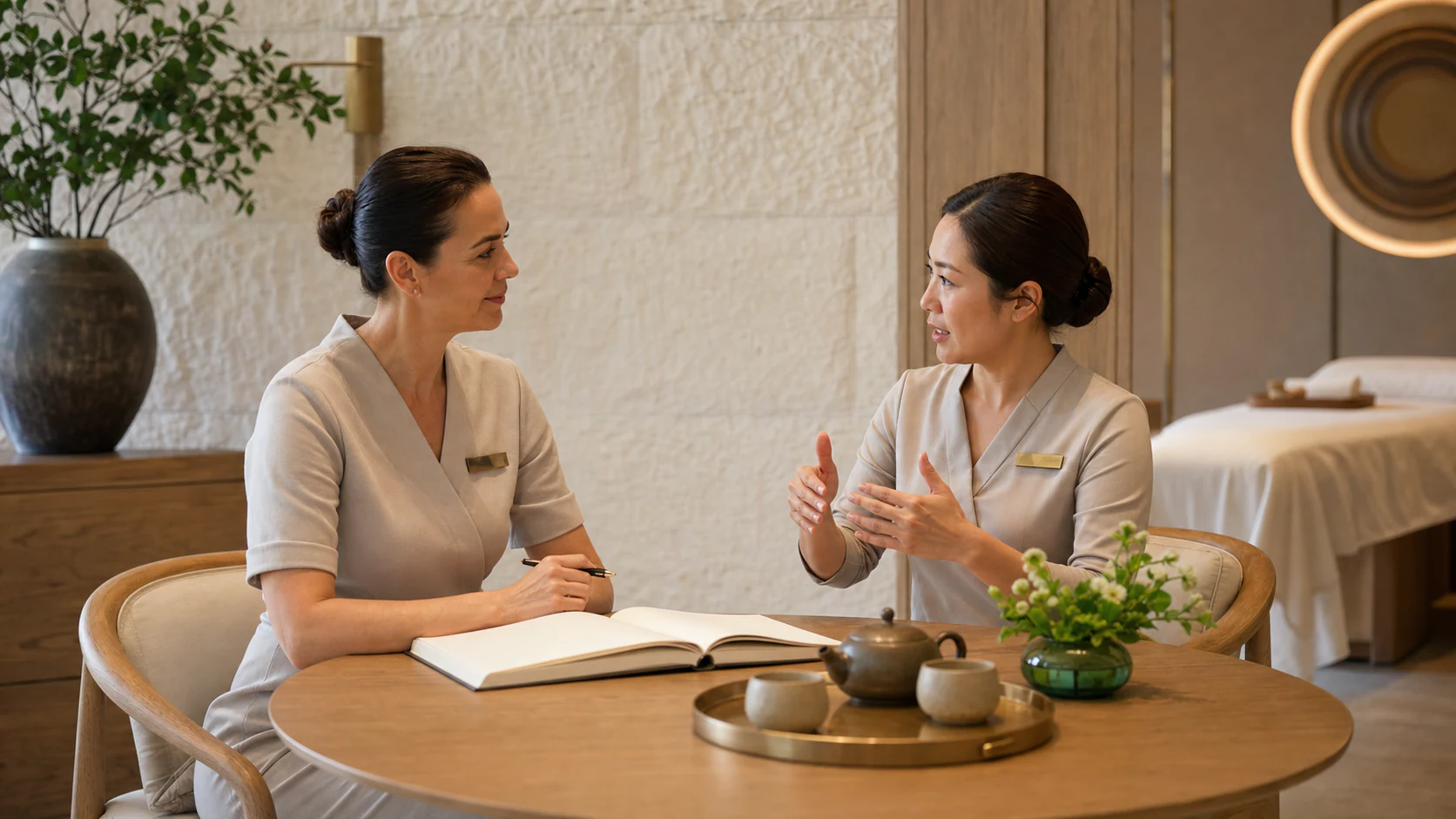
Three response models for deluxe spa teams
When the operational problem is verified
Hello Maya, we are sorry that the delayed start disrupted the calm experience you expected. We reviewed the appointment with our team and have corrected the handover that caused the wait. Our spa director would welcome the opportunity to speak with you directly and propose an appropriate solution. You can reach her at [contact]. Thank you for bringing this to our attention.
When important facts are disputed
Hello, we regret that the visit did not meet your expectations. After reviewing the appointment, some details in the review differ from the information available to our team. To protect your privacy, we will not discuss the record publicly. Our spa director remains available at [contact] to review the situation with you carefully and constructively.
When a safety boundary prevented the treatment
Hello, we understand the disappointment of being unable to receive the treatment booked. Guest safety remains our priority, and our team follows the contraindications established for this protocol. We cannot discuss personal information in a public reply, but our spa director can explain suitable alternatives privately at [contact].
These are models, not scripts to paste unchanged. A credible reply contains one verified detail, one human sentence and one real next step. The tone should match the property, but the substance must match what the team can actually deliver.
When restraint is the better response
Some reviews should be documented and reported rather than debated. This includes threats, hate speech, harassment, extortion, explicit private information and repeated provocation. A post that appears to describe no known visit can receive one neutral response: the spa cannot identify the appointment and invites the writer to contact management with booking details. Do not then enter a long exchange.
Serious safety, health or legal incidents also require restraint. A short acknowledgement may be appropriate, but the investigation belongs in a confidential escalation process. If the review breaches a platform policy, preserve evidence and use the official reporting route. Do not accuse the reviewer publicly of fraud unless the facts and legal advice clearly support that position.
Silence is not automatically authority. In these cases, limited communication is risk control. The difference is that the silence follows an internal decision, not avoidance.
Why generic AI replies can weaken a premium brand
AI can help a multilingual spa structure a draft, check tone or translate a response. It should not decide what happened or publish without human review. A 2025 hotel-review study found that participants struggled to distinguish AI-written managerial responses from employee-written ones. However, when AI authorship was disclosed, reactions were less favourable, with authenticity and a sense of uncanniness helping to explain the effect.
The operating rule is simple: automation may support the writing, but a responsible manager must verify the facts, remove private information, adapt the voice and own the action promised. “Your feedback is important to us” is not personalised merely because software inserted the guest’s name. At the luxury level, an efficient response that feels generic is still a service failure.
Turn criticism into a service-design system
A response closes the public loop. It should also open an internal learning loop. Classify review themes by booking accuracy, welcome, waiting time, therapist communication, treatment pressure, noise, cleanliness, privacy, temperature, billing, sales pressure and perceived outcome. Distinguish an isolated preference from repeated operational friction.
Then map the issue to the guest journey. A noise complaint may come from poor acoustic design, but it may also come from appointment spacing or an unclear mobile-phone policy. A complaint about treatment pressure may reveal a consultation gap, a handover problem or a therapist who does not check in at the right moment. Our guide to scent, flow, privacy and service explains why the most visible failure often begins earlier in the journey.
Track a concise set of measures: median response time; percentage of substantive negative reviews receiving a personalised reply; recurring themes by location, service and shift; private resolution rate; review updates after resolution; and corrective actions completed. Pair those measures with coaching, not blame. A therapist who reports a difficult interaction promptly gives management a chance to recover the experience before it becomes a public complaint.
The guest-facing side matters too. Clear pre-arrival information, accurate menus and appropriate etiquette guidance reduce preventable expectation gaps. The World Luxury Spa etiquette guide can help guests prepare, while the wellness concierge framework shows how a sharper brief improves the match between property, treatment and occasion.
The luxury standard is calm accountability
A deluxe spa does not need to explain every internal detail, persuade every critic or apologise for enforcing ethical boundaries. It should not reward abusive behaviour or turn a disagreement into public entertainment. It should listen, verify, protect and act.
The strongest response is often short because the operating work behind it is thorough. A future guest should finish reading with a clear impression: this property notices what happens, respects confidentiality, understands hospitality and can recover when the experience falls short.
That is the deeper purpose of review management. The goal is not a spotless comment section. It is visible evidence of mature service leadership.
Frequently asked questions
Should a luxury spa respond to every negative review?
Respond to substantive reviews when the spa can acknowledge the concern, clarify a relevant standard or offer a next step. Do not prolong exchanges involving abuse, repeated provocation or no useful public information.
How quickly should a spa answer a negative review?
Respond promptly, but only after checking the appointment and speaking with the employees involved. Many luxury operators set a next-business-day target while allowing serious incidents to follow a separate confidential escalation process.
Does an apology admit legal responsibility?
Expressing regret that a guest was disappointed does not necessarily confirm an unverified allegation. Serious legal, safety or health-related incidents should be reviewed through the property’s formal process and, where appropriate, by qualified counsel.
Should compensation be offered in the public reply?
Usually not. State that management wants to review the matter, then assess any remedy privately. Compensation should be proportionate to a verified failure and should not become a public incentive for escalating complaints.
Can AI write luxury spa review responses?
AI can assist with structure, tone and translation, but a human manager should verify the facts, protect privacy, personalise the language and approve every action promised.
Sources and further reading
- Google Business Profile Help: official guidance on managing and replying to customer reviews. Read the guidance.
- Sparks, So and Bradley, Tourism Management: experimental research on trust, concern, human voice and response timing. Read the study overview.
- Proserpio and Zervas, Marketing Science: research on the impact of management responses on hotel ratings and review behaviour. Read the open manuscript record.
- Tan, Liu and Litvin, Tourism Management: research on AI-generated managerial responses, authenticity and prospective customer reactions. Read the study overview.
- Service quality and cross-cultural guest satisfaction in wellness tourism: research on professional, tangible and empathy-related satisfaction drivers. Read the open-access study.