Licence to Move: What the Esthetics Compact Could Mean for Spa Talent
A luxury facial may last ninety minutes, but the professional authority behind it is built over years: education, examination, supervised practice, continuing learning and the judgement to know when a service should be adapted or declined. In the United States, that authority is granted state by state. When an esthetician moves, the treatment craft may travel instantly; permission to work often does not.
A new Esthetics Licensure Compact is intended to reduce that friction. Alabama, Kansas and Virginia have adopted its model language in 2026, according to the Council of State Governments. The compact is not yet active: it comes into effect only when a seventh state enacts it, after which a commission must create the rules and systems that make multistate licensing work. That gap between promise and operation is precisely why spa leaders should pay attention now—without advertising portability that does not yet exist.
The signal: licence mobility has become a spa-workforce issue
A Spa Business press release on 7 August 2026 reported that three industry associations had received an award for their work advancing the Esthetics Licensure Compact. Awards and association advocacy are not independent evidence that a policy will succeed. The more useful editorial signal is that professional mobility has moved from a private inconvenience to a visible operating question for spas, salons and skincare businesses.
The underlying labour market is substantial. The US Bureau of Labor Statistics estimated 97,400 skincare-specialist jobs in 2024 and projected employment to grow by 7 per cent from 2024 to 2034. It also projected about 14,500 openings each year on average, many arising when people change occupations or leave the workforce. Those figures describe jobs, not the number of licences ever issued, and should not be confused with broader industry estimates. They still show why delays in placing qualified people can matter to employers and guests.
Academic evidence gives the policy question a wider frame. A study of 22 licensed occupations in the American Economic Journal: Economic Policy found that occupational licensing reduces interstate migration, while cautioning that the effect explains only a small part of the wider decline in mobility. That is a useful balance. Re-licensing can be a real barrier without being the sole cause of recruitment, retention or regional staffing problems.
For luxury spas, the issue is not simply filling rotas. Facial services often depend on continuity: consistent consultation, technique, sanitation, product knowledge, escalation and aftercare. A vacancy can reduce appointment availability, but a rushed hire can weaken the guest promise. Portability is valuable only if it removes duplication while preserving clear responsibility.
What the Esthetics Licensure Compact is designed to do
The model legislation creates an additional multistate licensing route among participating US jurisdictions. An eligible professional would apply through their home state—the member state that is their primary residence and where they hold an active, unencumbered esthetics licence. A multistate licence issued by that home state would include authorisation to practise in the other member states.
This is not a casual mutual promise between employers. It is a regulatory structure. To participate, states must license and regulate estheticians, require education or training and a competency examination before initial licensure, maintain a complaint mechanism, consider relevant applicant history and participate in a shared data system. Member states would exchange licence status, adverse actions and specified investigative information.
The remote state—the member state where the service is delivered—retains authority over practice within its borders. The professional must follow that state’s scope-of-practice laws and is subject to its licensing authority, courts and laws. The compact therefore aims to make the licence portable, not to make every treatment rule identical.
That distinction is important for guests. A portable licence should make it easier for a qualified practitioner to work across participating states; it should not allow a service prohibited in one state merely because it is permitted in another. The location of the client and service remains operationally decisive.
Three enacted states do not yet make an operational compact
As of 15 August 2026, the Council of State Governments lists Alabama, Kansas and Virginia as having joined. Alabama’s enacted provisions take effect on 1 October 2026. Kansas adopted the compact within a wider bill covering several professions, and Virginia incorporated it into its professional-licensing code. These records verify legislative adoption; they do not mean a practitioner can request and use a multistate esthetics licence today.
Article 13 of the model legislation is explicit: the compact comes into effect when the seventh member state enacts it. The commission can then convene, review charter-state enactments, adopt bylaws and rules, establish fees and build the data and administrative processes needed for licensing. Experience from other professional compacts shows that statutory activation and practical availability may be separate milestones.
A responsible operator should therefore maintain three statuses. Enacted means a state has passed compatible law. Effective means the compact has reached its legal threshold. Operational means the commission and participating authorities are actually issuing or recognising multistate licences. Recruitment copy, onboarding and internal compliance records should use the status that can be verified on the date of hire.
There is no benefit in getting ahead of the law with vague claims such as “licensed to work nationwide”. Even after activation, the compact will apply only across member states and only to eligible licensees whose home state participates. Professionals living in a non-member state may still pursue individual state licences under existing processes, but a licence from a member state does not become multistate merely because the person once trained or worked there.
What portability will not standardise
It will not create one national scope of practice
The model text leaves education and professional requirements for initial state licences with each member state. It also keeps each remote state’s scope-of-practice law in force. A modality, tool or level of exfoliation allowed at one location may require different authority, supervision or exclusion at another. A multi-property spa group will still need a live service-by-state matrix.
It will not certify luxury-service competence
Licensure is a legal threshold, not proof that someone has mastered a brand’s consultation style, equipment, product protocols, accessibility standards or service choreography. Excellent onboarding remains essential. The most refined five-star spa experience design depends on how a team translates regulation and technique into calm, consistent hospitality.
It will not replace primary-source checks
Employers will still need to verify the current licence, home-state eligibility, multistate status, any relevant restrictions and the legal scope at the work location. A screenshot, résumé line or old certificate is not enough. Verification should come from the relevant licensing authority or compact system when it becomes available.
It will not authorise medical practice
The compact covers esthetics as cosmetic skincare services defined by member-state law. It should not be presented as medical licensure or used to blur the boundary between spa care, advanced aesthetics and healthcare. Titles, claims, referrals and supervision must remain accurate to the practitioner’s actual authority in the state where the guest is treated.

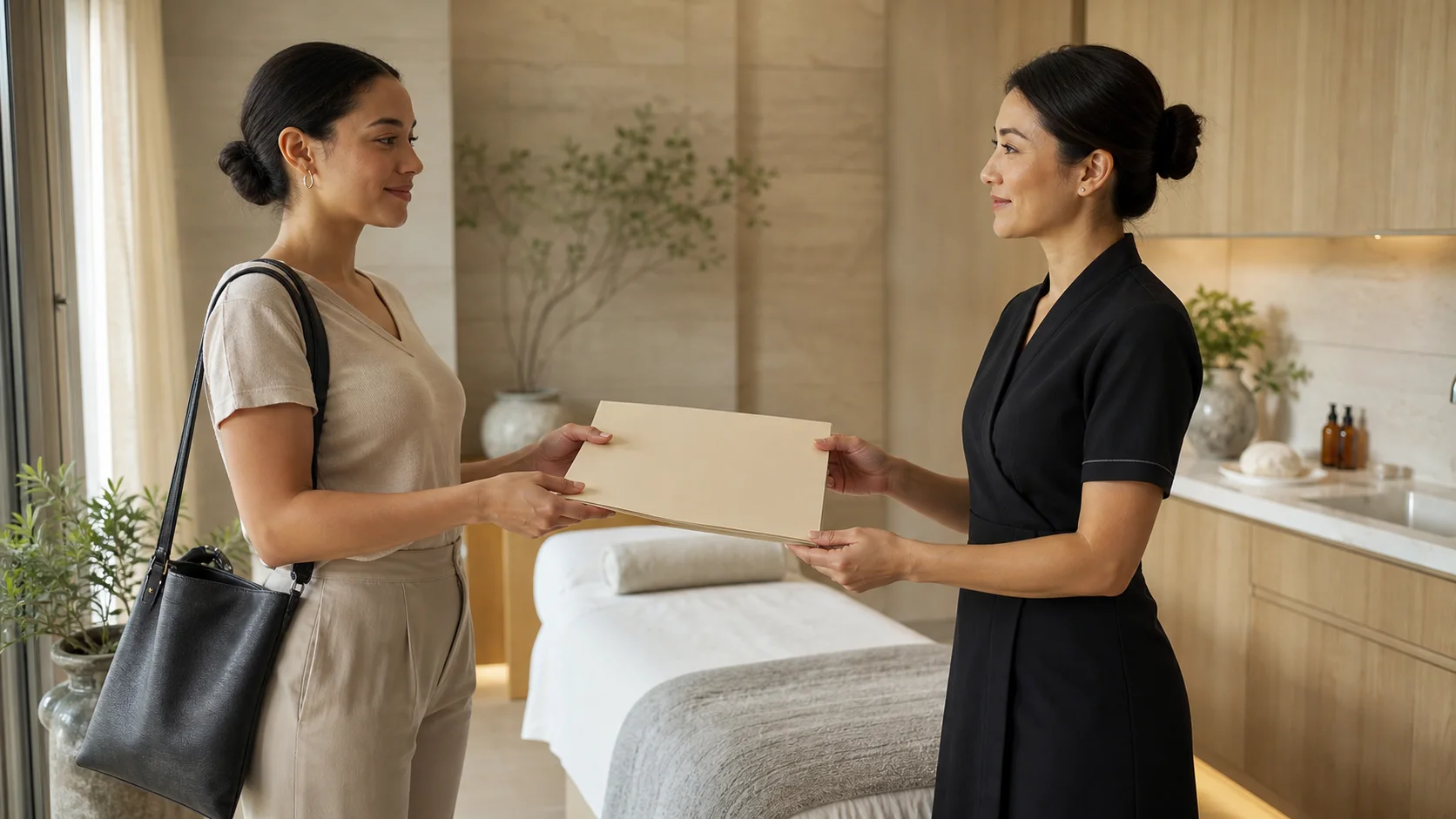
Editorial image note: both photographs in this feature are original AI-generated illustrations. They do not depict a named spa, employer, licensing authority, association or person.
A seven-part operating standard for spa groups
1. Build a jurisdiction register, not a shared spreadsheet of assumptions
For every location, record the licensing authority, primary verification URL, permitted and restricted services, required supervision, renewal dates, establishment rules and the person accountable for updates. Add compact status as a separate field. Date every entry and retain the source, because a matrix without provenance becomes stale confidence.
2. Separate legal eligibility from treatment competency
Use two gates. The compliance gate confirms that the professional may lawfully provide the named service at that location. The competency gate evaluates consultation, sanitation, technique, product and device training, contraindication awareness, consent, aftercare and escalation. Passing one gate should never imply passing the other.
3. Map each menu item to authorised actions
Elegant treatment names can hide operational differences. Break every facial into its real steps, products, tools and claims, then map those components to local scope and internal competency. This also strengthens the governance of luxury spa wellness claims: the marketed promise should match what the authorised professional actually delivers.
4. Design portable onboarding with local modules
A central curriculum can cover brand service, hospitality, privacy, product handling and incident reporting. Local modules should cover state law, restricted practices, escalation contacts, establishment rules and any jurisprudence requirement. When a practitioner moves, recognise completed central training but require the relevant local module before the first guest.
5. Make the guest record location-aware
Booking and treatment systems should associate the appointment with the service location, practitioner authority and approved protocol version. If a menu differs by state, the system should prevent the wrong protocol from being sold or assigned. Audit logs should show which version was active, not merely the current document.
6. Protect mobility from becoming precarity
A more portable licence could expand opportunity, but employers should not use mobility to normalise unstable schedules, unpaid relocation, permanent on-call travel or compressed training. A strong talent strategy states the location, hours, pay structure, travel expectations, insurance, continuing-education support and who bears compact or licensing fees.
7. Review incidents across the network without erasing local authority
Central teams should identify patterns in complaints, reactions, sanitation, consent and service recovery. Local compliance leads must still notify and cooperate with the appropriate authority where required. The compact’s data-sharing design is a reminder that mobility and accountability are meant to travel together.
Why military-spouse mobility is central to the design
The compact was developed by the Council of State Governments with industry stakeholders and US defence support. Military State Policy Source reports that 35 per cent of active-duty military spouses require a state-issued occupational licence for their chosen profession, and that 28 per cent of spouses who experienced a permanent-change-of-station move needed new licensure or certification at the new location, based on the 2024 Survey of Active Duty Spouses.
Those figures cover licensed occupations broadly, not estheticians alone. They should not be used to estimate the size of the spa workforce. Their relevance is structural: frequent moves make repeated state-by-state processes especially visible, and an occupation-wide compact can benefit both military and civilian professionals rather than creating a separate employment class.
For employers near military communities, that means talent systems should recognise portability without making assumptions about a candidate’s family status. Publish the licence evidence needed for the role, offer a clear route for verification and avoid asking for private military or family information that is unnecessary to the hiring decision.
What practitioners should check before accepting a mobile role
First, confirm whether the compact is operational, whether both the home and destination states are participating and whether the home-state authority is issuing multistate licences. Ask which fees, renewals, background or jurisprudence requirements apply. Do not resign, relocate or accept bookings based solely on a proposed bill or an employer’s summary.
Second, request the exact service list and scope analysis for the destination. Ask which protocols require separate training, supervision or exclusion; how the employer verifies authority; and whether professional liability cover follows the work across locations. A portable licence does not automatically make an insurance policy or independent-contractor agreement portable.
Third, examine the economics. Who pays application, renewal, travel and training costs? Is travel time paid? Are gratuities, commission and rebooking credit handled consistently? What happens if a state changes its law or a multistate authorisation is delayed? The most attractive mobility offer is one in which the administrative risk is not quietly transferred to the practitioner.
Finally, protect professional judgement. The right to pause or decline a service outside legal scope, current competence or safe practice should be explicit. A staffing gap is never a reason to stretch a licence, improvise with unfamiliar equipment or accept a claim that the protocol cannot support.
What sophisticated travellers should notice
Guests do not need to audit interstate law before a facial. They should, however, expect a property to know who is authorised to deliver the service, to describe the practitioner’s role accurately and to answer reasonable questions without defensiveness. A prestigious setting does not make credential checks optional.
Look for precise language. “Licensed esthetician” is more useful than a vague superlative, but it is still only one part of quality. The consultation should cover skin sensitivity, current products, previous reactions and the intended cosmetic result. The professional should be able to adapt the treatment, explain aftercare and refer concerns beyond their scope rather than diagnosing.
Portability may eventually improve continuity when a practitioner relocates or a spa group operates across states. It should not turn professionals into interchangeable names on a roster. Luxury is the combination of lawful authority, demonstrated competence, adequate time and a workplace that supports judgement.
The World Luxury Spa verdict
The Esthetics Licensure Compact is a credible response to a real friction, but it is still an emerging legal framework rather than an available national passport. Its most promising feature is not speed alone. It joins mobility to shared eligibility, data exchange and remote-state enforcement while preserving local scope-of-practice law.
The best spa groups will prepare before activation without pretending it has arrived. They will build source-backed jurisdiction registers, separate licensure from competence, modularise onboarding, align menus with local authority and offer fair mobile-work terms. If the compact reaches operation, those systems will let qualified talent move with less duplication. If it develops slowly, the same systems will still improve compliance and guest care.
A luxury workforce standard should make movement easier and responsibility clearer at the same time. Anything less is simply faster ambiguity.
Frequently asked questions
Is the Esthetics Licensure Compact active now?
No. Alabama, Kansas and Virginia have enacted it as of 15 August 2026, but the model compact comes into effect only when a seventh state enacts it. Practical licensing will also depend on the commission’s rules, systems and participating authorities becoming operational.
Will one multistate licence allow an esthetician to work anywhere in the US?
No. It is designed for eligible professionals whose home state belongs to the compact and would authorise practice only in other member states. Non-member states retain their existing licensing routes.
Does the compact make esthetics rules identical in every member state?
No. Each state retains its initial licensing requirements and scope-of-practice laws. A professional working in another member state must follow the laws and regulatory authority of the state where the service is provided.
Can a spa hire someone as soon as their home state joins?
Not on that fact alone. The employer should verify that the compact is operational, the professional holds the required current multistate authority, the destination state participates, the planned services fall within local scope and the practitioner has completed appropriate competency and onboarding checks.
What does the compact change for spa guests?
It could help qualified practitioners move between member states with less duplicated licensing, supporting recruitment and continuity. It does not replace the spa’s duty to verify authority, train for the actual protocol, follow local rules and provide safe, accurate guest communication.
Sources and further reading
- Spa Business: the 7 August 2026 association press release that brought the compact’s spa-workforce relevance into the current industry news cycle. Read the lead report.
- Esthetics Licensure Compact: the official information site and model legislation defining member-state requirements, multistate licensing, remote-state authority, data sharing and the seven-state effective-date threshold. Visit the official compact site and read the model legislation.
- Council of State Governments National Center for Interstate Compacts: the current compact database listing Alabama, Kansas and Virginia as joined in 2026. Review the member-state record.
- Official state records: enacted or signed compact records from Alabama, Kansas and Virginia.
- Military State Policy Source: 2026 analysis of occupational-licensure compacts and results from the 2024 Survey of Active Duty Spouses. Read the official policy resource.
- US Bureau of Labor Statistics: current Occupational Outlook Handbook data for skincare specialists, including 2024 employment and 2024–2034 projections. Read the occupation profile.
- American Economic Journal: Economic Policy: Johnson and Kleiner’s study of occupational licensing and interstate migration across 22 licensed occupations. Read the research abstract and paper details.