The Family Wellness Gap: Designing Luxury Resorts Where Parents Can Exhale
A luxury resort can give a parent a beautiful treatment room and still send them home exhausted. The contradiction usually begins outside the spa: the pool that demands uninterrupted vigilance, the children’s club with an awkward handover, the family timetable that makes one adult coordinate everybody else, or the “quiet” wellness programme that assumes the children are somewhere else.
Spa Business recently argued that luxury wellness overlooks families, especially in the moments around the pool and between formal experiences. The observation is persuasive because it shifts the question away from whether a hotel has children’s amenities. The more exact question is whether its spaces, staffing and schedules allow every family member to experience some agency, connection and restoration without quietly transferring all the work to one caregiver.
That is a service-design challenge, not a promise that a holiday will treat stress or transform family life. Research supports the potential value of family travel, but it also records tensions, unequal workloads and highly varied needs. A serious family-wellness offer must hold both truths at once.
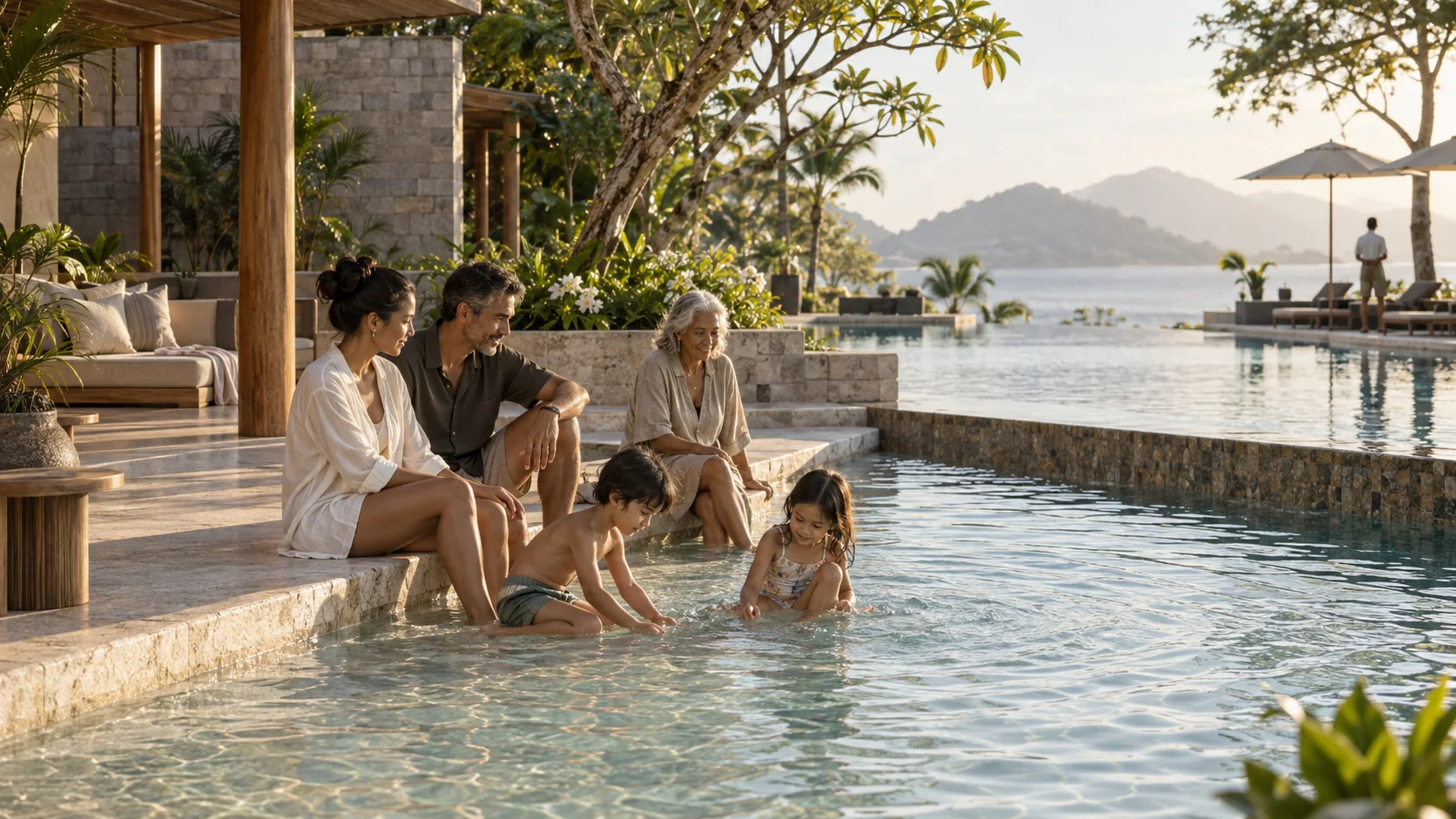
Family wellness is not an adult spa with childcare attached
The conventional resort model separates the adult wellness product from the family product. One side promises silence, treatments and unstructured time; the other supplies a kids’ club, a splash area and scheduled activities. That division can be useful, but it is not a complete design. Parents still have to understand the rules, persuade a child to participate, manage handovers, coordinate treatment times and remain reachable. A facility may remove a child from the treatment corridor while leaving the parent’s mental load intact.
The Global Wellness Institute’s policy work offers a broader frame. It distinguishes primary wellness travel, where wellness is the trip’s principal purpose, from secondary wellness travel, where people pursue wellbeing within another kind of journey. GWI estimated that secondary wellness travel accounted for 88 per cent of wellness trips in 2022. That estimate is not a measurement of family demand, but it makes an important operational point: wellbeing is shaped across accommodation, food, movement, transport and leisure, not only inside a spa.
For a family, this means the arrival, poolside, dining room, bedroom and activity timetable are all part of the wellness experience. A restorative massage cannot compensate for confusing supervision rules or a meal service that makes a caregiver negotiate every detail under pressure. Equally, a thoughtful family lounge can create real value without being labelled a treatment.
What the research supports — and what it does not
A 2022 study in Tourism Management followed 217 families with elementary-school children before and after a holiday. It reported increases in parents’ wellbeing and children’s generic skills, with memorable experiences and children’s perceived development associated with the change in parental wellbeing. The pretest–posttest design is stronger than a one-time opinion survey, yet it does not prove that a specific resort feature caused the improvements or that every family holiday will have the same effect.
More recent work complicates the optimistic story. A 2026 mixed-methods study of mothers on three-generational trips in China found that parenting stress was associated with lower travel satisfaction and subjective wellbeing, while partner support and self-efficacy were protective resources. The study’s cultural setting and focus on mothers matter; its findings should not be universalised to every family. Its core lesson is still practical: travel can offer respite and create new work at the same time.
A 2026 resort study based on interviews with 20 parents and 15 children in China further describes family holidays through multiple perspectives: peak and supporting moments, individual and family experience, and the contrast between home and away. The small qualitative sample cannot calculate how common an experience is. It does show why a property should not infer a child’s preferences from the adult booking the room, or assume that one spectacular activity will repair the quieter frictions surrounding it.
These studies justify careful experimentation, not wellbeing guarantees. A resort can reasonably aim to reduce avoidable friction, expand choice and protect shared time. It should not claim that a pool layout, programme or treatment will improve a child’s development, repair a relationship or relieve a clinical condition.
Design the family as a system of different guests
“Family” is not a single persona. It can include one parent, two parents, separated co-parents, grandparents, infants, teenagers, an adult or child with a disability, siblings with conflicting interests, or a caregiver travelling with several generations. Age alone does not reveal confidence in water, sensory preferences, communication style, mobility or willingness to join a group programme.
The most useful pre-arrival question is therefore not “Do you require childcare?” It is “What would make each person’s stay feel easier, safer and more enjoyable?” The answer might involve a quiet breakfast table, adjacent treatment times, a visual schedule, an allergy conversation, a shaded pool base, a private changing arrangement or simply the freedom for a teenager to decline an organised activity.
Inclusive design matters here. A 2026 hospitality study involving 16 families with autistic children identified a range of concrete and less visible hotel attributes that influenced the meaning and quality of a stay. Another 2026 study of parents travelling with autistic children emphasised flexible service routines, sensory-responsive environments and inclusive staff training. Both are based on small samples, and autistic people are not a uniform group. Their practical implication is to offer options and ask, rather than diagnose needs or impose a supposedly universal “sensory-friendly” package.
A family-centred resort should also respect children as guests with views, privacy and boundaries. That does not mean handing a child adult responsibility. It means explaining what will happen in age-appropriate language, seeking assent where appropriate, allowing a graceful refusal and never using a child’s image or personal information casually.
Build three kinds of time into the stay
The strongest family-wellness schedule protects shared time, parallel time and individual time. Shared time creates connection: a gentle nature walk, a family cooking session, an unhurried breakfast or a thermal experience specifically designed and risk-assessed for the participating ages. Parallel time lets family members do different but compatible things within one area. Individual time gives a caregiver or child space without framing separation as the only route to calm.
Shared time should not mean compulsory togetherness
A premium family ritual needs a clear duration, pace, age range and exit route. Children should not be expected to remain still through an adult-format ceremony, and adults should not be sold a “family” session that is simply entertainment supervision. Offer a meaningful activity with room for different levels of participation. A shared garden walk might include sensory observation for younger children, a photographic prompt for teenagers and comfortable rest points for grandparents.
Parallel time reduces the handover burden
Parallel design can be more restorative than a long separation. Imagine a shaded lounge where an adult reads or receives a short non-invasive treatment while children use a calm, supervised nature-play zone in clear sight. The success lies in acoustics, sightlines, staffing and boundaries, not decorative toys. The parent knows who is responsible; the child can reconnect without a formal collection process.
Individual time needs a reliable bridge
When families do choose childcare or separate programmes, the bridge must be trustworthy. Publish age bands, ratios, staff qualifications, opening times, booking deadlines, sign-in rules, collection permissions, emergency contacts and what happens if a child wants to leave. A parent cannot relax if the operational questions remain unresolved until five minutes before a treatment.
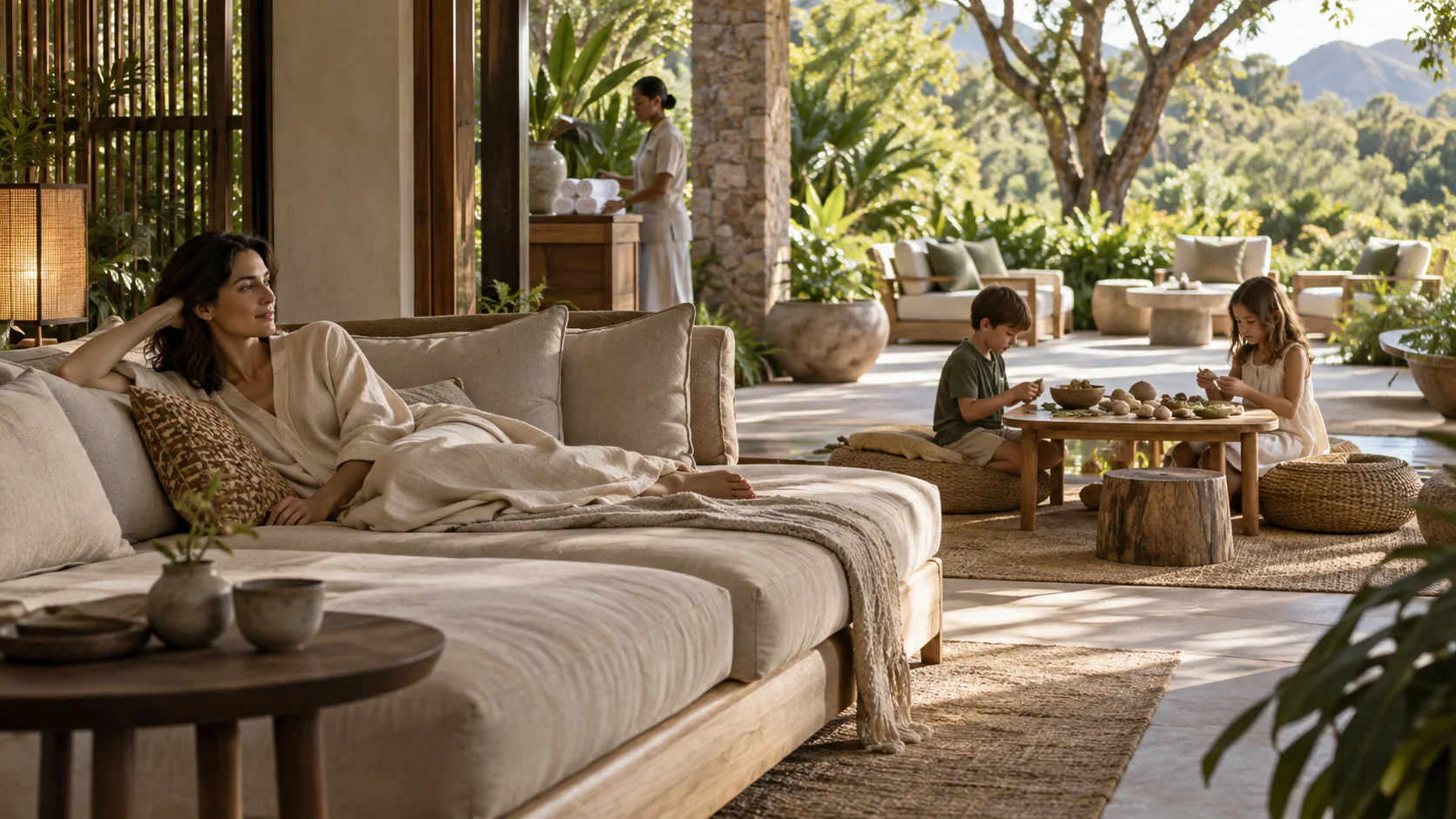
Poolside calm begins with explicit safety
The pool is where vague ideas about relaxation become a duty-of-care question. The World Health Organization reports that drowning disproportionately affects children and young people, and that risk increases when children are around water without active adult supervision. WHO recommends measures including barriers that control access, supervised childcare and water-safety education. Local laws and facility standards will determine the detailed requirements, but aesthetic serenity never substitutes for a risk assessment.
Hotels should make responsibility visible. Is a lifeguard present, and during which hours? Does that change the caregiver’s duty to supervise? Which pool is shallow, how is depth marked, where are the blind spots, and how are gates or water edges controlled? What is the protocol for swimming aids, lessons, emergencies and severe weather? These answers belong in pre-arrival information and poolside orientation, not only in small-print signage.
A dedicated play zone near the pool can reduce repeated negotiation, as the Spa Business lead suggests, but it must not create false reassurance. The design should preserve sightlines, shade and physical separation from water while defining who supervises. Staff should avoid language such as “we’ll keep an eye on them” unless the service is formally taking responsibility under a documented programme.
True luxury is low ambiguity. Parents should be able to understand the pool’s safety model within a minute, while children encounter boundaries that are consistent rather than punitive.
Transitions are the hidden architecture of rest
Family stress often gathers between headline experiences: room to breakfast, pool to changing room, children’s club to spa appointment, activity to dinner, or treatment to reunion. These are operational seams. A resort that studies them can remove more tension than one that adds another ambitious programme.
Map the journey minute by minute. Can a family store wet items without returning to the room? Are toilets and changing spaces convenient for different caregivers? Is there somewhere calm to wait when one activity ends before another begins? Can a treatment be delayed briefly after a difficult handover without a punitive tone? Does room service recognise that a child may need food before the adult dining schedule?
This is the family version of designing a five-star spa experience: scent, privacy and beautiful materials matter, but flow determines whether the guest experiences them as care. Information should be concise, repeated at the right moment and available in more than one format. A polished app is not inclusive if the only adult with the phone must coordinate every person.
Recovery space should exist on both sides of an activity. A shaded bench, quiet corner or short buffer in the schedule allows a family to regulate pace without appearing late or difficult. Operational flexibility should be bounded and fair, but a rigid timetable that ignores predictable transitions merely turns normal family behaviour into service failure.
Programme for capability and consent, not miniature adulthood
Some treatments and thermal experiences are unsuitable for children or require age, health and supervision restrictions. Resorts must follow local rules, product instructions, professional standards and a defensible risk assessment. Marketing should never imply that an adult protocol becomes appropriate simply by shortening it, lowering the temperature or renaming it for children.
Family wellness does not require a children’s facial menu. It can be built through sleep-supportive room design, nourishing food with genuine choice, safe movement, nature, creative play and time that is not overscheduled. If a spa offers a service to a minor, it should explain who performs it, what products and techniques are used, how consent and assent work, whether a guardian is present, what information is recorded and how discomfort or withdrawal is handled.
Teenagers deserve particular care. They may want privacy and autonomy without being placed in adult spaces or expected to share sensitive wellness information with family members. Clear age policies, private but safe changing arrangements and staff who can explain boundaries respectfully are more valuable than trend-driven “teen detox” or body-correcting language.
The same restraint applies to claims. Avoid promising better concentration, weight change, emotional regulation, immunity or sleep unless the exact service and population are supported by appropriate evidence and the claim is lawful. Hospitality can offer conditions that feel calm and supportive without turning childhood into a treatment target.
Staffing is the product
A family-wellness concept fails if responsibility is distributed informally across spa hosts, activity leaders, lifeguards, housekeepers and parents. Each role needs a written boundary, escalation path and handover. Teams should know who may be alone with a child, who can authorise collection, what to do after a disclosure or injury, how to record an incident and when a parent must be contacted.
Safeguarding should be treated as an operating system, not a certificate on the wall. Recruitment, reference checks, training, supervision, photography rules, digital communication and vendor contracts all matter. Staff need practical rehearsal for common situations: a child refuses to join, a caregiver cannot be reached, siblings are assigned to different groups, a guest requests an exception to an age rule, or a teenager shares private information.
Language also shapes the burden. Ask which adult is the authorised contact rather than assuming a mother will coordinate. Address children respectfully without bypassing the caregiver. Describe choices without pressure. Never promise confidentiality that safeguarding rules do not allow, and explain any necessary limits in plain language.
Operators should measure what the family journey actually costs staff. Late collections, ad hoc supervision and constantly changing requests may signal a design flaw rather than difficult guests. Add capacity, change the timetable or clarify the offer instead of relying on invisible emotional labour from frontline teams.
A practical family-wellness operating standard
Before arrival
Publish age rules, water-safety arrangements, accessibility information, activity schedules, childcare terms, treatment restrictions and meal flexibility. Ask a short set of preference questions without collecting unnecessary health or behavioural data. Confirm adjacent or connecting-room arrangements precisely rather than leaving families to discover them at check-in.
At arrival
Orient both adults and children. Identify water boundaries, meeting points, quiet spaces and the named contact for schedule changes. Check that every caregiver understands collection permissions and that staff pronounce names correctly. A five-minute, well-designed welcome can prevent hours of uncertainty.
During the stay
Protect buffers between bookings and offer one clear channel for changes. Observe where queues, noise and handovers accumulate. Give staff authority to solve small problems within defined limits. Preserve choice: a family should be able to join, separate, pause or leave without being made to feel that it has failed the programme.
After departure
Ask each participating age group what worked. Separate questions about adult rest, child enjoyment, shared time, safety clarity and staff support; one overall satisfaction score hides trade-offs. Review incidents and near misses, not only complaints. Track whether the service delivers the schedule and staffing level it advertises.
How travellers can judge a family-wellness resort
Start with operational evidence. A resort should be able to answer who supervises children, how pool safety works, which experiences are shared, what adults can do during children’s activities and how the plan changes if a child opts out. Vague assurances such as “perfect for all ages” reveal less than a clear timetable and policy.
Look for a rhythm that fits your family rather than the longest menu. Consider travel time, sleep, heat, mobility, sensory load and the amount of coordination one person will carry. Our guide to choosing a luxury spa resort can help evaluate service, setting and practical fit beyond photographs.
Ask about flexibility before paying a non-refundable rate. Can spa appointments be placed beside a children’s programme? Is there a backup if the programme is cancelled? Can one caregiver use the spa while another has a genuinely comfortable base with the children? Which spaces are adults-only, family-inclusive or age-restricted, and are those boundaries consistent?
Finally, reject guilt in either direction. Adults do not have to spend every minute with children to make a family holiday meaningful, and children do not have to perform wellness to justify the trip. The best resort creates trustworthy options, then lets a family choose its own balance.
Editorial verdict
The family-wellness gap will not be closed by adding a branded activity pack beside the pool. It closes when a resort treats parental attention, children’s agency, staff capacity and safety information as connected parts of one experience. The design goal is not silence everywhere. It is a legible rhythm in which togetherness, play, privacy and rest can coexist.
Research suggests family travel can support memorable experiences and wellbeing, while also exposing stress and unequal responsibility. Luxury hospitality earns its premium by working with that complexity honestly. A parent’s exhale should not depend on uncertainty being hidden; it should come from knowing that the property has anticipated the difficult moments and made responsibility clear.
Frequently asked questions
What is a family-wellness resort?
It is a resort that designs wellbeing across the whole family journey, including rooms, food, movement, pools, shared activities, individual time and transitions. A kids’ club or children’s treatment menu alone does not make the experience family-wellness focused.
Does family wellness mean parents and children must do everything together?
No. A strong programme offers shared, parallel and individual time. It makes supervision and handovers clear, respects a child’s willingness to participate and lets each family choose a balance without pressure.
Can a lifeguard replace active parental supervision at a resort pool?
Not automatically. The property should state the lifeguard’s role and its supervision rules explicitly. Caregivers should follow the resort’s safety instructions and local guidance rather than assuming that a visible staff member has accepted responsibility for an individual child.
What should parents ask before booking childcare or children’s activities?
Ask about age bands, staff qualifications, child-to-staff ratios, safeguarding, sign-in and collection, emergency procedures, accessibility, how staff respond if a child wants to leave, and what happens if the programme is cancelled.
Are spa treatments appropriate for children and teenagers?
Suitability depends on age, the exact treatment, products, local rules, professional standards and individual circumstances. The resort should explain restrictions, consent and assent, guardian presence, practitioner qualifications and how a young guest can stop. Adult treatments should not simply be renamed for children.
Sources and further reading
- Spa Business — Parents are overlooked
- Miyakawa and Oguchi — Family tourism improves parents’ wellbeing and children’s generic skills
- Wan et al. — Balancing Stress and Leisure: Mothers’ Experiences During Three-Generational Family Travel
- Zhang et al. — Family vacation experiences in resorts: Voices of Chinese parents and children
- Pung, Atzeni and Del Chiappa — Hotel attributes and values for families with autistic children
- Wang et al. — Travel as Transformation: Parental Coping and Adaptation with Autistic Children
- World Health Organization — Drowning fact sheet
- Global Wellness Institute — Wellness Policy Toolkit: Wellness in Tourism