The People Behind the Calm: A Staff Wellbeing Standard for Luxury Spas
A luxury spa asks guests to notice what ordinary life often hides: tension, fatigue, hurried breathing and the need for recovery. Yet the people creating that calm may be moving through a fully booked day, resetting rooms against the clock, absorbing intimate conversations and maintaining a composed presence regardless of what happened in the previous appointment.
That contradiction is not solved by adding a staff meditation class after an overloaded shift. Employee wellbeing begins with how work is designed: realistic demand, control over the day, safe equipment, recovery time, supportive management, fair treatment and a clear response when a guest crosses a boundary. The serenity of the public spaces cannot be purchased by making pressure invisible backstage.
This standard complements our analysis of spa workforce mobility and the trust questions raised by dynamic spa pricing. Its concern is different: what should a sophisticated guest, spa leader or hotel owner expect from an operation whose promise depends so heavily on human attention and skilled touch?

The current signal: wellness work deserves its own wellbeing standard
A current Spa Business Insider opinion feature asks a pointed question: if the spa industry exists partly because exhausted people need relief, who is looking after the people delivering that relief? The article describes the gap between a guest-facing promise of reconnection and a working environment that may ask therapists, reception teams and attendants to remain calm while coping with workload, emotional labour and recruitment pressure.
The feature is an opinion, not an industry-wide audit. Its anecdotal observations cannot establish how most spas are managed, and individual workplaces differ greatly. Its value is that it directs attention to an under-examined part of luxury: the labour required to make rest feel effortless. That question can be tested against research and established occupational-health frameworks rather than answered through sentiment.
A 2023 peer-reviewed qualitative study explored the experiences of women working as therapists at two beauty spas in Victoria, Australia. The researchers identified stress associated with job overload, emotional labour and gendered aesthetic labour. The sample was small and specific, so the findings should not be generalised to every therapist, country or spa format. They do, however, make visible work that conventional productivity measures can miss: managing emotion, presentation and intimate client contact while completing physically repetitive services.
Evidence about spa employees remains limited. That is a reason for careful local assessment, not for assuming there is no problem. A luxury operator should know its own demand, injuries, near misses, turnover, unwanted guest behaviour, schedule changes and ability to take breaks. It should also hear directly from the people doing the work, including temporary, contracted, migrant and junior staff whose experience may not appear in an executive survey.
Wellbeing is a property of the system, not a personality test
The World Health Organization identifies excessive workloads, understaffing, long or inflexible hours, low job control, poor physical conditions, limited support, harassment, unclear roles, job insecurity and inadequate pay among the psychosocial risks that can arise at work. Its guidance prioritises organisational interventions that assess and change working conditions. Manager training and individual support matter, but they do not replace action on the source of risk.
That distinction is especially important in wellness businesses. A breathwork session, discounted treatment or resilience workshop may be appreciated, but it cannot compensate for an appointment book that contains no realistic reset time, an unsafe table height or a manager who rewards employees for accepting inappropriate behaviour. Benefits become cynical when they are used to help people endure preventable problems.
The UK Health and Safety Executive offers a practical work-design lens through six areas: demands, control, support, relationships, role and change. The framework is jurisdiction-specific and does not replace local law elsewhere, but the questions travel well. Are workload and patterns achievable? Can people influence how they work? Do they have resources and managerial support? Are conflict and unacceptable behaviour addressed? Are roles clear? Is change communicated and managed?
The International Labour Organization's 2026 global report similarly frames the psychosocial working environment through job design, organisation, management and wider policies. That pushes the discussion beyond whether a worker appears cheerful. A person can perform composure while the system remains unsafe; a team can report a difficult week without being dysfunctional. The aim is not permanent happiness. It is decent, sustainable work with hazards identified and controlled.
Calm is skilled labour
Spa work combines technical competence with continuous attention to another person's comfort. A therapist assesses preferences, adjusts pressure and positioning, protects draping and privacy, notices contraindications within their scope, manages time and leaves the guest feeling unhurried. Reception and locker teams absorb uncertainty, lateness, disappointment and private information. Attendants keep heat, water, laundry, hygiene and circulation working without intruding on the experience.
Part of that work is physical. Repeated manual techniques, prolonged standing, awkward reaches, linen handling, room turnover and unsuitable equipment can create strain. Part is emotional: remaining attentive through intimate conversations, distress, entitlement or behaviour that tests professional boundaries. Part is aesthetic: a luxury setting may impose detailed expectations about voice, grooming, posture and emotional tone. None of these demands automatically makes the job harmful, but they need to be recognised in staffing, training, equipment, scheduling and recovery.
Luxury service often celebrates personalisation. Operationally, personalisation creates variance. A guest may need more time to change position, ask additional questions, disclose a concern or require an adapted setup. If every minute has already been sold, the accommodation is funded by the next worker or guest. A humane schedule therefore contains capacity for reality rather than treating every variation as a failure of speed.
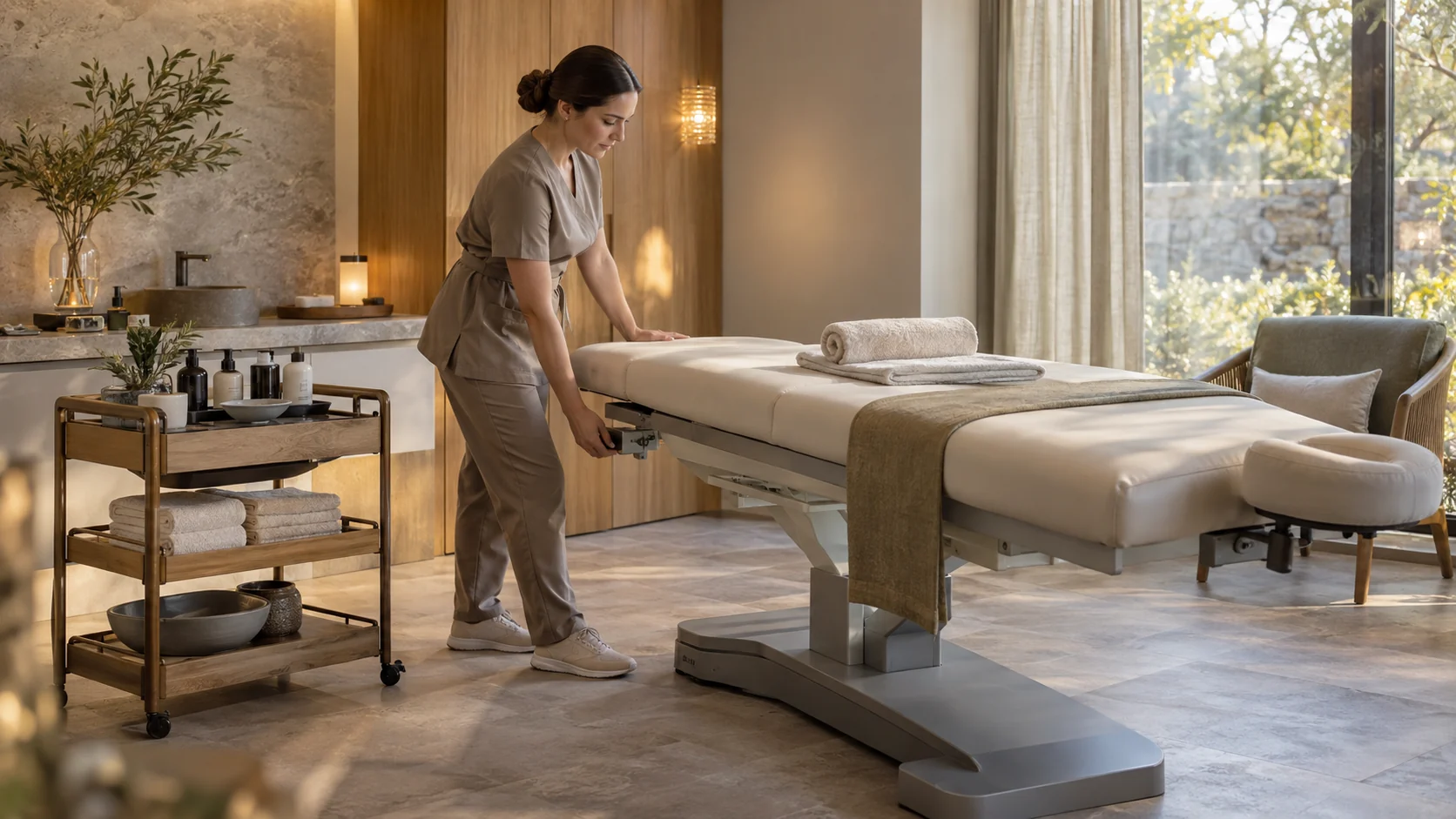
An eight-part staff wellbeing standard
1. Design demand before selling capacity
Begin with the actual work behind each appointment: preparation, consultation, treatment, sanitation, linen, notes, product restocking, guest questions and transition. Set service times and room utilisation from that workload, not only from the duration displayed on the menu. A sixty-minute booking is not a sixty-minute unit of labour if it requires meaningful work on both sides.
Limit consecutive physically demanding treatments and define when the mix of services should change. Build rules for late arrivals, overruns, equipment failure and guests who need additional assistance so the employee is not forced to choose between care and punctuality. If dynamic pricing or promotions increase demand, staffing and reset capacity must be reviewed at the same time. Yield management that fills every gap can turn a commercially attractive diary into an operational hazard.
2. Protect recovery as part of paid work
Breaks need enough time, coverage and privacy to be usable. A nominal break that disappears when the spa is busy is not a control. Neither is a relaxation room that employees cannot reach without leaving their area uncovered. Managers should monitor missed and interrupted breaks, consecutive-treatment patterns and closing-to-opening turnarounds rather than relying on a policy document.
Recovery also includes variation. Rotate demanding services where skills and guest safety allow, alternate physical and less intensive tasks, and provide realistic time to reset posture and equipment. The goal is not to prescribe one universal treatment quota. Service technique, table design, practitioner experience, individual circumstances and local occupational-health advice all matter.
3. Make the room fit the worker as well as the guest
Adjustable tables, accessible controls, stable stools, suitable flooring, task lighting, reachable supplies and well-designed trolleys are workforce infrastructure. Inspect them with the people who use them. A treatment room can photograph beautifully while requiring repeated bending, twisting or lifting that could have been designed out.
Provide training on setup and body mechanics, but do not transfer responsibility entirely to the therapist. If the room is too small, equipment is broken or the turnaround target makes adjustment impossible, technique training alone will not control the risk. Record faults, respond promptly and involve qualified ergonomics or occupational-health expertise where the assessment requires it.
4. Treat guest boundaries as an operating system
Intimate service requires clear rules before a problem occurs. Guests should receive concise information about draping, consent, appropriate conduct, phone and recording restrictions, and the therapist's right to pause or end a service. Staff should know the words they can use, how to summon support, who makes the decision, how the guest is removed from the situation and what happens afterwards.
The ILO's Convention No. 190 recognises violence and harassment in the world of work and calls for prevention that takes third parties into account where applicable. Legal duties vary by jurisdiction and ratification status, but the operational principle is clear: guest status does not cancel worker protection. Reporting should not depend on whether a supervisor personally agrees that the conduct was serious enough. Retaliation, lost commission or pressure to continue must be prohibited.
5. Give people control, voice and clear roles
Control does not mean every employee chooses every shift or service. It means the people affected have a meaningful say in scheduling, service sequencing, room setup, change and improvement. Publish how availability is collected, how unpopular shifts are shared, how changes are notified and how an employee can raise a constraint without being labelled uncommitted.
Role clarity matters when hospitality, beauty, fitness and clinical language meet. Staff should know what they are qualified and authorised to do, when to stop, what requires a supervisor and where a health concern should be referred. A therapist should not be pushed into diagnosing, counselling or making medical claims because a guest wants certainty. Clear boundaries protect both parties.
6. Make support ordinary, confidential and credible
Support starts with competent day-to-day management: check-ins that can change work, prompt attention to equipment, fair handling of conflict and follow-through after an incident. Managers need training to listen, recognise distress, respond within their role and direct people to appropriate help without attempting diagnosis. Employees also need a route outside the immediate line manager when the manager is part of the concern.
Any counselling, employee-assistance or occupational-health service should explain confidentiality, eligibility, cost, access and limits. It should not become a substitute for correcting workload or conduct. A spa should also avoid collecting more health information than it needs. Support is credible when people can use it without fearing gossip, damaged progression or a different schedule imposed as punishment.
7. Connect pay, progression and dignity
Wellbeing cannot be separated from financial stability and predictability. Explain base pay, commission, service charges, tips, product targets, cancellation pay, training time and deductions in language workers can understand. Review whether incentives reward behaviours that conflict with safety, such as skipping breaks, accepting unsuitable bookings or selling products during a vulnerable conversation.
Create progression routes that do not require an excellent therapist to become a manager in order to advance. Senior technical practice, training, quality, treatment development and specialist pathways can recognise expertise. Contract type, migration status, age, gender or part-time hours should not determine who receives safe equipment, incident support or access to learning.
8. Measure conditions without turning care into surveillance
Use several forms of evidence: staffing against booked demand, missed breaks, overtime, schedule changes, injuries, near misses, equipment faults, unwanted guest behaviour, sick leave, turnover, vacancies, grievances, training access and the time taken to resolve concerns. Segment carefully enough to find patterns, while protecting privacy and avoiding tiny groups that make individuals identifiable.
Pulse surveys can help, but a high score does not erase incident records and a low score is not proof of a diagnosis. Ask specific questions about demand, control, support, relationships, role and change. Share what was heard, what will change, who owns the action and when it will be reviewed. Repeated surveys without visible action teach people that disclosure creates data rather than improvement.
What a sophisticated guest can notice
Guests should not interrogate individual workers about private conditions or expect them to criticise an employer. They can still read the operation. Does the booking flow allow enough information before arrival? Are staff rushing between rooms? Are consultations attentive without feeling scripted? Does the spa handle lateness without transferring pressure visibly down the line? Can a therapist involve a colleague or supervisor without drama?
Good signs include stable introductions, clear consent and draping practices, equipment adjusted before treatment, enough transition time, managers who help rather than hover, and a calm response when a request falls outside scope. A guest can support the system by arriving on time, respecting boundaries, speaking directly about comfort and avoiding demands for off-menu or inappropriate services.
Certification, awards and beautiful design do not by themselves answer the workforce question. Operators can make the answer more legible through a concise people standard: how they assess work-related risk, protect breaks, respond to misconduct, develop skills and review the effects of scheduling. The statement should be specific enough to test and modest enough not to expose employee data.
A board-level dashboard for the people behind the guest score
Workforce wellbeing belongs beside revenue, utilisation and guest satisfaction because those metrics interact. Track booked treatment hours against paid staffing and room-reset demand; missed breaks; overtime; use of consecutive-treatment limits; table and equipment faults; incidents involving guests; time to support and resolution; voluntary turnover; vacancy duration; sickness absence; training and progression; and the stability of rosters.
Do not reduce the dashboard to a single wellbeing number. A spa may achieve high guest satisfaction during a period of unsustainable effort, or show strong revenue while experienced staff quietly leave. Compare trends, examine differences between teams and employment arrangements, and ask workers to interpret the pattern. When performance changes, investigate workload and system design before attributing it to attitude.
Leaders should review major menu changes, promotions, new technology, renovations and opening-hour extensions for workforce effects before launch. A treatment innovation is incomplete until the spa has assessed training, physical demand, room setup, contraindication boundaries, turnover time and how the service changes the rest of the day.
The World Luxury Spa verdict
Luxury spa wellbeing is credible only when it includes the people producing it. The evidence base specific to spa therapists is still small, and global workplace frameworks should be adapted to local law, culture and employment arrangements. That uncertainty does not justify waiting for a perfect industry benchmark. It supports a disciplined cycle of listening, risk assessment, action and review.
The practical standard is demanding but not mysterious: sell capacity that the team can deliver, pay for the work around the treatment, design rooms around real bodies, protect recovery, make boundaries enforceable, give people voice, support them confidentially and measure conditions without surveillance. Perks can enrich that system; they cannot replace it.
The truest expression of calm is not a silent corridor. It is an operation in which no one must hide unsafe pressure to preserve the mood. When staff wellbeing is treated as work design rather than décor, guest care becomes more honest, professional skill becomes more sustainable and luxury gains the substance its atmosphere promises.
Visual note: both photographs in this article are original AI-generated editorial illustrations. They depict fictional adults and interiors and do not represent a named spa, hotel, institution, employee or research participant.
Frequently asked questions
What does staff wellbeing mean in a luxury spa?
It means designing work so people can perform it safely and sustainably: realistic demand, usable breaks, suitable equipment, clear roles, fair treatment, supportive management, protection from harassment and a meaningful voice in changes that affect them. Personal wellbeing benefits can complement those conditions, but they do not define them.
Can staff perks compensate for understaffing or excessive workload?
No. A treatment allowance, mindfulness class or social event may be valued, but it does not control the risks created by chronic understaffing, missed breaks, unsafe equipment or an unmanageable pace. Workplace guidance prioritises assessing and changing the conditions that create risk.
How should a spa protect therapists from inappropriate guest behaviour?
Publish clear conduct and consent rules, train staff in boundary language, provide a rapid way to summon support, allow the service to be paused or ended, document and investigate reports, protect the worker from retaliation or lost income and apply local law and policy consistently. Guest status should not override worker safety.
Which staff wellbeing metrics should spa operators track?
Use a balanced set: staffing against booked demand, missed breaks, overtime, schedule changes, injuries, near misses, equipment faults, unwanted guest behaviour, sickness absence, turnover, vacancies, grievances, training access and resolution time. Combine records with confidential worker feedback and avoid turning the data into individual surveillance.
Should guests ask how a spa treats its staff?
Yes, but ask the business rather than pressing an individual employee to disclose private experiences. Useful questions concern training, treatment time, professional boundaries, staff development and how the spa handles inappropriate conduct. Guests can also contribute by arriving on time, respecting consent and accepting a therapist's right to stay within scope.
Sources and further reading
- Spa Business: the current opinion feature that asks how the spa industry looks after the people who deliver guest wellbeing. Read the lead feature.
- Frost, Van Dijk and Ooi, International Journal of Spa and Wellness: Monash University's record and abstract for the 2023 qualitative study of occupational stress among women spa therapists in Victoria. Review the study record.
- World Health Organization: the current fact sheet on psychosocial risks and action for mental health at work. Read the fact sheet.
- World Health Organization: the evidence-based guidelines covering organisational interventions, manager and worker training, individual support and return to work. Review the guidelines.
- UK Health and Safety Executive: the Management Standards framework for demands, control, support, relationships, role and change. Review the standards.
- International Labour Organization: the 2026 global report on the psychosocial working environment, work design and prevention. Read the report overview.
- International Labour Organization: guidance on Convention No. 190 and Recommendation No. 206, including the prevention of violence and harassment involving third parties. Open the ILO guide.