The Peakspan Promise: What Fitness Reserve Really Means for Luxury Wellness
Longevity has spent years selling more time. Its newest vocabulary asks a sharper question: what will a person still be able to do with it? “Peakspan” is the emerging answer—the proposed period during which physical or cognitive performance remains close to an individual’s best. For wellness hospitality, that changes the scene from passive anti-ageing theatre to strength, aerobic capacity, balance, mobility, recovery and the confidence to use them in ordinary life.
The idea is timely, but the name is not yet a recognised medical endpoint. Its defining paper is a preprint, the suggested threshold is unvalidated, and no single test can forecast one person’s future. The opportunity for luxury spas is therefore not to promise preserved youth. It is to design thoughtful, inclusive experiences that help guests understand and support function—while keeping exercise, wellbeing and clinical care in their proper lanes.
The signal: longevity is moving from years to capability
Spa Business reported on 31 July 2026 that “peakspan” was gaining attention as a progression from healthspan. The term comes from a paper by Alex Zhavoronkov and colleagues that proposes defining peakspan as the years in which a person retains at least 90 per cent of their highest capacity in a particular physiological or cognitive domain. Suggested measures include cardiorespiratory fitness, grip strength and processing speed.
The underlying paper is available on arXiv and describes itself as a framework. It is not a clinical guideline, and a preprint has not necessarily completed peer review. The proposed 90 per cent line is conceptually neat, but it should not be mistaken for an agreed diagnostic threshold. Different capacities peak at different ages, tests vary, everyday function depends on context, and very few adults possess reliable measurements from their personal peak years.
Yet the broader editorial signal is strong. Consumers increasingly want longevity programmes to feel relevant to a flight of stairs, a mountain path, a suitcase, a tennis match or the floor at home—not merely to a laboratory panel. This functional turn also challenges the beauty-led language of “anti-ageing”. A capable later life is not a younger-looking later life; it is one with enough physical, cognitive, social and environmental support to keep doing what matters.
That distinction matters in luxury wellness. The industry has often borrowed biomedical language before the evidence or governance was ready. Fitness reserve offers a more grounded direction only if operators resist turning a useful question into another absolute score.
A better foundation already exists: functional ability
The World Health Organization defines healthy ageing as developing and maintaining the functional ability that enables wellbeing in older age. Functional ability includes meeting basic needs, learning and making decisions, being mobile, maintaining relationships and contributing to society. It emerges from a person’s intrinsic capacity, the environment around them and the interaction between the two.
This is more expansive than staying within 90 per cent of a personal maximum. Intrinsic capacity includes physical and mental capacities such as locomotion, cognition, vitality, vision, hearing and psychological capacity. Environment includes homes, transport, relationships, attitudes, services and policies. A handrail, welcoming group, clear signage or patient coach can enable function just as a strong pair of legs can.
The WHO framework also rejects the idea of one typical older person. Two people of the same age can have very different capacities, health conditions, resources and goals. Healthy ageing remains relevant when illness or disability is present; it is not reserved for an unusually fit minority. That gives spas a valuable correction to the optimisation culture surrounding longevity.
“Reserve” is best understood here as editorial shorthand, not a bankable biological account. Strength, aerobic fitness, balance and movement skill can provide more room between ordinary demands and a person’s current limit. But capacity is dynamic. It changes with training, illness, injury, medication, sleep, stress, nutrition and access to support. The ethical ambition is not permanent peak performance. It is greater agency for more people.
What the evidence supports—and what it does not
There is substantial evidence that physical fitness and capability matter. A 2024 overview in the British Journal of Sports Medicine brought together meta-analyses representing more than 20.9 million observations from 199 cohort studies. It found cardiorespiratory fitness to be a strong and consistent predictor of morbidity and mortality in adults. A long-running body of research has also associated measures such as grip strength, walking speed, chair-rise performance and standing balance with later health outcomes.
These are associations at population level, not clocks for an individual life. A low grip-strength reading does not reveal a date of death; a high aerobic score does not guarantee protection. Test results can reflect current health, body size, technique, motivation and the protocol used. They are signals that may support a broader assessment, not verdicts.
Physical activity guidance is more stable than the peakspan branding. WHO reports benefits from regular activity across adulthood and recommends that older adults include varied movement, with multicomponent activity that emphasises functional balance and strength. The US National Institute on Aging similarly highlights aerobic, muscle-strengthening and balance activity, while advising people who are unsure about a movement to seek appropriate professional guidance.
None of this proves that a three-day spa stay extends lifespan or reverses ageing. Nor does it validate a universal sequence of high-intensity intervals, cold exposure, supplements and tests. Exercise programmes can improve specific aspects of fitness and function, but outcomes depend on starting point, dose, consistency, supervision and health status. The strongest hospitality proposition is to help guests begin safely, learn well and carry a realistic practice home.
Five dimensions of a credible fitness-reserve programme
1. Strength for ordinary demands
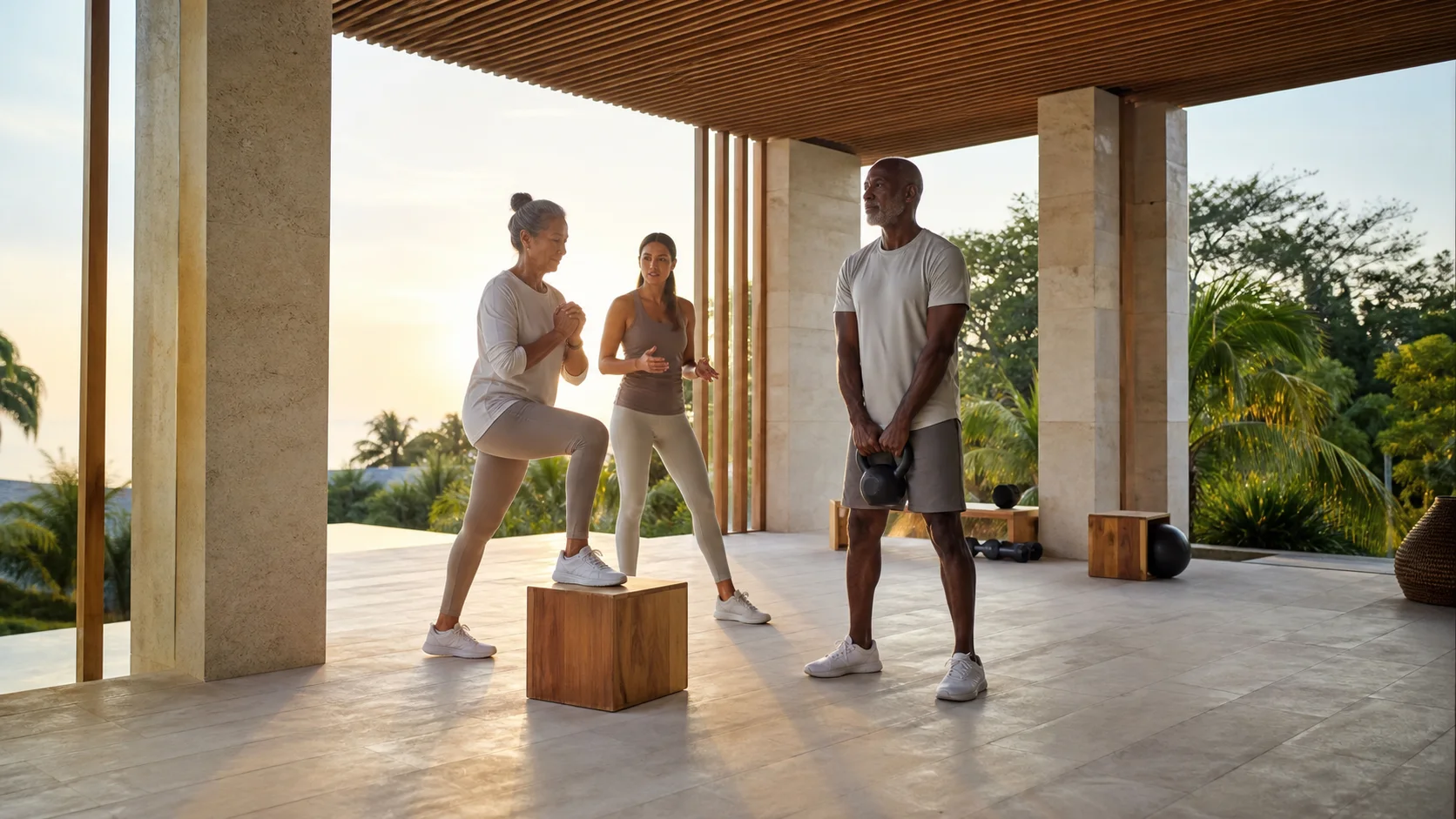
Strength becomes meaningful when it supports standing from a chair, lifting luggage, climbing steps or recovering balance. A luxury programme might introduce carefully scaled resistance exercises, loaded carries, step-ups and controlled floor transitions. The standard should be excellent coaching and progression, not impressive-looking weight. Guests need stable equipment, enough space, clear technique and permission to stop.
2. Aerobic capacity without a punishment narrative
Cardiorespiratory fitness describes the ability of the circulatory and respiratory systems to supply oxygen during sustained activity. It can be assessed in different ways, from formal exercise testing to simpler field protocols. A resort can offer walking, cycling, swimming or interval-based sessions, but intensity must suit the guest. “Harder” is not automatically more effective, more luxurious or more appropriate.
3. Balance, mobility and movement confidence
Balance is not decorative stretching. It involves sensory information, strength, coordination, attention and the environment. Thoughtful sessions can use stable supports, changes of direction and simple single-leg or tandem tasks while avoiding circus-like challenges. Mobility work should serve a clear movement goal rather than promise to erase structural differences or pain.
4. Recovery that supports adaptation
Sleep, rest, food, hydration and sensible spacing between sessions help the body respond to training. Massage, bathing and quiet rituals may improve comfort or the subjective experience of recovery, but they should not be sold as substitutes for movement or treatment for disease. The most sophisticated spa pairs effort with calm without inventing a detoxification mechanism.
5. An environment that makes participation possible
Good design widens the audience. Non-slip floors, glare control, seating, shade, railings, accessible routes and calm acoustics are performance infrastructure. So are private orientation, small groups, culturally respectful clothing guidance and coaches who do not assume every older guest is frail—or athletic. Inclusion is not a softer alternative to performance; it is how more people get to practise it.
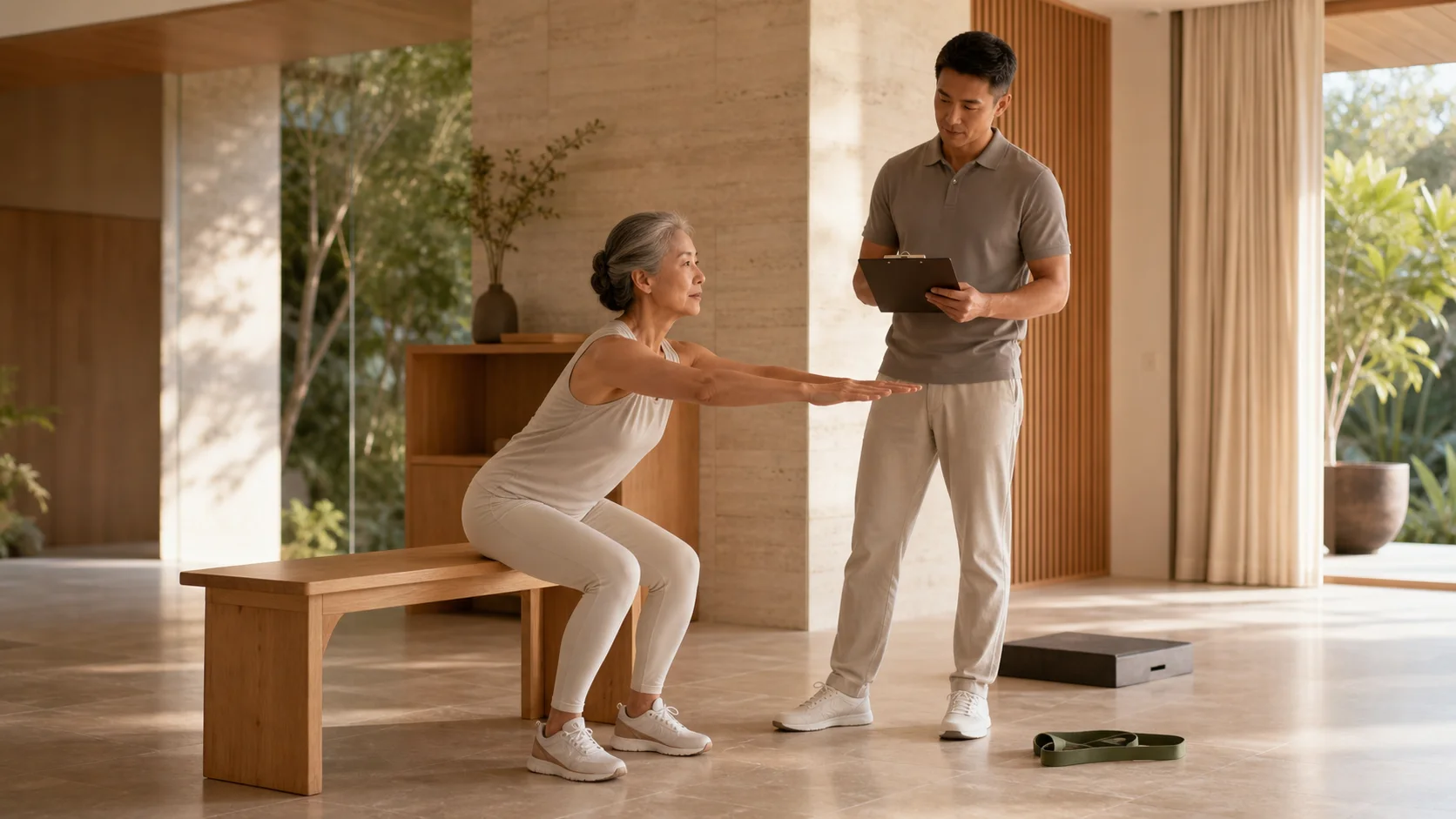
Editorial image note: both photographs in this feature are original AI-generated illustrations. They do not depict a named property, institution or person.
Assessment should inform care, not manufacture anxiety
Measurement can make a programme precise, but only when the test answers a useful question. Before testing, the operator should explain what is being measured, why it matters, how results will be used and whether the guest can decline. The protocol, equipment and assessor competence should be consistent enough for a repeat result to mean something.
Simple functional tasks can be valuable: a timed chair rise, walking pace, a supported balance task or a professionally administered grip test. More demanding cardiorespiratory tests require greater expertise and screening. If a resort offers maximal or near-maximal exercise testing, it moves closer to the territory of medical wellness retreats and should identify the licensed clinical oversight, emergency procedures and limitations of the test.
Consumer devices add another layer of uncertainty. Watches and rings can be useful for observing personal patterns, but estimates from different products or algorithms are not automatically comparable. Heart-rate variability is particularly sensitive to measurement conditions and should not be presented as a daily moral score. An abnormal or unexpected reading deserves context, not instant upselling.
Results should be communicated as ranges and trends where appropriate. A skilled practitioner connects the number to the guest’s goal, acknowledges day-to-day variation and avoids age-shaming. The guest should leave with one or two practical actions, not a dashboard of deficits.
The ethical problem with “90 per cent of peak”
A personal-peak threshold sounds fair because it compares a person with themselves. In practice, the baseline is usually missing. Retrospective estimates can be speculative, while a single youthful maximum may reflect access to sport, health, wealth and time that was never distributed equally. Performance also has multiple dimensions: a slower runner may be a better strategist, partner, artist or leader.
The peakspan paper’s language of productive lifespan invites another concern. Human value cannot be reduced to paid productivity or the ability to sustain youthful output. Later life contains adaptation, knowledge, care, contribution and pleasure that a power test cannot measure. A wellness property should never imply that a guest who uses a mobility aid, lives with a chronic condition or has lower test scores is ageing unsuccessfully.
Targets can motivate, but they can also intensify perfectionism. A programme built around constant optimisation risks excluding beginners—the very people who may benefit from a welcoming entry into movement. Luxury should lower unnecessary friction: discreet assessment, scaled choices, attentive instruction and a setting where progress is not performed for an audience.
The better question is not “How close are you to your peak?” It is “Which abilities support the life you value, and what is a safe, realistic next step?” That is less dramatic marketing and better hospitality.
What sophisticated travellers should look for
A beautiful gym and a longevity menu reveal little about programme quality. Before booking, ask who conducts the assessment, what qualifications they hold and when a physician or physiotherapist becomes involved. Request the schedule in enough detail to judge intensity, recovery and choice. A credible operator will describe contraindication screening and adaptation without promising a particular biological age.
Look for a mix of movement rather than one heroic modality. Aerobic, strength and balance work should be adjustable. There should be alternatives for injuries, disability, low fitness or simple preference. If testing is included, ask whether it is validated for the intended use, whether the same protocol is repeated, how personal data are stored and what happens when a result raises concern.
Scrutinise language. “Supports”, “helps practise” and “tracks change under this protocol” are more credible than “reverses”, “guarantees” or “optimises every system”. Be wary when an assessment inevitably leads to a branded supplement, device or expensive treatment. A useful recommendation can stand without a sales funnel.
Finally, judge the handover. A five-day surge of activity followed by silence is not a serious functional strategy. The best programme produces a concise record, explains how to continue at home and recommends local clinical or fitness support when needed. It should complement good five-star spa experience design, not turn a holiday into an examination.
An operator blueprint: from longevity theatre to useful practice
Define the promise
Choose a narrow, honest outcome: helping guests learn safe strength movements, understand a repeatable functional baseline or build confidence in varied activity. Do not market disease prevention or lifespan extension unless a qualified clinical service has the evidence and authority to make a specific claim.
Build the governance
Map which activities are hospitality, fitness, allied health or medicine in the jurisdiction where the property operates. Set referral and emergency pathways, consent language, data retention, safeguarding and incident review. Verify practitioner credentials rather than relying on the word “expert”.
Select a minimal assessment set
Use the fewest measures needed to guide the programme. Record the protocol, equipment, conditions and meaningful limitations. Avoid proprietary composite scores that cannot be explained. Reassessment should use comparable conditions and should never be promised to show improvement over an unrealistically short stay.
Design three levels of participation
Offer an accessible foundation, a progressive middle level and an appropriately screened higher-intensity option. All three should feel equally considered. Language, timetable and staff attention should not make the foundation group feel like a consolation prize.
Measure programme quality
Track participation, completion, adverse events, guest understanding, confidence and follow-through—not just biometrics. Review who declines or drops out and why. If only already-fit guests thrive, the programme may be reinforcing status rather than expanding capability.
The World Luxury Spa verdict
Peakspan is a memorable name for a legitimate concern: extra years mean more when people can move through them with agency. But the term currently carries more conceptual energy than clinical authority. Its 90 per cent threshold is a proposal, not a universal standard, and the preprint behind it cannot justify deterministic scores or age-reversal claims.
The durable idea is fitness reserve within a broader view of functional ability. Luxury spas can contribute through excellent coaching, inclusive design, proportionate assessment, restorative hospitality and a responsible bridge to continuing support. The winning programme will not make older guests chase their younger selves. It will help each guest invest in the abilities that make their own future larger.
Frequently asked questions
What is peakspan?
Peakspan is a proposed term for the period in which a person retains close to their best capacity in a particular physical or cognitive domain. Its defining paper suggests a 90 per cent threshold, but this is not an established clinical standard or diagnosis.
Is fitness reserve the same as longevity?
No. Fitness reserve is a useful way to discuss capacity above everyday demands, while longevity concerns length of life. Better fitness is associated with important health outcomes at population level, but no score can guarantee an individual lifespan.
Which abilities matter most for healthy ageing?
Strength, aerobic fitness, balance and mobility all support physical function, but healthy ageing is broader. The World Health Organization also includes cognitive, psychological and sensory capacities, plus the environment that enables people to do what they value.
Should a spa measure VO2 max or grip strength?
Only when the result has a clear purpose, the protocol and practitioner are appropriate, risks are screened and limitations are explained. Measurements are most useful as part of a broader assessment and repeated consistently, not as standalone predictions.
Can a wellness retreat reverse physical ageing?
A retreat may teach movement, support recovery and help a guest begin healthier routines, but it should not promise to reverse ageing or prevent disease. Lasting change usually depends on appropriate, consistent activity and support beyond the stay.
Sources and further reading
- Spa Business: the 31 July 2026 report introducing peakspan as an emerging longevity and fitness trend. Read the lead report.
- Zhavoronkov and colleagues: the arXiv preprint proposing the peakspan concept, domain-specific measures and 90 per cent threshold. Read the preprint.
- World Health Organization: the official explanation of healthy ageing, functional ability, intrinsic capacity and enabling environments. Read the WHO framework.
- World Health Organization: its physical activity fact sheet, including benefits, global inactivity estimates and guidance across age groups. Read the fact sheet.
- National Institute on Aging: practical official guidance on combining aerobic, muscle-strengthening and balance activity for older adults. Read the NIA guidance.
- British Journal of Sports Medicine via PubMed: a 2024 overview of meta-analyses on cardiorespiratory fitness, morbidity and mortality in adults. Read the systematic overview.
- The BMJ via PubMed: a systematic review and meta-analysis of grip strength, walking speed, chair rises, balance and mortality in community-dwelling populations. Read the physical-capability review.