The Public-Land Wellness Test: How Nature-Led Precincts Earn Their Place
A forest outlook, cold river and slow sunrise can make a wellness proposal sound inevitable. Add thermal bathing, a few timber pavilions and the promise of regional jobs, and the development begins to look like a gift to both traveller and destination. Yet when the site is public land, the first question is not whether the concept photographs beautifully. It is whether private luxury will return durable public value without consuming the landscape, culture and access that made the opportunity attractive.
Tasmania has brought that question into sharp focus. Its government has announced a three-month Expression of Interest for a nature-led wellness precinct on Crown land in the north of the state. The invitation is still a proposal process, not a finished property: no operator, design or promised guest experience should be imagined from the announcement. Its value as an editorial signal is broader. Governments and destinations are increasingly treating wellness as regional infrastructure, investment policy and place-making—not merely as a spa department inside a hotel.
This article builds on our analysis of the carbon cost of a luxury spa visit and the way wellness attributes shape hotel choice. The question here is upstream: before a precinct is approved, built or marketed, what should the public, local businesses, rights holders, future workers and the landscape be entitled to expect?

The current signal: wellness moves from hotel amenity to regional strategy
Spa Business reported on 11 October 2026 that the Tasmanian Government intends to invite developers, investors and operators to propose a wellness precinct on Crown land in Northern Tasmania. Potential components mentioned in the announcement include thermal and spa experiences, hot and cold immersion, accommodation, retreats, walking and nature immersion, and programmes described with wellness, longevity or preventive-health language. The government has said the process will run for three months and form part of its Northern Economic Plan.
The demand case rests partly on research commissioned by Tourism Tasmania. Its public summary says 22 per cent of Australian travellers surveyed are strongly motivated by wellness and a further 73 per cent are open to wellness experiences. Eighty-eight per cent plan to travel with others. Nature, clean air and tranquillity were among the state associations most relevant to the opportunity, while stargazing, sunrise and sunset viewing, bushwalking and nocturnal wildlife tours appeared among the drawcards.
Those figures are useful market intelligence, not a planning consent, revenue forecast or instruction to build at maximum scale. Stated openness to wellness does not show how many people will book a particular precinct, at what price, in which season or with what pressure on roads, water, housing and natural sites. Interest in a low-cost walk or night-sky experience cannot automatically be converted into demand for luxury accommodation or a large thermal complex.
The official positioning contains a more important idea: the precinct should build around capabilities that already exist among local operators, growers and guides rather than import a generic wellness industry. That principle can distinguish a destination from a placeless resort. It can also become empty language unless procurement, tenancies, training, supply contracts and decision-making actually give local people a material role.
At the time of writing, the project remains an announced opportunity. This article does not assess an unidentified bid or claim that any development will proceed. It uses the proposal to define the evidence a responsible public-land wellness project should produce before renderings turn possibility into apparent fact.
Public land changes the luxury brief
A private hotel can still affect neighbours, ecosystems and infrastructure, but public land adds a different obligation. The state is not simply regulating a commercial site; it is deciding whether a shared asset should support an exclusive use, under what conditions and for how long. The quality of the guest suite is therefore only one part of the design. The concession, lease or other arrangement must explain what the public receives, what remains accessible and what happens if the operator changes, fails or leaves.
The Global Sustainable Tourism Council’s standards provide a useful international reference rather than a local legal test. They organise sustainable tourism around management, socioeconomic impact, culture and environment. Their destination criteria call for planning and development controls, community participation, protection of sensitive environments, visitor management and monitoring. Their attraction criteria also address land and water rights, local and Indigenous community engagement, infrastructure, biodiversity and cumulative impact.
The distinction between a standard and a licence matters. A sustainability badge cannot replace applicable planning, environmental, heritage, water, building, employment or public-health requirements. Nor does a checklist settle political questions about whether a site should be developed at all. It can, however, make vague promises testable. “Nature positive” should lead to a baseline, limits, responsibilities, a budget and public reporting—not simply more native-looking planting around a new pool.
Luxury has a legitimate role if it pays for careful design, skilled employment, conservation, excellent access and a guest experience that respects the place. It fails the public-land test when exclusivity is the principal benefit and the destination carries the traffic, ecological risk, cultural appropriation or emergency burden. The licence to operate is earned through stewardship, not price point.
Nature is not a treatment room with the walls removed
Nature contact is associated with aspects of health and wellbeing, but hospitality marketing often strips away the uncertainty. One widely cited study analysed survey data from 19,806 adults in England and found that people reporting at least 120 minutes of recreational nature contact in the previous week were more likely to report good health and high wellbeing than those reporting none. The authors controlled for several factors, but the design remained observational and based on self-report. They explicitly called for longitudinal and experimental work before clear exposure guidance could be established.
The result does not mean a resort can prescribe a two-hour forest dose, guarantee recovery or treat a mental-health condition. The quality of the environment, meaning of the place, activity, safety, mobility, weather and individual circumstances all matter. A voluntary walk in a familiar park is not interchangeable with a paid itinerary in a sensitive landscape.
The joint World Health Organization and International Union for Conservation of Nature report on nature-based solutions offers a wider frame. It links human health with biodiversity, climate adaptation and resilient communities, while emphasising context, co-design, equity, Indigenous rights, multiple knowledge systems and measurable co-benefits. The landscape is not a wellness input to be consumed. Protecting ecological function is part of the health proposition.
That changes the design sequence. Start with habitats, water, fire, climate, cultural meaning, existing uses and community needs. Then ask what level of visitation and built form those systems can carry. Do not begin with a room count and search for an environmental story afterwards.
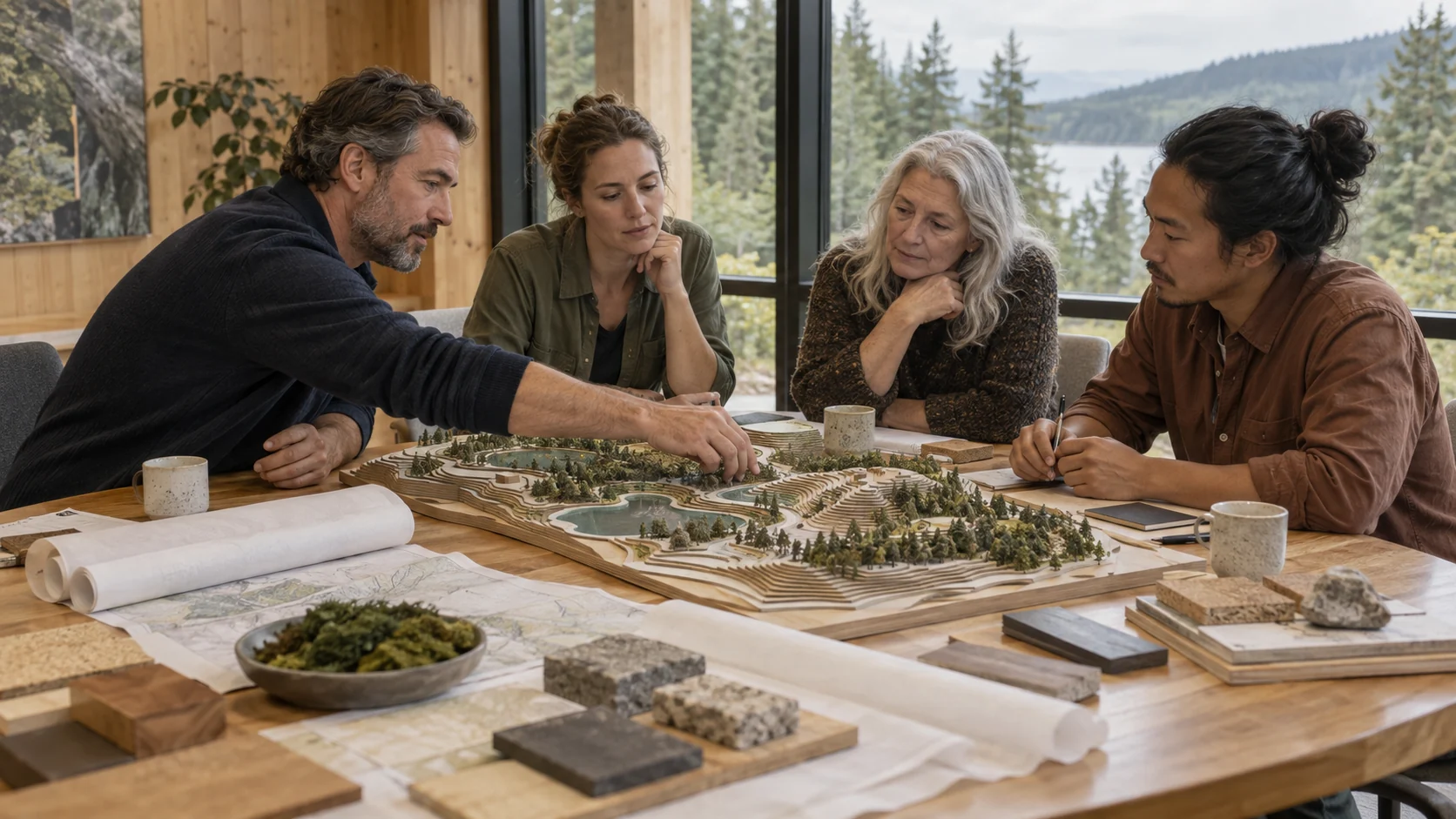
An eight-part public-interest standard
1. Publish the baseline before the beauty shot
A credible process begins with what exists: land status and current access, ecological condition, species and habitat sensitivity, water availability, fire and flood exposure, transport capacity, cultural heritage, neighbouring land uses, local workforce and housing conditions. The baseline should be detailed enough to reveal constraints, not merely opportunities.
Renderings should be labelled as concepts and kept subordinate to evidence. They can demonstrate massing or material intention, but they should not imply established trees will remain, water will be available or views will be private until those claims are supported. The no-build and smaller-build options belong in the comparison. A public process that considers only variations of one desired development is not testing whether development is the best outcome.
2. Treat Indigenous Peoples as rights holders, not a design theme
Local law and the specific rights, histories and governance of the people connected to a place must guide the process. The United Nations guide to free, prior and informed consent describes consent as more than a late consultation meeting: participation should occur before decisions are made, without coercion, with adequate information and through representative processes chosen by the affected peoples. How that principle applies legally will vary by jurisdiction and circumstance.
A wellness developer should not extract names, stories, plants, ceremony, visual motifs or “ancient wisdom” for a guest narrative without authority and agreement. Cultural knowledge is not raw material. Where communities choose to participate, the relationship should define control, attribution, payment, confidentiality, review rights and the ability to say no. A generic acknowledgement at reception cannot repair a project designed without meaningful participation.
3. Set carrying capacity from the landscape outward
Capacity is not simply how many rooms can achieve an acceptable return. It includes peak people on trails and at bathing areas, vehicle movements, quiet zones, wildlife disturbance, wastewater treatment, water abstraction, waste collection, emergency access and seasonal stress. Limits should cover day visitors, events, staff, contractors and deliveries as well as overnight guests.
Management tools can include timed access, small groups, route rotation, temporary closures, dark-sky lighting, restricted sound, shuttle systems and reservation caps. The important point is that triggers are decided before pressure becomes damage. If monitoring shows that a threshold has been exceeded, the operating plan should say who must reduce capacity and how quickly.
4. Make water, heat and energy legible
Thermal pools, saunas, laundries, kitchens and guest rooms can make a wellness precinct resource-intensive even when the architecture looks organic. A proposal should quantify normal and peak water demand, source reliability, treatment, recirculation, discharge, drought response and the effect on other users and ecosystems. If naturally heated water is not present, marketing should not imply a geothermal asset.
Energy modelling should include heating water and buildings, cooling, pumps, filtration, ventilation, transport and backup systems. Embodied carbon, construction access and replacement cycles matter alongside operational energy. Renewable supply is valuable, but it does not remove the need to reduce demand. Public reporting should compare design assumptions with actual use once the precinct opens.
5. Convert local language into local contracts
“Supporting local” becomes meaningful when the bid identifies which goods and services can be sourced locally, how small businesses will qualify, when invoices will be paid, what volume is realistic and how seasonal risk will be shared. It should distinguish headline construction jobs from permanent roles and publish expectations for pay, training, housing, transport, progression and safe working conditions.
A precinct can strengthen a network rather than swallow it. Independent guides, growers, makers, bathhouse operators, therapists and food businesses may benefit more from bookable partnerships and distributed itineraries than from being copied inside one gated campus. Procurement targets should protect quality and fairness rather than force suppliers into volumes they cannot sustain.
6. Preserve public access and design for more than the highest spender
Public value does not require every facility to be free, but it should be visible. A proposal can protect existing paths, viewpoints and customary uses; provide accessible trails or selected community sessions; support local transport; and create experiences at more than one price point. Any closure, security boundary or change to access needs a clear rationale and mitigation.
Universal design belongs at concept stage. Step-free arrival, changing, water entry, sensory clarity, resting places, weather shelter, toilets, emergency communication and information formats should be integrated rather than retrofitted. Nature-led wellness is not inclusive if the view is available to everyone in the brochure but only to a narrow range of bodies on site.
7. Separate hospitality wellbeing from healthcare
Walking, bathing, rest, food and attentive service may support a guest’s sense of wellbeing. They do not automatically prevent disease, reverse ageing or treat a condition. Any longevity or preventive-health component should name the exact service, practitioner qualifications, evidence, risks, regulatory status and referral boundaries. The more clinical the claim, the more accountable the governance must become.
Heat, cold, water and remote environments also require ordinary safety competence: screening proportionate to the activity, supervision, hygiene, slip and fall prevention, weather and fire plans, accessible evacuation, incident review and links with local emergency services. A dramatic setting can lengthen response times; luxury service cannot wish that geography away.
8. Design the concession for the full life of the project
Public-interest conditions should survive the launch. The agreement needs measurable obligations, public reporting, audit rights, review points, remedies for under-performance, rules for ownership changes and a funded exit or restoration plan. Commercial confidentiality should not hide the terms needed to judge public value.
Metrics should cover more than visitor spend: local procurement, stable employment, worker retention, public access, accessibility, water and energy intensity, biodiversity indicators, transport mode, resident sentiment, cultural-governance commitments, incidents and complaints. Targets need baselines and dates. If the operator is rewarded for growth but not charged for exceeding ecological or social limits, the contract has written the wrong behaviour into the landscape.
Questions for travellers, operators and public decision-makers
- Stage: Is this an announced opportunity, an approved plan, a construction project or an operating destination?
- Land: What existing access, rights and uses will continue, change or end?
- Consent: Who helped frame the project before the preferred concept was chosen, and how can affected people influence or refuse elements?
- Scale: What ecological, water, transport and emergency limits determine capacity?
- Benefit: Which jobs, contracts, skills, access rights and conservation outcomes are enforceable rather than aspirational?
- Claims: Which experiences are hospitality, which are regulated healthcare and who is accountable for each?
- Evidence: Which baselines, targets and annual results will be public?
- Exit: Who restores the site and protects ongoing access if the commercial model fails?
A sophisticated traveller does not need to read a concession agreement before booking. They can still notice whether the destination speaks precisely: whether nature is described as a relationship rather than a cure, local collaborators are named with permission, access information is practical, and sustainability claims are supported by measured results. Good governance becomes part of the guest experience because it removes the suspicion that calm has been created by shifting costs elsewhere.
A dashboard for public value
The first year of operation should test the promises made at selection. Report actual peak visitation against approved capacity; water and energy per guest-night and day visit; waste and discharge performance; wildlife or habitat indicators; transport modes; local and regional procurement; permanent and seasonal employment; training; accessibility use; public-access delivery; incidents; complaints; and corrective action.
Numbers need interpretation. A rising share of local purchasing may be positive, but not if suppliers face late payment or untenable exclusivity. A stable biodiversity indicator may hide pressure transferred beyond the measured boundary. High visitor satisfaction may coexist with resident frustration. Independent review and community-defined measures help expose those gaps.
Publication should be regular enough to matter and simple enough to read. Report failures with the same clarity as successes. If a project cannot share the evidence behind a public-value claim, it should not use that claim as a luxury differentiator.
The World Luxury Spa verdict
The Tasmanian proposal is newsworthy because it places wellness inside an economic and land-use strategy, not because an unbuilt precinct can already be judged beautiful or beneficial. The opportunity may produce a thoughtful project, a smaller distributed model, a different use or no development at all. A credible process must remain open to those outcomes.
Nature-led luxury earns its place when the landscape remains the principal asset, rights holders shape the terms, local participation is contractual, access and inclusion are real, health language stays within evidence, and success is measured for residents and ecosystems as well as guests. The more valuable the public setting, the stronger—not weaker—the burden of proof.
The future of wellness precincts should not be a collection of private compounds using public nature as atmosphere. It should be a form of stewardship in which excellent hospitality helps pay for a place to remain ecologically alive, culturally respected and meaningfully shared.
Visual note: both photographs in this article are original AI-generated editorial illustrations. They depict fictional people, architecture and landscapes and do not represent a named property, proposed development, institution, community member or planning process.
Frequently asked questions
What is a wellness precinct?
A wellness precinct is a planned cluster of complementary experiences or services—such as bathing, spa, movement, nature, food, accommodation or selected health services—within one destination or connected area. The term has no single universal legal meaning, so travellers and communities should examine the exact uses, governance and claims rather than rely on the label.
Does spending time in nature guarantee a health benefit?
No. Research associates nature contact with several aspects of health and wellbeing, but outcomes vary and much evidence is observational. A destination can support safe, meaningful access to nature; it should not guarantee recovery, prescribe a universal “dose” or present hospitality as treatment for a medical or mental-health condition.
What should a public-land wellness project provide beyond a private resort?
It should show durable public value proportionate to its use of a shared asset. That can include protected access, local contracts and skills, inclusive design, conservation funding, transparent resource limits, public reporting and enforceable restoration obligations. The exact mix should be defined through lawful, place-specific participation rather than assumed from a generic checklist.
How should Indigenous rights and culture be handled?
Indigenous Peoples should be treated as rights holders with their own representative processes, not as a theme or source of marketing content. Engagement should begin before key decisions, follow applicable law and respect free, prior and informed consent where relevant. Knowledge, names, stories, plants and practices should not be used without authority, agreed control and fair benefit.
What should travellers look for in a nature-led wellness destination?
Look for precise information on land and water stewardship, local partnerships, public or community benefit, accessibility, visitor limits, practitioner qualifications, safety and measured environmental performance. Treat vague claims such as nature positive, healing or regenerative cautiously unless the operator explains the baseline, action, evidence and accountable party.
Sources and further reading
- Spa Business: the lead report on Tasmania’s proposed Northern wellness precinct, the planned Expression of Interest and the publicly stated opportunity. Read the lead report.
- Premier of Tasmania: the official announcement of the proposed Crown-land wellness precinct and its place in the Northern Economic Plan. Read the government announcement.
- Tourism Tasmania: the official public summary of its 2026 wellness-tourism research, including traveller motivation, shared travel and nature associations. Review the research summary.
- Global Sustainable Tourism Council: the overview and links for its destination, hotel, tour-operator and attraction sustainability standards. Review the GSTC standards.
- WHO and IUCN: the report on nature-based solutions for health, biodiversity, climate resilience, equity and community co-design. Read the report overview.
- United Nations: guidance resources on Indigenous Peoples, including the guide to free, prior and informed consent. Open the UN guidance collection.
- White et al., Scientific Reports: the open-access observational study of weekly nature contact, self-reported health and wellbeing in adults in England, with the authors’ stated limitations. Read the study.