Why Social Sauna Is Becoming Luxury Wellness’s New Third Place
The most interesting new luxury spa may not be a silent treatment suite. It may be a timber room where strangers share heat, conversation and a ritual simple enough to repeat every week. Social sauna is moving beyond the hotel amenity checklist and re-emerging as something more culturally meaningful: a place between home and work where people can pause without performing, be alone together and return often enough to recognise one another.
That shift deserves careful attention. It offers spa leaders a recurring, lower-friction relationship with local guests and gives travellers a way to experience wellness as participation rather than consumption. It also brings responsibilities around cultural literacy, safety, inclusion and honest health communication. This report examines the evidence and the operating choices behind the movement, alongside our guides to five-star spa experience design and luxury spa etiquette.
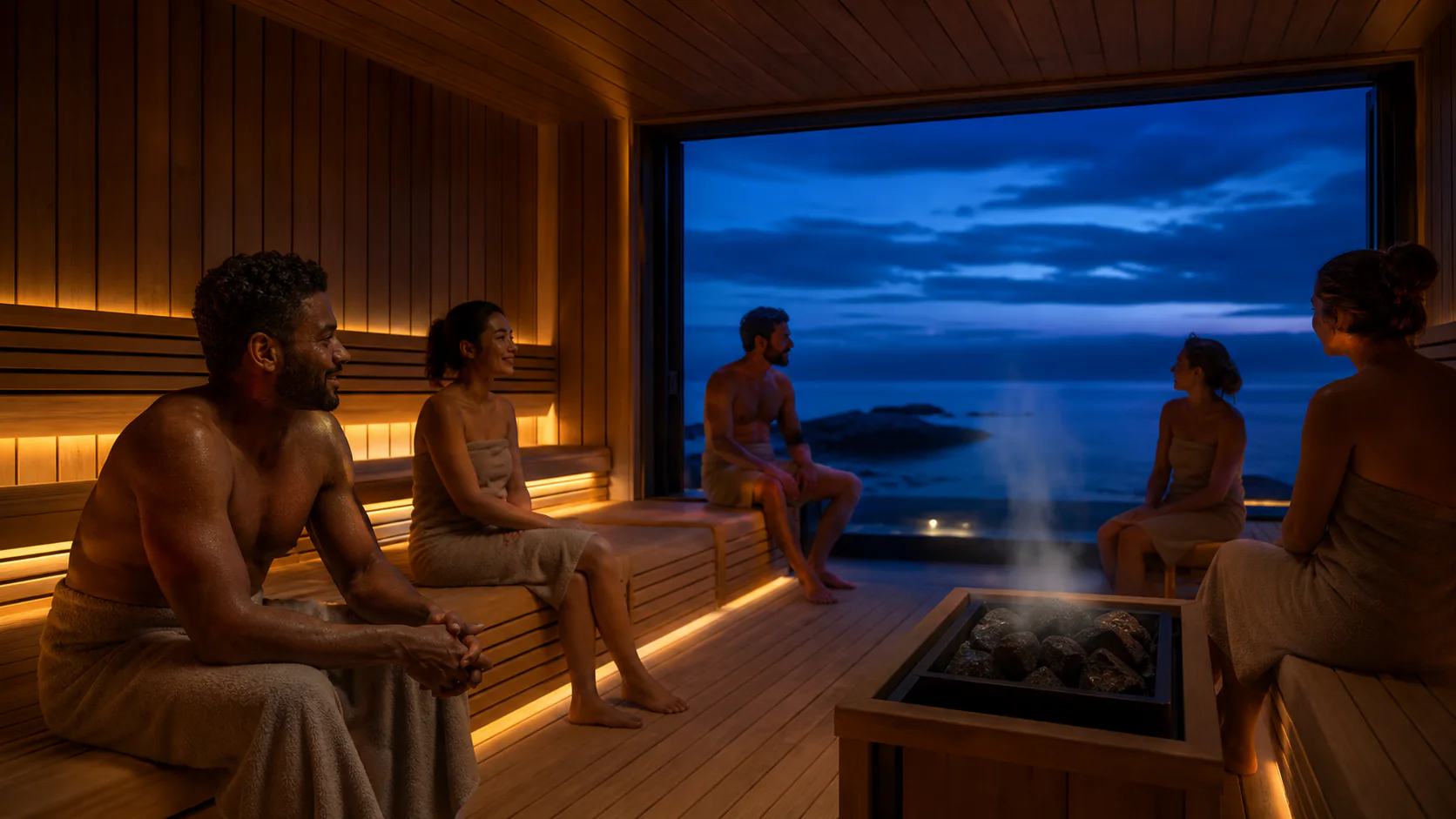
The signal from Australia
Spa Business reported on 28 July 2026 that the Australian Sauna Association had been established to support authentic, accessible and community-led sauna culture across spas, health clubs, bathhouses and social-wellness businesses. The non-profit describes a remit that includes education, research, advocacy, international connection and practical work on planning, insurance and operating conditions. Its first flagship public gathering, The Big Sweat, was announced for 22–23 August in the Blue Mountains of New South Wales.
The association itself is not the larger story. The revealing detail is the vocabulary around it: shared standards, public access, community, ritual and cultural knowledge. This is a different proposition from installing a hot room beside a gym because a competitor has one. It treats sauna as an experience with social rules and a lineage, then asks how that experience can grow responsibly in a new climate and market.
Similar energy has been visible elsewhere. Public and mobile sauna formats have spread across the United Kingdom, Ireland, North America and Australia, often beside coastlines, lakes or urban neighbourhoods. Some spaces pair heat with cold water; others add guided steam, music or quiet sessions. The formats vary, but the common commercial insight is that a shared ritual can create a reason to return far more frequently than an occasional destination-spa treatment.
From amenity to third place
Sociologists use “third place” to describe an informal setting beyond home and work where repeated, low-pressure encounters help social life take shape. A well-run social sauna can perform part of that role. Guests arrive with a clear activity, phones usually stay outside and status markers become less useful. Conversation can happen, but silence remains legitimate. The ritual gives people enough structure to share a room without needing an elaborate introduction.
This distinction matters in luxury wellness. Traditional high-end service often maximises privacy: a private arrival, a private suite, a private therapist and a carefully controlled bubble around the individual. That remains valuable. Yet the same guests may also be hungry for belonging, especially when travel, remote work and digitally mediated routines have made casual human contact less dependable. Social sauna does not replace private treatment; it supplies a different form of value.
The strongest version is not a party in a hot room. It is a calmly facilitated commons. Good operators make the expectations visible, protect choice and let the social intensity rise or fall. A solo visitor should be able to participate without being recruited into conversation. Friends should be able to share the experience without dominating it. Regulars should create warmth without turning the room into a private club.
What the emerging research can — and cannot — tell us
A 2026 paper in Social Science & Medicine examined sauna use, belonging, ritual and wellbeing across three UK studies involving 1,907 participants. Two studies used before-and-after designs and found improvements in emotional wellbeing or affect after sauna sessions. The cross-sectional study found that a stronger sense of sauna identity was associated with self-reported physical and emotional improvement. Perceiving the experience as ritual, and feeling a degree of emotional synchrony with others, were also linked to stronger group identification.
The important idea is not that conversation magically treats illness. It is that some of the value participants report may be connected to belonging and repeated ritual, not heat alone. The researchers frame this through the “social cure” model: group identification can become a resource through which people experience support, meaning and connection. For an operator, that suggests the host, timetable, code of conduct and atmosphere may be as consequential as the heater specification.
The limitations are equally important. The work includes self-reported outcomes, non-randomised designs and participants who had chosen to use sauna. Association is not proof that sauna caused a lasting health improvement, and a positive feeling immediately after a session is not a diagnosis or clinical outcome. One author was affiliated with the British Sauna Society, a relevant interest to notice even though the paper reports university ethics approval and appears in a peer-reviewed journal.
For luxury properties, the responsible conclusion is modest: social and ritual design deserves to be treated as a genuine part of guest experience, while medical promises remain outside the evidence. A sauna can support rest, pleasure and connection without being sold as a cure for loneliness, anxiety, cardiovascular disease or any other condition.
A living culture, not a decorative theme
UNESCO inscribed sauna culture in Finland on the Representative List of the Intangible Cultural Heritage of Humanity in 2020. Its record describes a practice that takes place at home and in public, is passed through families as well as clubs and universities, and centres on löyly: the steam and spirit released when water meets heated stones. It also notes that public saunas, after declining in Finnish cities during the twentieth century, have been built again through private initiatives.
That recognition is useful because it shifts attention from equipment to knowledge. Temperature alone does not create culture. Culture lives in how people enter, share steam, negotiate quiet, care for the room and pass the practice on. The Finnish Sauna Society expresses its own bathing principle through respect, community spirit and peaceful bathing. It explicitly rejects competitions to see who can tolerate the most heat and asks bathers to consider one another when water is added to the stones.
Sauna is also not the only communal heat tradition. Hammams, banyas, sentō, jjimjilbangs and Indigenous sweat practices have distinct histories, protocols and meanings. A global spa should not flatten them into a generic “ancient thermal ritual” or borrow sacred elements as entertainment. Cultural respect begins with naming the tradition accurately, learning from appropriate knowledge holders and being honest about what is locally adapted rather than inherited.
Luxury can contribute by funding skilled hosts, excellent maintenance, thoughtful interpretation and dignified access. It becomes extractive when it lifts symbols from a culture while discarding the restraint, reciprocity or communal responsibility that gives the practice meaning.
Designing a room that can hold both quiet and connection
The thermal room is only one part of the experience
A social sauna begins before the heat. Guests need an intelligible route from arrival to changing, showering, sauna, cooling, hydration and rest. They need to know where conversation is welcome, where silence is protected and how long a session normally lasts. Uncertainty creates self-consciousness, particularly for first-time visitors entering a shared space with unfamiliar dress customs.
Generous thresholds are more valuable than theatrical corridors. A bench near the entrance lets a guest orient themselves. Clearly separated wet and dry zones reduce slips and confusion. Hooks, towels, drinking water and simple signage remove questions that otherwise fall to a busy host. The cooling area needs shade, safe circulation and choices beyond an extreme plunge.
Benches shape the social contract
Long, continuous benches encourage a shared field of attention, while small inward-facing groups can invite conversation. Neither should trap a guest. Different heights allow bathers to choose thermal intensity, and enough depth helps people sit comfortably without crowding. Sightlines should feel open enough for safety yet not expose changing or shower areas.
Acoustics matter. Timber, hard surfaces and small volumes can amplify every movement. A host who understands the room will set group size and session rhythm accordingly. If guided music or towel work is offered, it should be programmed rather than allowed to leak into every session. Quiet is not the absence of design; it is an amenity that requires protection.
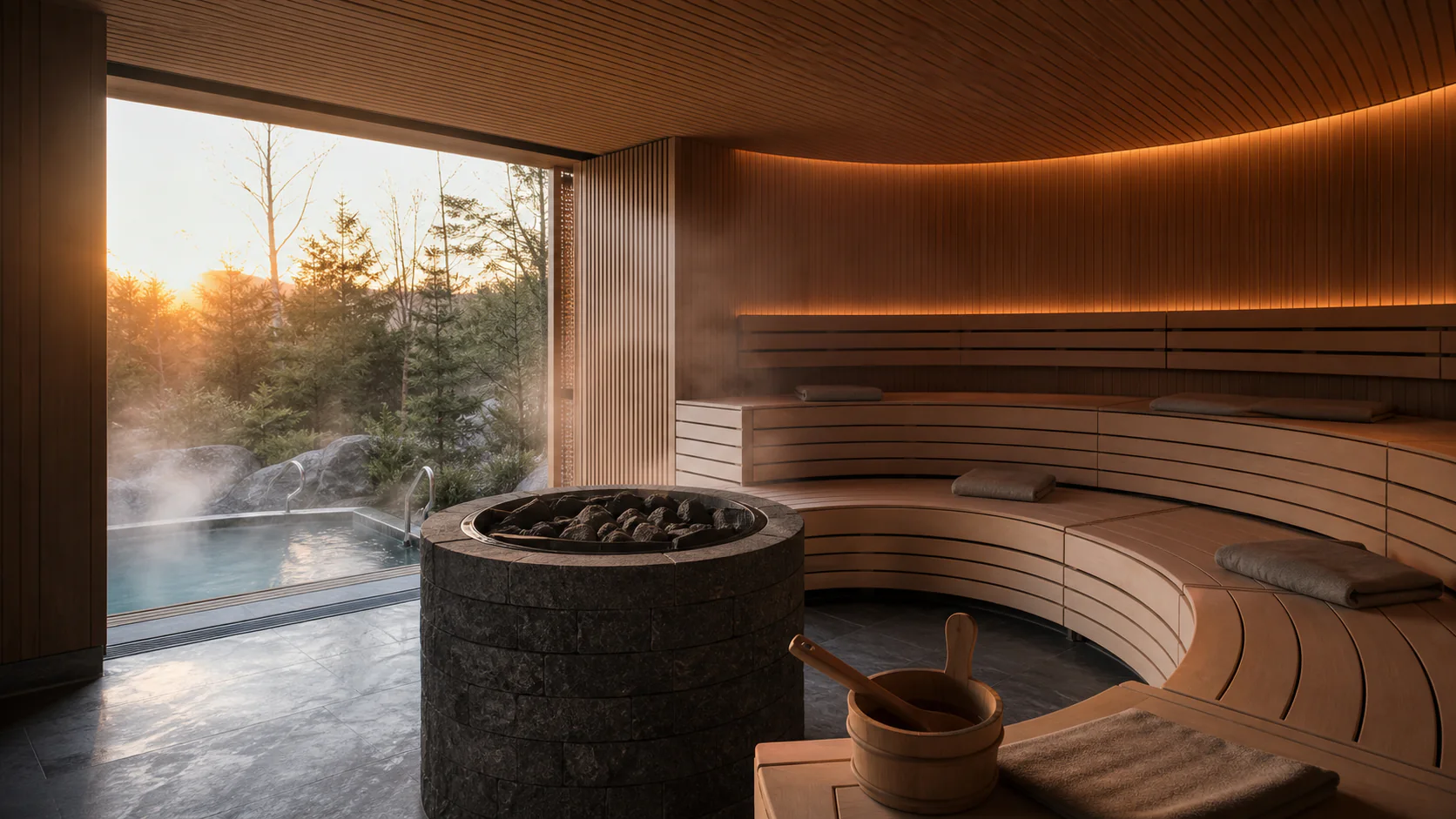
Editorial image note: both photographs in this report are original AI-generated illustrations. They do not depict a named property, institution or person.
Programming turns heat into ritual
A beautiful room can still produce a shallow experience. Ritual gives a session a beginning, progression and close. At its simplest, the host welcomes the group, explains heat and exit choices, adds water with consent, observes the room and marks a cooling interval. More expressive formats may include guided Aufguss, in which steam, scent and towel movement are choreographed. The distinction between facilitation and performance should remain clear.
Not every session needs an event concept. A calendar can alternate quiet bathing, first-timer introductions, social sessions and carefully trained guided rituals. Regularity is important: belonging forms when guests can return to a recognisable cadence and encounter familiar standards. Constant novelty may sell tickets, but consistency builds trust.
Hosts need more than charisma. They should understand heat exposure, hydration, emergency response, consent, cultural context, cleaning cycles, guest behaviour and the limits of wellness claims. They also need permission to slow or end a session. In social wellness, the host is part facilitator, part safety lead and part custodian of the room’s emotional temperature.
Safety must remain ordinary, visible and unglamorous
Heat creates predictable operational risks: dehydration, dizziness, burns, falls and distress in guests whose health or medication changes their response. Harvard Health notes that blood-pressure responses can vary and advises people with uncontrolled high blood pressure or heart disease to seek medical advice before sauna use. Its general precautions include avoiding alcohol, limiting time in the heat, cooling gradually, rehydrating and leaving immediately if unwell.
These are general precautions, not a universal prescription. Temperature, humidity, health status, acclimatisation and session format differ. Pregnancy, acute illness, cardiovascular conditions, medications affecting heat regulation and a history of fainting all justify specific advice from a qualified clinician. Cold-water immersion adds a separate acute stress and should never be framed as a compulsory proof of courage.
The Australian Sauna Association’s voluntary operator charter points in the right direction: fire, electrical and building compliance; maintained heaters, guards and ventilation; clear emergency procedures and first-aid provision; accurate descriptions of temperature and facilities; and accessible contraindication guidance before bathing. Luxury is demonstrated when these fundamentals are calm and obvious, not hidden behind waivers or romantic language.
A responsible host never rewards endurance. Guests should be free to sit lower, leave early, skip cold exposure or choose a gentler session without embarrassment. A social ritual becomes unsafe the moment belonging depends on ignoring the body.
Inclusion is designed before the guest arrives
Shared bathing raises questions about nudity, swimwear, gender, body confidence, disability, religion and privacy. There is no single globally correct dress code. Finnish norms, British seaside formats and hotel-spa expectations may differ. The essential standard is clarity: publish the rule before payment, explain the reason, offer practical options where possible and apply it consistently.
Some venues will offer mixed sessions in swimwear; others may provide gender-specific hours, towel options or private bookings. Accessible design should consider transfer routes, handrails, bench height, non-slip surfaces, lighting, quiet waiting space and how a guest can summon help. Neurodivergent guests may benefit from precise sensory information about heat, scent, sound, group size and lighting.
Photography policy matters too. A phone-free room protects privacy and strengthens the sense of release, but guests need secure storage and a clear method for urgent contact. Marketing content should be made during controlled shoots with explicit consent, never by treating paying guests as atmosphere.
Good social design also prevents clique formation and harassment. A brief code of conduct, visible reporting route and trained host make welcome tangible. “Community” is not automatically inclusive; it becomes inclusive through boundaries that protect newcomers as carefully as regulars.
The commercial model rewards repeatability
Private treatments depend on therapist hours and treatment-room inventory. Social sauna can accommodate several guests within a shared session, creating a different relationship between space, labour and revenue. Memberships, multi-visit passes, resident rates, off-peak sessions and hotel-guest access can all work, provided capacity is managed rather than oversold.
The danger is assuming that shared automatically means cheap to operate. Energy, ventilation, cleaning, laundry, water quality, host training, maintenance and insurance remain material costs. Wood-fired systems bring fuel sourcing, emissions, storage and fire-management questions. Electric systems bring demand peaks and grid intensity. Cold plunges add filtration, testing and water-management requirements. A credible sustainability claim needs measured consumption, not imagery of timber and wilderness.
Operators should track more than occupancy. Useful measures include first-to-second-visit conversion, repeat frequency, member retention, session utilisation by time, incidents, early exits, guest comfort feedback, water and energy per visit, maintenance downtime and the proportion of first-time bathers who understood the pre-arrival guidance. These indicators show whether the concept is becoming a healthy local habit or merely a launch-season novelty.
Hotels can use social sauna to build a relationship with residents who may never book a room. Independent bathhouses can add hospitality through tea, simple food, restorative seating and skilled hosting without imitating a resort. In both cases, the commercial advantage comes from belonging that is earned through repeated quality, not manufactured through exclusivity.
How sophisticated travellers should evaluate a social sauna
Start with the operating information. A polished venue should state session length, expected temperature range, dress code, group format, whether steam or scent is used, what cooling options are available and which health cautions apply. It should explain whether a host is present and whether the experience is quiet, social or guided.
Then look at choice. Can you leave and re-enter? Is cold immersion optional? Are there lower benches or gentler sessions? Can sensitive guests avoid fragrance? Is drinking water easy to reach? Are first-timers welcomed without being singled out? The best social rituals make participation legible while preserving autonomy.
Finally, consider cultural and environmental credibility. Does the venue name its influences accurately? Does it treat löyly as more than a decorative word? Are local rules, water constraints and energy use acknowledged? A premium price is justified by excellent hosting, maintenance, materials, safety and atmosphere — not by inflated biological promises.
An operating blueprint for spa leaders
Define the social promise
Choose whether the core experience is contemplative, conversational, ceremonial or a balanced calendar of all three. Write one sentence explaining what a guest should feel able to do in the room. Every subsequent decision — layout, capacity, music, hosting and membership — should support that promise.
Build the safety system before the event calendar
Resolve building, fire, electrical, ventilation, water, accessibility and insurance requirements for the actual jurisdiction. Create opening, between-session and closing checks. Train for fainting, burns, water incidents, harassment and evacuation. Make the guest briefing short because the backstage system is thorough.
Develop hosts as a professional discipline
Document who may lead a session, add water, use scent, perform towel work and supervise cold exposure. Combine technical training with facilitation, inclusion and cultural education. Observe sessions and coach hosts on consent, pacing and when to intervene.
Pilot with evidence
Begin with a limited timetable and varied session types. Gather structured feedback from first-time guests, regulars and people who chose not to return. Review incidents, utilisation and resource use before expanding. Growth should follow demonstrated operating control.
Keep claims within hospitality
Describe warmth, rest, ritual, sociability and guest-reported experience. Do not promise detoxification, disease prevention, mental-health treatment or guaranteed recovery. When citing research, name the study design and limitations. Trust is a more durable luxury asset than a dramatic claim.
The World Luxury Spa verdict
Social sauna is compelling because it asks luxury wellness to become less performative and more participatory. Its best expression is not an exclusive room with hotter air. It is a beautifully maintained setting where a first-time guest can understand the ritual, a regular can feel known, silence and conversation can coexist, and nobody has to prove endurance or belonging.
The movement will mature through standards, trained hosts and cultural humility. Properties that treat sauna as equipment will add another amenity. Those that treat it as social infrastructure may create something rarer: a place people organise part of their lives around.
Frequently asked questions
What is a social sauna?
A social sauna is a shared heat-bathing experience designed around respectful communal use rather than private treatment. It may be quiet, conversational or guided, but should have clear etiquette, trained oversight and freedom to leave the heat at any time.
Is a social sauna the same as contrast therapy?
No. A social sauna may offer cool air, showers or cold water between heat sessions, but cold immersion is a separate exposure and should be optional. The social value of the ritual does not depend on extreme temperature changes.
Does research prove that social sauna improves mental health?
No. A 2026 UK study found associations between sauna ritual, belonging and self-reported wellbeing, including before-and-after improvements in emotional measures. Its non-randomised designs do not prove a lasting clinical effect or establish sauna as treatment.
What should first-time guests check before booking?
Check the dress code, session format, temperature guidance, group size, host presence, cooling options, accessibility, health cautions and whether fragrance is used. A credible operator explains these points before payment.
What makes a social sauna feel luxurious?
Luxury comes from excellent hosting, thermal comfort, privacy where needed, clean transitions, cultural care, unhurried pacing and genuine choice. Expensive finishes cannot compensate for crowding, vague safety information or exaggerated health claims.
Sources and further reading
- Spa Business: the 28 July 2026 report on the launch of the Australian Sauna Association and its community-led remit. Read the lead report.
- Australian Sauna Association: the organisation’s standards and voluntary operator charter covering safety, honest information and care for the craft. Read the standards.
- UNESCO Intangible Cultural Heritage: the official record for sauna culture in Finland, inscribed in 2020. Read the UNESCO record.
- Newson and colleagues, Social Science & Medicine: the 2026 peer-reviewed study of sauna ritual, social connection and wellbeing across three UK studies. Read the open-access paper.
- Finnish Sauna Society: practical customs centred on respect, community spirit, peaceful bathing and considerate use of löyly. Read the customs.
- Harvard Health Publishing: conservative general precautions for heat exposure, hydration and medical advice. Read the safety overview.