The Sea Is Not a Metaphor: A Truth Standard for Thalassotherapy
Luxury wellness has become fluent in the language of place. A pool may be “ocean-inspired”, a ritual “marine-infused” and a mountain spa “thalasso-style”. These phrases can describe a thoughtful creative influence. They can also blur several very different experiences: bathing in treated fresh water with added salt, using a marine cosmetic, entering a pool filled with transported seawater, or undertaking a coordinated programme beside the sea itself.
The distinction matters because thalassotherapy is not simply an elegant synonym for hydrotherapy. In its established European reference tradition, it combines seawater and other elements of the marine environment, usually in a coastal setting and, in the classic French definition, under medical supervision. The sea is not decorative scenery. It is the source, climate and organising logic of the experience. Luxury spas can innovate beyond that model, but they should name the result with precision.
The signal: thalasso has travelled inland
On 21 August 2026, Spa Business reported the opening of a high-altitude resort spa in Uzbekistan with what it described as a “thalasso-inspired” concept. The article said sea- and mineral-based therapies associated with coastal settings had been reimagined for the mountains, including an indoor pool described as seawater enriched with magnesium salts. The story is a property opening, and its claims come principally from the operator; it is a lead, not independent evidence of treatment outcomes or a reason to review the named resort.
The wording is nevertheless revealing. Thalasso-inspired acknowledges both an influence and a distance from the traditional model. That modifier is doing useful work. It raises a broader question that applies well beyond one project: as marine aesthetics, salt rooms, mineral pools and sea-derived products spread across global wellness, what should a sophisticated guest be entitled to understand from the name?
This is not a campaign to reserve every water ritual for the coast. Inland spas have their own legitimate assets: natural mineral springs, skilled hydrotherapy, local bathing cultures, carefully engineered saline pools and landscapes that support rest. The editorial standard is simpler. Call each experience what it is, explain the source of the water and ingredients, separate atmosphere from evidence, and never borrow a medical or geographical implication that the operation cannot support.
What thalassotherapy has historically meant
France’s Directorate General for Enterprise defines thalassotherapy as the combined use, under medical supervision, of benefits associated with the marine environment: climate, seawater, marine muds, algae, sands and other substances extracted from the sea, for preventive or therapeutic purposes. The same official overview describes seawater pumped near the coast and heated for use in treatments. This is a French policy and tourism reference, not a universal law for every country, but it captures the defining idea: thalassotherapy is a system of marine factors rather than a single salted pool.
France’s national water-use nomenclature makes another useful boundary explicit. It distinguishes thermalism, which uses fresh natural mineral waters, from thalassotherapy, which uses the marine environment. Elsewhere, regulations and professional traditions vary. Some jurisdictions protect particular terms or require clinical oversight; others treat “thalasso” as descriptive hospitality language. A global magazine cannot turn one national definition into worldwide legal advice. It can, however, use the reference to test whether marketing preserves the material difference between sea, spring and manufactured pool water.
The European Spas Association’s EuropeSpa system approaches quality through audited criteria for service, safety, hygiene and infrastructure. Its existence is a reminder that a beautiful water surface tells a traveller little about what happens behind it. Provenance, treatment, microbiological control, staff competence and maintenance are largely invisible. Stars, marble and a coastal view do not verify them.
Four water experiences that should not collapse into one
Coastal thalassotherapy
In the classic model, seawater is used as part of a coordinated programme in direct relationship with the coast and its climate. Marine mud, algae, movement, rest and supervised treatments may form part of the offer. The exact requirements depend on local law and the centre’s claims, but a guest should be able to identify the marine source, how water reaches the facility and who is responsible for the programme.
Thermal or mineral-water bathing
Thermal traditions are based on naturally occurring fresh mineral water, often associated with a recognised spring and a particular composition. They can be culturally rich and operationally sophisticated without being marine. “Thermal”, “mineral” and “medical spa” may also be regulated differently across countries, so provenance and local status matter more than a generic wellness label.
Balneotherapy and hydrotherapy
These broad terms commonly refer to treatment or exercise using baths and water. Depending on the context, the water may be fresh, mineral or saline, and the programme may range from relaxation to supervised rehabilitation. They describe a method more readily than a marine origin. Operators should specify the water and purpose instead of assuming that “hydro” answers every question.
Saltwater, seawater and mineral-enriched pools
A saltwater pool may be an ordinary treated pool in which dissolved salt supports chlorine generation. A mineral-enriched pool may begin with fresh water and a formulated blend. A seawater pool may use transported or directly abstracted marine water. These can all deliver pleasurable bathing, buoyancy and sensory distinction, but they are not interchangeable. The relevant questions are what the water was before treatment, what has been added, how it is disinfected and what outcome is actually promised.
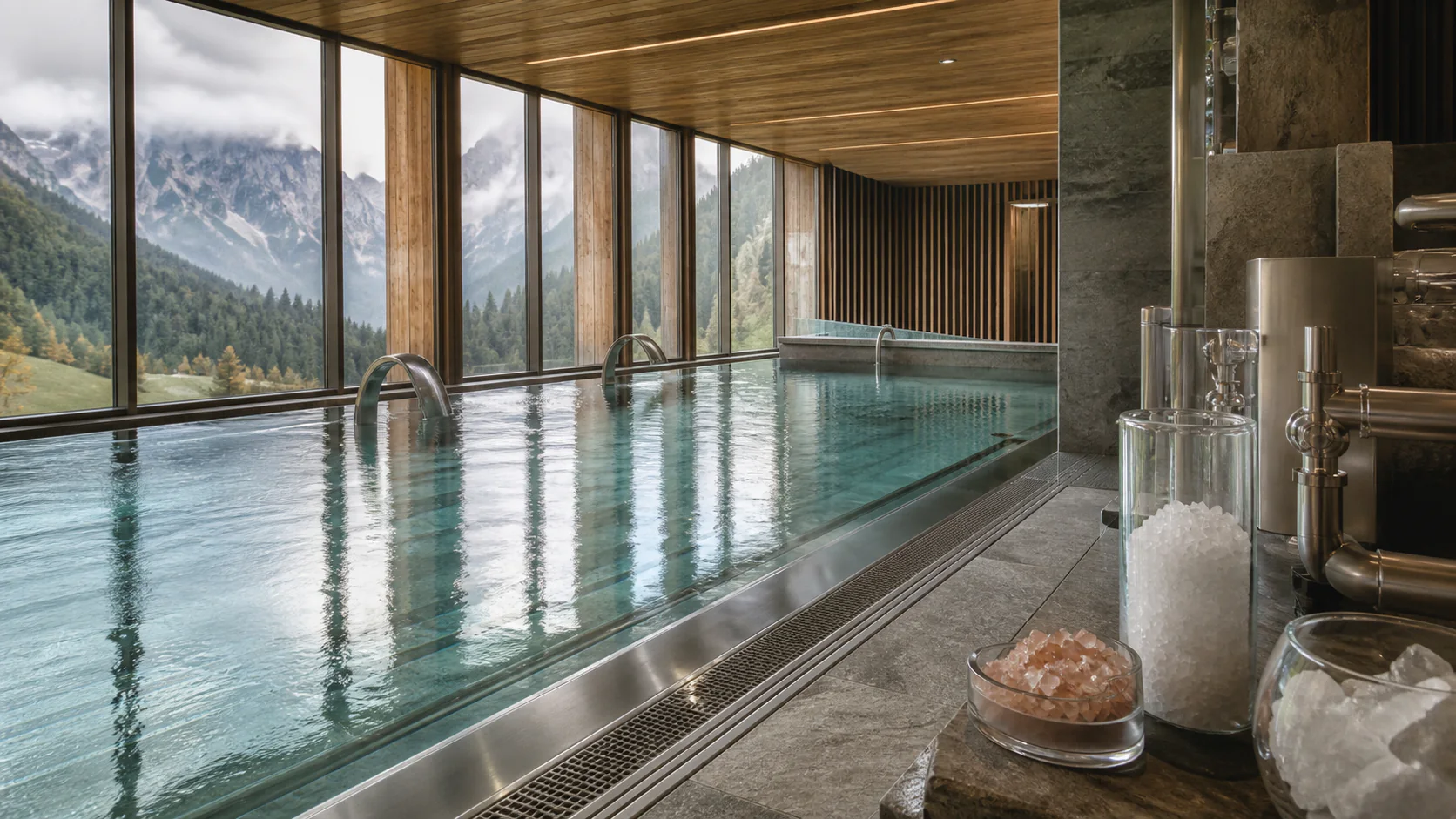
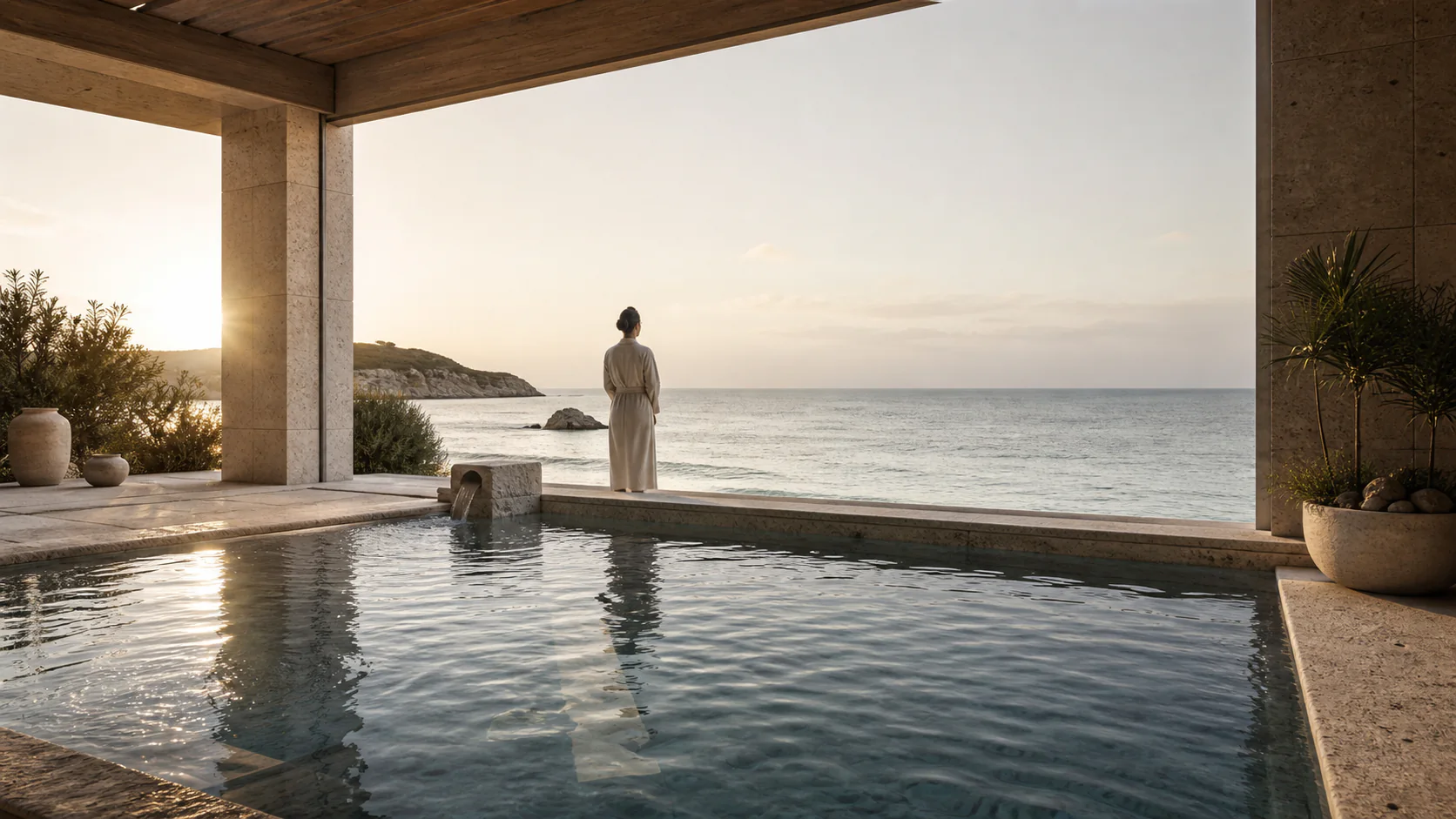
Editorial image note: both photographs in this feature are original AI-generated illustrations. They do not depict the resort in the Spa Business report or any named property, institution or person.
What the evidence can—and cannot—carry
The word “therapy” creates a higher burden than the word “bathing”. A 2026 systematic review of climatotherapy in marine and Dead Sea environments included nine studies covering 465 participants with musculoskeletal or rheumatological conditions. The authors reported consistent short-term improvements across several outcomes, but only two studies could be pooled for pain, the pooled result was inconclusive, methods were heterogeneous and safety reporting was inconsistent. They concluded that stronger multicentre trials with standardised outcomes and safety assessment are needed.
That review is relevant, but it does not establish that any hotel salt pool reproduces a studied intervention. The research combined complex exposures: seawater or saline-lake environments, climate, mud, sunlight, movement and time away from ordinary routines. Participants had defined conditions, and the studies varied in design and comparison. A menu cannot select the most attractive conclusion while discarding the population, protocol, duration and setting that produced it.
For a luxury traveller seeking rest rather than healthcare, the honest promise may be experiential: warm-water comfort, supported movement, time outdoors, a distinctive sense of place and a carefully paced ritual. Those can be valuable without being presented as treatment for arthritis, skin disease, anxiety, circulation or “detoxification”. If a centre makes clinical claims, it needs appropriate local authority, qualified oversight, contraindication screening and evidence matched to the exact service. The same discipline that should govern luxury spa wellness claims applies especially strongly when a traditional therapeutic term enters a hotel menu.
A seven-part truth standard for marine wellness
1. Name the water before naming the benefit
The first line of a menu should make the source legible: locally abstracted seawater, transported seawater, natural mineral water, treated fresh water with added marine salts, or a conventional saline pool. “Mineral-rich” is not a source. If composition is relevant to a claim, the operator should know who tested it, when and against which specification.
2. Separate origin from formulation
Recreating selected concentrations with salts may be a valid design choice. It is still formulation, not provenance. An elegant inland pool can say that it is inspired by marine bathing and describe its ingredients accurately. It should not imply that a packet of salts reproduces the total chemistry, living context or coastal climate of the sea.
3. Make the process traceable
If marine water is pumped, transported, stored, filtered, heated or blended, each step affects operations. Leaders should document the intake location, supplier, storage time, treatment method, turnover, temperature and disposal route. Guests do not need a plant-room lecture, but staff should be able to explain the chain in plain language and provide more detail when asked.
4. Treat hygiene as part of luxury
The World Health Organization’s guidance for swimming pools and similar environments addresses microbial contamination, chemicals, injury and operational control. Seawater imagery does not remove those obligations. Warm pools, jets, high bather loads and aerosol-generating features require risk assessment, disinfection, monitoring and maintenance appropriate to the facility and local regulation. A claim of naturalness must never become an excuse for weak control.
5. Match supervision to the promise
A relaxation circuit and a programme marketed for a diagnosed condition are not the same service. The former still needs trained attendants, safe temperatures, clear contraindications and escalation routes. The latter may require licensed clinicians, assessment, records and governance depending on the jurisdiction. “Traditionally used for” is not a substitute for current evidence or competent oversight.
6. Account for the environmental route
Transporting heavy seawater inland, heating large pools, treating corrosion and discharging saline water can create material operational impacts. The best choice depends on local infrastructure and cannot be judged from distance alone. Operators should measure water and energy demand, protect receiving environments, comply with discharge rules and compare alternatives. Importing the sea for symbolism is difficult to defend if the ecological cost is hidden.
7. Use modifiers as disclosure, not decoration
Terms such as “marine-inspired” and “thalasso-inspired” can be honest when the next sentence explains the departure from the traditional model. They become evasive when the qualifier is small and the therapeutic promise is large. Naming should be consistent across the website, booking engine, consultation, treatment menu, signage and staff script.
A vocabulary guests can trust
World Luxury Spa proposes a practical three-tier vocabulary. This is an editorial standard, not a legal classification, and operators must still follow the rules where they work.
Use “thalassotherapy” for a genuinely marine system
The facility can demonstrate seawater provenance, meaningful coastal context, appropriate programme design, safety controls and the level of professional oversight implied by its claims. It describes which components are marine and does not suggest that every traditional claim is clinically proven.
Use “thalasso-inspired” for a transparent adaptation
The experience borrows selected elements—perhaps marine ingredients, salt-water buoyancy or a sequence influenced by coastal practice—but clearly states that it is inland, formulated or otherwise different. The description should identify what is present rather than relying on the borrowed word to do all the selling.
Use “saline”, “mineral-enriched” or “marine-cosmetic” for the exact offer
Precise language can sound less romantic in a concept meeting and more trustworthy at the point of purchase. A warm mineral-enriched flotation pool in the mountains does not need to impersonate an ocean to be desirable. Its value can rest on design, service, water quality, landscape and the quality of the bathing experience.
What sophisticated travellers should ask
Begin with one courteous question: What water is actually used? A confident team should distinguish direct seawater, transported seawater, natural mineral water and treated fresh water with salts. Ask whether “thalasso” describes the entire programme or one ingredient. If the answer moves immediately to vague language about trace minerals and energy, request the practical version.
Then ask how water quality is managed, whether medical screening or supervision is included, which claims are experiential and which are clinical, and whether the itinerary can be adapted for pregnancy, cardiovascular conditions, skin sensitivity, recent surgery, mobility needs or medication. Guests with health concerns should seek advice from an appropriate clinician; a magazine and a concierge cannot assess individual suitability.
Finally, compare the experience on its real merits. Is the water pleasant and well maintained? Are temperatures and durations explained? Is there an easy route to exit? Does the programme allow rest rather than forcing a sequence? Is the marine story connected to local ecology and culture, or has it been imported as scenery? These questions also help identify signature spa treatments worth travelling for: the strongest are specific enough to understand and coherent enough to belong where they are offered.
For spa leaders: audit the nouns
Gather every place the concept is named: feasibility study, design brief, water specification, supplier contract, website, public-relations copy, treatment menu, waiver, therapist protocol and maintenance log. Circle each material noun—sea, seawater, mineral, therapy, clinical, detox, circulation, recovery. For every noun, identify its source, owner, evidence and operational consequence.
Next, walk the guest journey. Can reservations explain the difference before payment? Does the consultation repeat the same facts? Do therapists know which ingredients are marine-derived and which are manufactured analogues? Can engineering show water test records and incident thresholds? Can sustainability teams account for abstraction, transport, heating and discharge? A truthful concept should survive contact with every department.
Procurement deserves particular attention. Ask suppliers for composition, origin, batch traceability, storage conditions, safety information and substantiation of any performance claim. “Ocean minerals” without a specific origin or specification is a mood phrase. “Dried sea salt from a named, tested supply chain, added at a stated concentration to treated pool water” is an operational fact.
Finally, test the most conservative description. If the experience remains compelling after inflated language is removed, the concept is strong. If it collapses when “thalasso” is qualified, the problem is not copywriting. It is a lack of distinctive substance.
The World Luxury Spa verdict
Thalassotherapy can evolve. Traditions survive by being interpreted, and luxury hospitality has always carried ideas across borders. But interpretation should add clarity, not dissolve the source. A mountain spa may create an exceptional saline or mineral bathing ritual. A coastal centre may offer an unremarkable one. Geography alone does not guarantee quality, and innovation alone does not grant provenance.
The standard is to tell the truth in layers: what the water is, where it came from, what the setting contributes, how the system is controlled, who supervises the programme and what evidence can support the promised outcome. When those facts are clear, “inspired” becomes an honest creative bridge. When they are hidden, it becomes a loophole.
The sea does not need luxury wellness to romanticise it. It asks the industry to be exact.
Frequently asked questions
Does thalassotherapy have to take place beside the sea?
In the established French and European reference tradition, thalassotherapy combines seawater and other marine factors in a coastal context, often with medical supervision. Legal definitions vary internationally. An inland spa can offer a marine- or thalasso-inspired experience, but should explain clearly how it differs from the traditional model.
Is a saltwater pool the same as a seawater pool?
No. A saltwater pool may be a treated fresh-water pool using dissolved salt, sometimes to generate chlorine. A seawater pool uses marine water, whether directly abstracted or transported. A mineral-enriched pool may use a formulated blend. Guests should ask about the original water source and treatment process.
Are the health benefits of thalassotherapy conclusively proven?
No. A 2026 systematic review found signals of short-term benefit in some marine and Dead Sea programmes, but the evidence was fragmented, methods varied and pooled analysis was limited. Findings from defined clinical programmes should not be transferred automatically to hotel pools or individual marine products.
What should I ask before booking a thalasso programme?
Ask what water is used, where it comes from, which parts of the programme are genuinely marine, how water quality is monitored, what professional supervision is included, which contraindications apply and whether advertised outcomes are experiential or clinical.
Can an inland luxury spa use marine ingredients responsibly?
Yes. It can use traceable sea salts, algae, muds or marine cosmetics and create a thoughtful water ritual. The responsible approach is to name the ingredients and water accurately, avoid implying a complete coastal therapy, substantiate claims, manage safety and disclose environmental impacts where they are material.
Sources and further reading
- Spa Business: the 21 August 2026 report on a high-altitude resort with a “thalasso-inspired” spa, used here as the editorial lead rather than independent evidence of outcomes. Read the lead report.
- France, Directorate General for Enterprise: official tourism overview defining the French thalassotherapy model through the combined marine environment, seawater and associated materials under medical supervision. Read the official overview.
- France, Eaufrance: national water-use nomenclature distinguishing fresh mineral-water thermalism from thalassotherapy’s use of the marine environment. Review the official classification.
- World Health Organization: recreational-water resources covering risk management for coastal water, pools and spas, including links to the relevant WHO guidelines. Open the water-safety resources.
- EuropeSpa / European Spas Association: cross-border quality and certification framework addressing service, safety, hygiene and infrastructure in medical-spa and wellness facilities. Review the standards framework.
- International Journal of Biometeorology: the 2026 systematic review of climatotherapy in marine and Dead Sea environments, available through PubMed Central, including its methodological and safety limitations. Read the systematic review.