The Hotel Is the Wellness Programme: Why Guests Are Booking Beyond the Spa
The treatment room is losing its monopoly on hotel wellness. Travellers are beginning to judge the entire stay as a recovery system: whether the room supports sleep, the outdoor spaces invite unhurried time, the pool feels usable rather than decorative, and the route from arrival to breakfast preserves more energy than it consumes.
A large new travel survey has given this shift unusually concrete numbers. The figures are useful, but they are not a licence to turn every terrace into “forest therapy” or every hot tub into hydrotherapy. They measure what intending travellers say attracts them, not what they ultimately book, use or benefit from. The opportunity is therefore less about adding wellness labels and more about making the hotel’s ordinary systems visibly better.
This feature complements our practical guide to choosing a luxury spa resort and our analysis of five-star spa experience design. Its focus is different: how wellness is becoming a hotel-selection filter, how to read the evidence without overclaiming, and what operators must prove when the promise moves beyond the spa door.
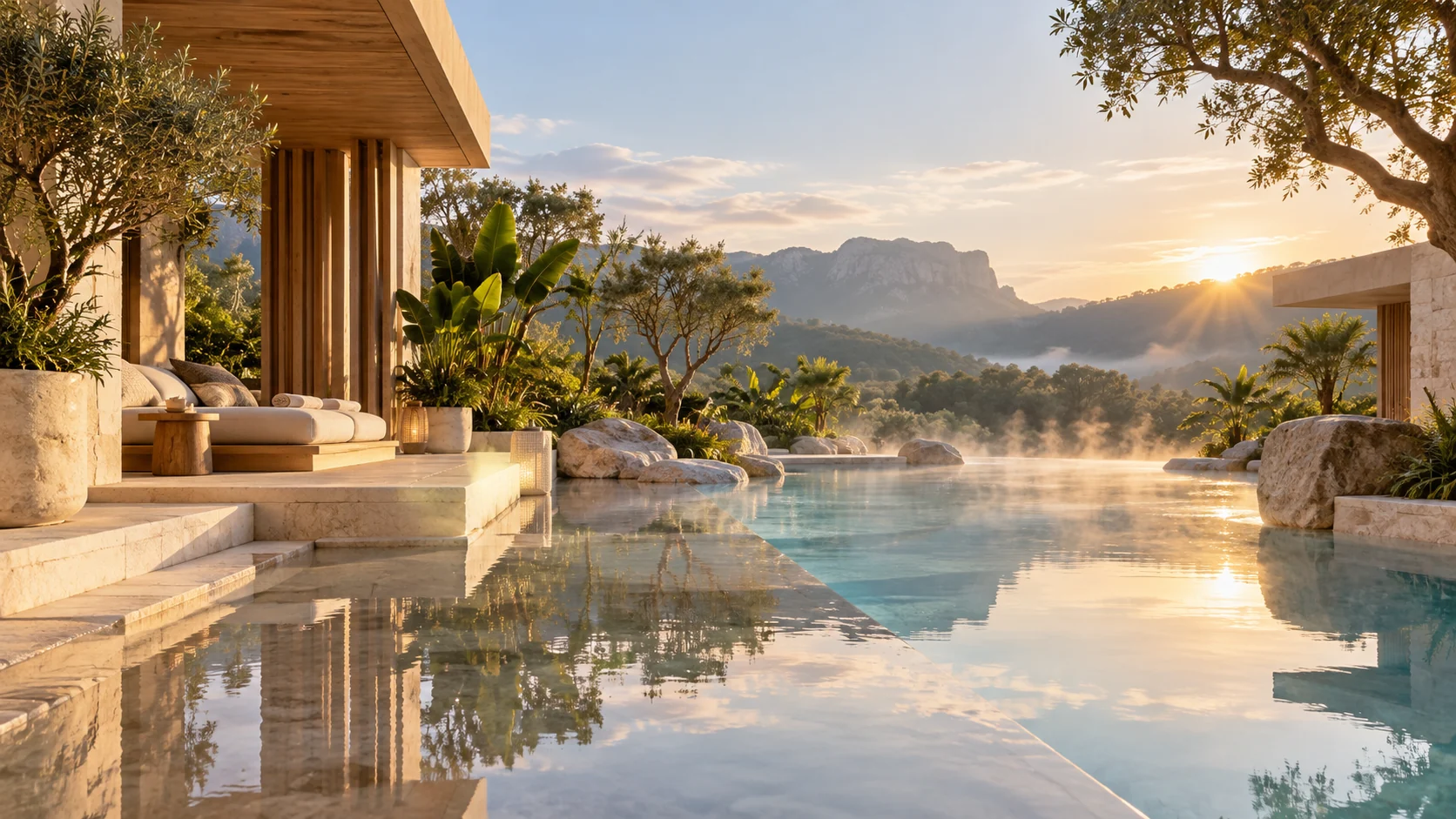
The new signal: wellness can decide where a guest stays
Spa Business reported on 30 September 2026 that thermal bathing, nature and recovery spaces are becoming meaningful hotel-selection criteria. Its lead was Hilton’s 2027 Trends Report, based on research conducted by Morning Consult among 14,744 adults in 14 countries who expected to travel during the following 12 months. Fieldwork ran from 18 May to 1 June 2026. Hilton reported an approximate margin of error of one percentage point for the total sample and around three points for individual markets.
Among respondents, 61 per cent said they were more likely to engage in water-based wellness experiences while travelling, and 60 per cent were more drawn to those experiences when they could be shared. Twenty-nine per cent said an on-site pool could be the reason they chose a hotel, while 20 per cent said the same of a sauna or steamroom. Nature and rest also appeared as selection signals: 35 per cent said they would book specifically for outdoor relaxation spaces, and 32 per cent for spaces designed to support deep rest and sleep.
Those numbers do not mean that a third of all hotel bookings are now won by a garden or that a fifth are caused by a sauna. The sample was limited to people already intending to travel, the questions capture stated preference, and the research was commissioned by a hotel company with a commercial interest in the subject. The country mix is broad, but an overall percentage can still hide major differences in climate, bathing culture, income, trip purpose and familiarity with spa facilities.
Used carefully, the survey is still valuable. It suggests that wellness attributes have moved closer to the top of the booking funnel. They are no longer relevant only after a guest has chosen the hotel and opens the treatment menu. A pool, a quiet room, a garden or a thermal circuit can now help form the reason for choosing the property in the first place.
Why the whole-hotel idea is credible
The broader market context supports the direction, even if it cannot validate every survey percentage. The Global Wellness Institute estimates that travellers made 1.239 billion domestic and international wellness trips in 2024. In its methodology, wellness tourism includes both primary trips motivated mainly by wellbeing and secondary trips in which travellers maintain or pursue wellness activities during another kind of journey. The institute estimates that these trips represented 8.3 per cent of tourism trips but 17.6 per cent of tourism spending in 2024.
That distinction between primary and secondary wellness travel is central. Most hotels do not need to become intensive retreats. A business traveller may simply want reliable sleep, a usable gym, a calm swim and breakfast that does not create another decision problem. A family may value shaded outdoor space and clear pool supervision. A couple may choose a property because a shared sauna or garden makes the stay feel restorative without requiring a scheduled treatment.
Academic research also gives the design conversation more texture. A 2024 study in the Journal of Hospitality & Tourism Research used conjoint analysis to examine combinations of biophilic attributes in four- and five-star urban hotels. The researchers considered elements such as indoor landscaping, water features, natural light, living walls and outdoor terraces. The work explores perceived restoration rather than proving a clinical outcome, but it supports a practical point: guests read combinations of environmental cues, not isolated decorative gestures.
The World Health Organization’s work on nature, biodiversity and health likewise describes high-quality green and blue spaces as relevant to health, wellbeing and quality of life. That is not evidence that a resort garden treats stress or that a sea view guarantees better sleep. It is a reason to protect genuine access to nature and to avoid reducing it to a marketing image that guests cannot actually use.
A booking filter is not the same as a wellness outcome
Hotel marketing often collapses three different questions. The first is attraction: did a feature help a traveller notice or choose the property? The second is use: did the guest actually enter the garden, sleep well, use the pool or join the class? The third is outcome: did the experience contribute to the form of rest, connection or physical activity the guest wanted? A photograph can influence the first while the operation fails at the other two.
This is why survey intention should be paired with behavioural evidence. Operators can compare booking-page engagement, amenity filters, pre-arrival questions, actual facility use, waiting times, cancellations, repeat stays and post-stay feedback. They should also record who cannot use the feature. A pool that attracts bookings but lacks a workable step-free entry is not a success for every guest. A sleep programme that adds gadgets while allowing corridor noise to continue is an upsell, not a system.
Measurement must remain proportionate. A hotel does not need to collect sensitive health data to learn whether guests found a quiet room, understood the thermal circuit or used the garden. Simple operational questions are often better: Was the amenity available at the advertised time? Could the guest understand how to use it? Did capacity feel calm? Was the route accessible? Did staff know the safety and etiquette guidance? Would the guest choose the hotel for that feature again?
Five hotel systems now carrying the wellness promise
1. Water that is operated, not merely photographed
Aquatic experiences are among the strongest signals in the survey, but they are also operationally demanding. The credibility of a pool, hot tub or hydrotherapy circuit depends on water quality, air quality, maintenance, slip control, safe entry and exit, temperature management, supervision, capacity and a clear response to incidents. Local law comes first. As a detailed reference, the US Centers for Disease Control and Prevention’s Model Aquatic Health Code covers the design, construction, operation and management of public pools and spas, including those at hotels. It is guidance rather than federal law, which makes precise local compliance essential.
Luxury is visible in the unglamorous details: a handrail placed where a body needs it, water-testing records, dry towels at the point of use, a staff member who can explain the circuit without making medical promises, and a capacity plan that prevents a serene photograph from becoming a crowded reality.
2. Nature that guests can enter
A landscape contributes more when it is usable. Shade, seating, gradients, distance information, lighting, weather alternatives, insect management and safe evening access determine whether a garden is part of the stay or simply a view through glass. In hot or wet climates, covered transitions may matter more than another ornamental planting bed. In cold climates, a sheltered threshold, drying space and suitable footwear guidance may decide whether guests step outside.
Operators should also resist the idea that imported greenery automatically creates connection to place. Native and climate-appropriate planting, local ecological knowledge, dark-sky care, water restraint and honest interpretation can make the landscape more specific and less resource-intensive. A nature promise becomes stronger when the property explains both access and stewardship.
3. Sleep built into the room, not sold as an accessory
Deep rest begins with basic room performance: acoustic separation, light control, thermal comfort, a supportive bed, clean air, simple controls and housekeeping practices that respect the guest’s requested schedule. Pillow menus, scent rituals and sleep technology may help some people, but they cannot compensate for a bright thermostat, a noisy minibar or a gap under the door.
Hotels should describe what is controllable and avoid guaranteeing sleep. They can publish practical information about blackout conditions, room orientation, connecting doors, lift proximity, ventilation and quiet-room requests. They can train reservations staff to ask one useful question instead of offering a long menu of products. The goal is not to diagnose insomnia. It is to remove preventable friction from the night.
4. Social wellness with permission for privacy
The survey’s interest in shared water experiences reflects a broader move towards sociable wellness. Yet “social” should not mean compulsory conversation, mixed-gender use without clear notice, or layouts that expose people who expected privacy. Strong properties distinguish quiet sessions, conversational times, family access, adult-only periods and hosted rituals. They state dress codes, phone rules, fragrance use and expected etiquette before payment.
The operator’s role is to make participation legible. A first-time guest should know where to stand, how long a session lasts, when to leave and whether cooling is optional. A regular should not be allowed to turn familiarity into ownership of the room. Hospitality is the active work of making shared space feel safe without making it stiff.
5. Transitions that protect energy
The most overlooked wellness feature may be the gap between amenities. A tranquil spa can be undermined by a ten-minute queue at reception, a confusing lift transfer, wet corridors, a loud breakfast room or an early housekeeping knock. Conversely, a hotel without a vast spa can feel restorative when arrival is clear, luggage disappears quickly, rooms are ready as promised and guests can move between rest, food, water and outdoors without repeated decisions.
This is where the whole-hotel proposition becomes an operating model. Engineering, housekeeping, food and beverage, security, digital product, landscaping, front office and spa teams all own part of the result. Wellness cannot remain a department if the selection promise depends on the complete stay.
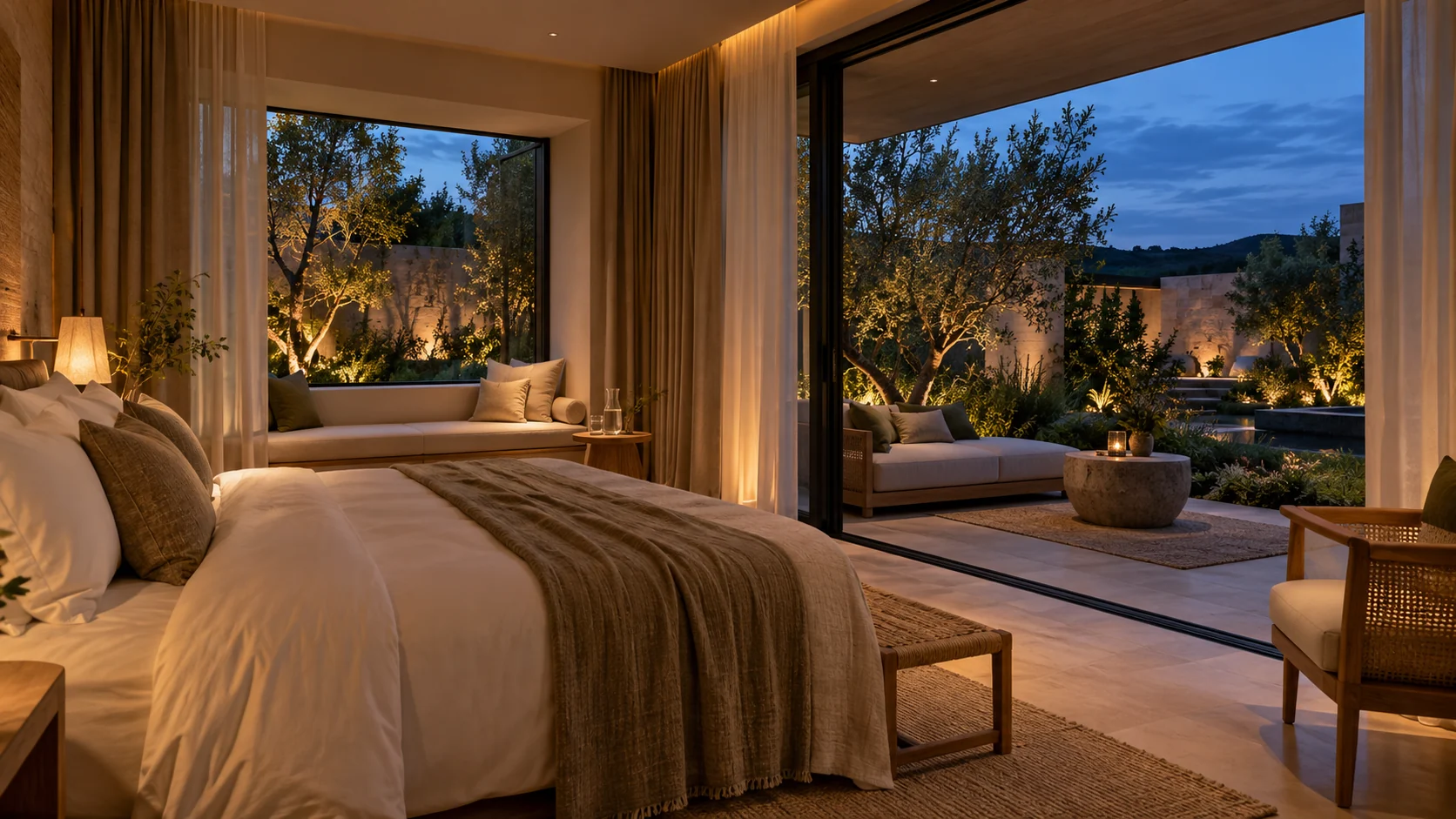
The proof standard: what travellers should be able to see before booking
If wellness is a selection criterion, evidence must appear at the selection stage. A vague icon marked “spa” is no longer enough. Travellers should be able to understand which facilities exist, whether access is included, who may use them, the opening hours, booking requirements, capacity model, age rules and important accessibility information. Photographs should show the real facility and its scale rather than a generic treatment still life.
Properties should distinguish planned features from open ones, seasonal features from permanent ones and private services from shared amenities. “Hydrotherapy” should identify the actual experience rather than act as a prestige synonym for a pool. “Nature immersion” should describe the route, duration, terrain and facilitation. “Sleep support” should separate room design from optional products. This level of specificity helps guests compare value and protects operators from expectations they never intended to create.
Price presentation matters too. State whether thermal access is included in the room, attached to a treatment, limited to a time slot or sold as a day pass. Disclose mandatory fees and cancellation terms. A feature cannot function as a credible booking filter if its real availability only becomes clear after purchase.
An operator blueprint from promise to performance
Map the whole journey
Start with the booking page and continue through arrival, room, amenities, food, sleep and departure. Record every place the property makes a wellness implication and identify the team responsible for delivering it. The map will usually reveal that the marketing promise crosses far more departments than the spa director controls.
Create one evidence card for every major feature
For each pool, sauna, garden route, sleep feature or programme, document the exact description, operating hours, capacity, staffing, maintenance owner, accessibility, safety checks, seasonal limits, claims boundary and source of guest-facing photographs. Review the card whenever the feature or its availability changes.
Test with different bodies and trip purposes
A romantic weekend, business stopover, family holiday and solo recovery break use the same hotel differently. Walk the journey with mobility, sensory and communication needs in mind. Include guests who do not already understand spa etiquette. The aim is not to create one universal experience, but to make choice, limitations and alternatives clear.
Connect marketing data to operating data
If a booking page highlights an outdoor pool, compare clicks and conversions with opening hours, weather closures, capacity refusals and complaints. If sleep is a differentiator, review room moves, noise reports, maintenance logs and repeat requests. If the garden is central, measure actual access and maintenance downtime. Demand evidence without delivery evidence encourages overinvestment in imagery and underinvestment in service.
Keep claims inside hospitality
Describe quiet, comfort, warmth, fresh air, movement, social connection and the guest’s ability to rest. Do not promise to reset a nervous system, boost immunity, cure sleep disorders or deliver a guaranteed mental-health effect. When research is cited, name what it studied and what it did not establish. Confidence grows when the experience does not need inflated biology to sound valuable.
Questions sophisticated travellers should ask
- Availability: Is the advertised feature open for the dates of the stay, and does it require a separate reservation or fee?
- Access: What are the route, changing, water-entry, seating and sensory conditions, and what alternatives are available?
- Capacity: Is use timed, hosted or limited, and what happens when weather or demand changes the plan?
- Sleep: Which room conditions are designed for rest, and which requests can the property realistically guarantee?
- Safety: Who supervises the water or thermal area, what guidance is given and how are local rules applied?
- Claims: Is the hotel describing a hospitality experience or implying a health outcome that needs stronger evidence?
- Value: Is access included in the room price, bundled with a treatment or sold separately?
The World Luxury Spa verdict
The important shift is not that every hotel needs a larger spa. It is that travellers increasingly notice whether the stay protects sleep, gives genuine access to nature and water, and makes restorative choices easy. That places wellness inside the architecture, operating calendar and service culture of the whole property.
The survey behind the current conversation is a strong signal, not a universal law of demand. Operators should test stated interest against real use, repeat choice and operational quality. Travellers should look past the hero photograph to access, capacity, safety and inclusion. The winning hotel will not be the one that labels the most spaces as wellness. It will be the one whose ordinary systems make a better day feel plausible.
Visual note: both photographs in this article are original AI-generated editorial illustrations. They depict fictional places and do not represent a named hotel, spa, institution, architect or destination.
Frequently asked questions
Is wellness really becoming a reason to choose a hotel?
A 2026 multinational survey of intending travellers found that meaningful minorities would choose accommodation specifically for features such as a pool, sauna or steamroom, outdoor relaxation space or deep-rest space. These are stated intentions rather than observed bookings, so they are best treated as a demand signal that hotels should test against actual behaviour.
Does a hotel need a large spa to compete on wellness?
No. Reliable sleep conditions, usable outdoor space, thoughtful movement options, good food, calm transitions and honest information can matter across the stay. A smaller property may deliver these fundamentals better than a resort with an impressive spa but inconsistent access or service.
What should I verify about hotel pools and thermal facilities?
Check opening dates and hours, whether access is included, reservation and age rules, supervision, water-entry options, changing facilities, capacity, temperature guidance and health cautions. Local safety and public-health requirements matter more than a marketing label such as hydrotherapy.
Can a hotel guarantee better sleep or stress recovery?
No. Hotels can reduce avoidable friction through acoustic control, darkness, thermal comfort, clean air, bedding, simple controls and respectful service. They should not guarantee sleep, treat insomnia or promise a clinical stress outcome; individual needs and health circumstances vary.
How can operators tell whether a wellness feature drives bookings?
Connect booking-page interest and pre-arrival questions with actual use, capacity refusals, maintenance downtime, guest feedback, repeat choice and complaints. Measure accessibility and failed delivery as well as popularity, and avoid collecting sensitive health data when simple operational evidence will answer the question.
Sources and further reading
- Spa Business: the 30 September 2026 lead report on wellness, water, nature and sleep as hotel-selection considerations, including survey scope and limitations. Read the lead report.
- Hilton: the complete 2027 Trends Report, including the “Wellness, Rewired” findings and the property operator’s examples. Read the report.
- Global Wellness Institute: the 2025 Global Wellness Economy Monitor, including definitions, methodology and 2024 wellness-tourism estimates. Read the monitor.
- Suess, Legendre and Hanks, Journal of Hospitality & Tourism Research: open-access research on biophilic attributes and perceived restorative experiences in four- and five-star urban hotels. Read the study.
- World Health Organization Regional Office for Europe: a research synthesis on nature, biodiversity, green and blue space, health and quality of life. Read the report.
- US Centers for Disease Control and Prevention: the current Model Aquatic Health Code resource, a voluntary US reference for the design, operation and management of public pools and spas. Read the guidance.