The Carbon Cost of Calm: How Luxury Spas Can Measure Every Visit
A thermal pool can look timeless while its energy demand changes hour by hour. Behind the limestone, warm towels and quiet treatment rooms sit boilers, heat pumps, ventilation systems, chillers, pumps, laundry cycles, refrigerants, staff journeys and thousands of purchased products. Until those flows are measured, a spa’s environmental language remains atmosphere rather than evidence.
A new peer-reviewed method for allocating emissions to individual spa and wellness visits has made that gap harder to ignore. The important story is not a single calculator or operator. It is the arrival of a more useful question: what did this experience require, where were its emissions created and which operating decision can reduce them next? That question belongs beside thoughtful five-star spa experience design and the resource discipline already implicit in well-run social sauna.

The signal: carbon accounting reaches the spa visit
Spa Business reported on 31 July 2026 that a collaboration between Therme Group and the University of Surrey had produced the Spa and Wellness Dynamic Emissions Calculator, or SPA-DEC. The report described a method that combines live metered energy and water data with normalised estimates for sources such as waste and staff travel, then allocates the resulting greenhouse-gas emissions to individual visits.
The underlying study, published in Communications Sustainability, is more valuable than the launch language. It sets a visitor entry-to-exit boundary, converts activity data into carbon-dioxide-equivalent emissions and distributes both open-hour and closed-hour loads across visitors. It covers operational sources across Scope 1, Scope 2 and selected Scope 3 categories, and it is designed to show not only a total per visit but also when and where the footprint arises.
The researchers tested the framework with one large wellness facility and one smaller sports and wellness facility using 2024 data. A typical four-hour visit at the large site was associated with about 5 kilograms of carbon dioxide equivalent, while a typical 1.5-hour visit at the smaller site was associated with about 3.5 kilograms. Those figures are case-study results, not a global spa benchmark. The facilities differed in scale, visit length, equipment, renewable generation, grid conditions and data availability.
The paper is explicit about its limits. Both case studies cover one calendar year; longer time series would give a stronger view of seasonal stability and decarbonisation progress. Incomplete sub-metering and limited inventory detail can create uncertainty, especially in Scope 3, while spend-based estimates depend heavily on the quality of classifications and emission factors. This is precisely why the study matters: it makes the assumptions visible enough to examine.
Why a per-visit figure changes the conversation
An annual carbon total is necessary, but it is difficult for a spa director to use during Tuesday’s operating meeting. It does not immediately show whether an empty hydrotherapy zone was heated all morning, whether one late opening created an avoidable energy peak or whether a busier day used the building more efficiently. A per-visit measure connects the corporate inventory to occupancy, dwell time and operating choices.
That granularity can reveal patterns. A property may learn that the first hour after opening carries a large share of daily thermal demand, that a particular water feature has a disproportionate load, or that closed-hour systems are not setting back as expected. It can test a change, such as fitting a pool cover, altering ventilation schedules or recovering waste heat, and compare the same facility before and after.
Intensity metrics also carry a trap. Emissions per guest can fall when more guests share the same base load even if the property’s total emissions rise. A crowded pool is not automatically a sustainable pool. Responsible reporting keeps at least three numbers together: the absolute annual footprint, a clearly defined intensity measure and progress against a fixed baseline. Each answers a different question.
For luxury hospitality, the value is managerial rather than theatrical. The metric should help engineering, spa operations, finance, procurement and guest experience work from the same evidence. If it becomes only a number on the booking confirmation, its potential has been reduced to marketing.
Start with the boundary, not the dashboard
Carbon footprints are constructed through boundaries. Before choosing software, a spa must decide which facilities, activities, gases, time periods and value-chain sources are included. The GHG Protocol separates emissions into three scopes, but applying them to a spa still requires judgement and documentation.
Scope 1: direct sources the operator controls
These may include gas or oil burned in boilers, fuel used by owned vehicles, on-site combustion for kitchens or thermal systems and leaks of refrigerants from cooling or heat-pump equipment. A wood-fired sauna is not automatically carbon-free; fuel sourcing, combustion and the accounting method all matter.
Scope 2: purchased energy
This usually includes electricity, steam, heating or cooling bought from another provider. Pumps, air handling, dehumidification, lighting, electric heating, chillers and treatment equipment can all contribute. Grid emissions vary by location and time, while renewable electricity claims depend on the contractual and reporting framework used.
Scope 3: the value chain beyond the meter
Purchased linens, cosmetics, chemicals, food, disposable items and capital equipment carry upstream emissions. Outsourced laundry, waste treatment, supplier transport, employee commuting and business travel may also be material. Guest travel can dominate the footprint of a destination wellness holiday, but a visitor entry-to-exit spa metric may deliberately exclude the journey. That is acceptable only when the boundary is stated clearly.
A “5 kg visit” and a “wellness trip footprint” are therefore not interchangeable. One may cover the facility experience; the other may include flights, ground transport, accommodation and food. Precision without a boundary is false confidence.
Build a data hierarchy before claiming accuracy
The strongest footprint uses activity data that reflects what the property actually did. Utility meters, fuel invoices, refrigerant service records, waste weights, water consumption, laundry volumes, purchasing records and verified supplier data are more informative than a single estimate based on spend. Yet few spas begin with a perfect dataset. The practical task is to label quality, improve it deliberately and avoid presenting modelled numbers as measurements.
Start with whole-property electricity, fuel and water data, then map the equipment serving the spa. If the spa shares a hotel boiler, central laundry or chilled-water loop, document the allocation rule. Floor area may be easy but misleading; operating hours, metered heat, laundry kilograms or another activity driver may better represent use. Keep the rule consistent long enough to track improvement.
Sub-metering should follow likely impact. Thermal pools, steam rooms, saunas, hot-water systems, dehumidification and HVAC are sensible candidates, but the order will differ by climate and design. A compact treatment-led spa may find laundry and purchased products more significant than a thermal suite does. A facilities walk-through and equipment schedule are often more useful at the beginning than an elaborate software procurement.
Every input should have a short data note: source, unit, period, owner, emission factor, estimation method and confidence. Supplier-specific figures should explain their own boundary and assurance. Spend-based estimates can fill gaps, but they should be marked as provisional and replaced first where they influence a major decision.
Measure for reduction, not for decorative precision
The most useful carbon model identifies hotspots that a property can act on. A thermal spa’s priorities might include heat generation, air handling, humidity control, pool circulation, hot water and refrigerants. The first response is rarely to remove the experience guests value. It is to engineer the same sense of generosity with less waste.
Scheduling is a powerful starting point. Heating and ventilation should correspond to real opening patterns, recovery time and occupancy rather than legacy timer settings. Closed-hour setbacks, pool covers, variable-speed pumps, heat recovery and better control sequences can reduce base loads. Changes must still protect water quality, humidity, fabric integrity and guest safety; an energy target cannot override health and building requirements.
Electrification and renewable energy can lower operational emissions, particularly where efficient heat pumps replace fossil-fuel equipment and the electricity supply is becoming cleaner. The case-study paper found that geothermal and photovoltaic supply materially reduced modelled energy-related emissions at the two sites. The exact benefit elsewhere will depend on climate, equipment performance, grid factors, maintenance and the accounting treatment of purchased electricity.
Hot water connects energy and water strategy. Low-flow fittings that preserve comfort, leak detection, sensible towel policies, efficient laundry equipment and heat recovery can address both. The Global Sustainable Tourism Council’s hotel criteria treat energy and water as separate resources to measure and manage, a useful reminder that carbon accounting does not replace water stewardship.
Procurement requires a different conversation. Concentrates, refillable formats, durable textiles, repairable equipment and right-sized amenities may reduce material and transport impacts, but claims need evidence across the product life cycle. “Natural”, “local” and “plastic-free” are not carbon calculations. A credible supplier can provide composition, origin, packaging, logistics and methodology rather than a green adjective.
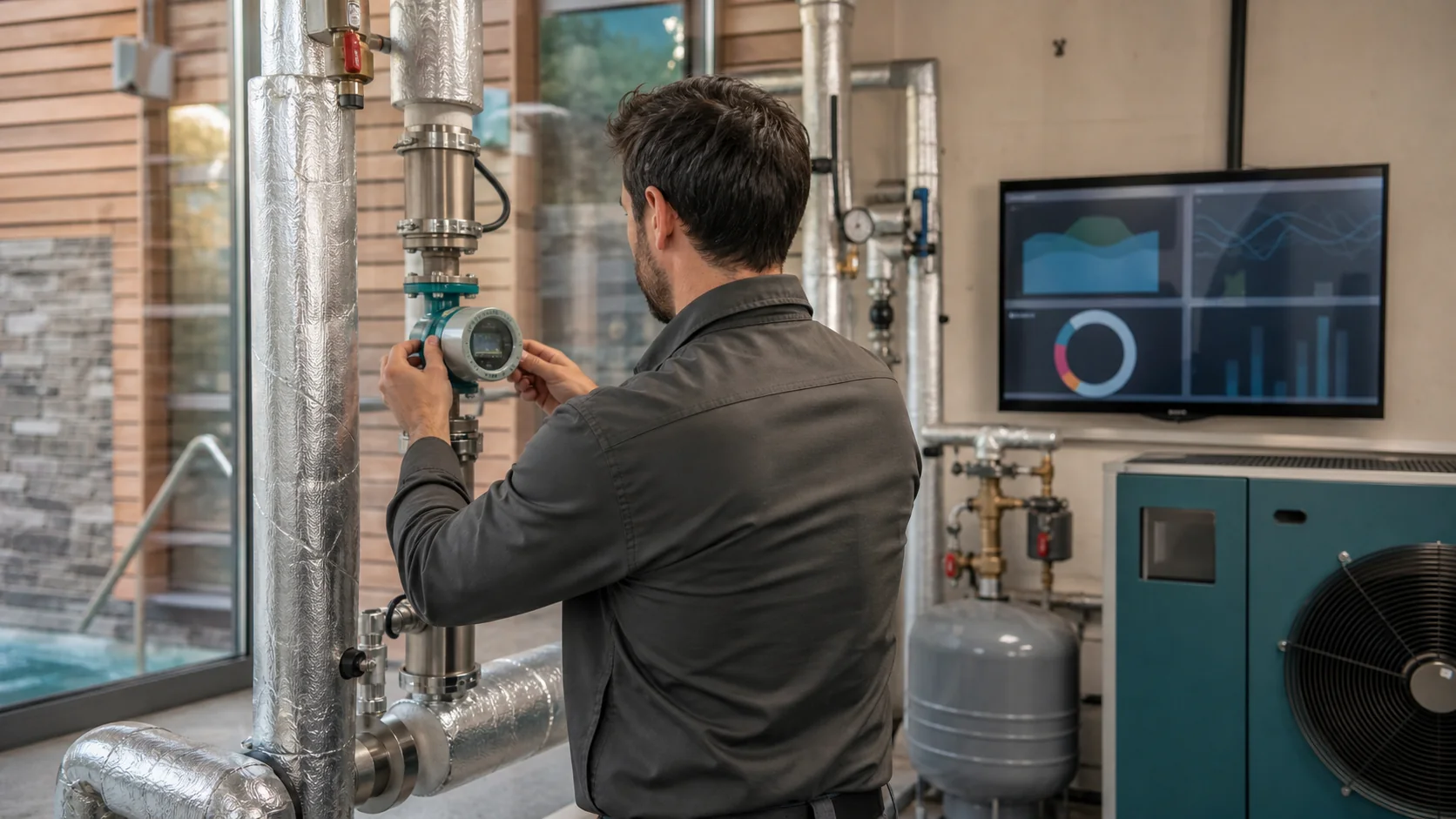
Editorial image note: both photographs in this report are original AI-generated illustrations. They do not depict a named property, institution or person.
Benchmarking requires shared rules
A number feels comparable simply because it uses kilograms of carbon dioxide equivalent. That is not enough. Two spas may include different scopes, use different emission factors, allocate hotel systems differently, measure different visit lengths or treat renewable electricity and outsourced laundry in different ways. Their published totals can look precise while describing different objects.
The GHG Protocol cautions that its Scope 3 Standard is designed primarily to compare one company’s emissions over time, not to rank different companies without additional methodological consistency. Intensity ratios can help, but only when the underlying boundaries and data are aligned. For spas, visit duration and facility type are especially important: a day-long thermal resort and a 60-minute treatment studio should not be placed in a league table without context.
Hospitality already offers a useful precedent. The Hotel Carbon Measurement Initiative provides a common method for calculating a property’s total footprint, carbon per occupied room and carbon per meeting-space hour. It includes on-site energy, purchased electricity, refrigerants and applicable outsourced operations such as laundry. A hotel spa should reconcile its allocation with the property inventory rather than creating a second total that double-counts or omits shared services.
Good benchmarking groups like with like, discloses the method and shows a range rather than pretending there is one universal “good” number. The most defensible first benchmark is internal: this facility, under the same boundary, against its own baseline and reduction target.
What trustworthy guest communication looks like
Most guests do not need to inspect an emissions workbook. They do deserve language that distinguishes measurement, reduction, renewable energy and compensation. “We measured our operational footprint using this boundary and reduced it by this percentage from this baseline” is more useful than “eco-luxury” or “carbon-conscious”.
If a per-visit number is displayed, the property should link to a short methodology note. It should state the reporting period, scopes and material exclusions; explain whether the figure is an average, forecast or visit-specific calculation; identify the main data sources; and show whether independent review has occurred. Uncertainty should be acknowledged, especially for purchased goods and travel.
Offsets and removals must be separate from gross emissions. The Science Based Targets initiative places rapid, deep reductions across direct and value-chain emissions before neutralising residual emissions at net zero. Buying a credit does not make an inefficient thermal system disappear. A spa may finance climate action, but it should report that contribution alongside—not instead of—its own footprint and reductions.
Luxury travellers can ask calm, specific questions: does the sustainability report cover the spa? Are thermal systems separately metered? What changed during the last reporting year? Are outsourced laundry and refrigerants included? Is renewable electricity generated on site, purchased through a contract or represented by certificates? A trained team may not know every figure at reception, but it should know where the verified answer lives.
A practical 90-day blueprint for spa leaders
Days 1–30: define and map
Name an accountable owner and assemble spa operations, engineering, finance and procurement. Define the organisational and visit boundary, list Scope 1, 2 and material Scope 3 sources, and map shared systems. Record current meters, invoices, service logs, occupancy data and supplier information. Do not delay the map because one category is uncertain; mark the gap.
Days 31–60: calculate and challenge
Build a baseline using a documented method and suitable emission factors. Reconcile the spa allocation with the whole property. Separate measured, supplier-specific, modelled and spend-based inputs. Review the result with the people who operate the building: an unexpected hotspot may be a real fault, a poor allocation rule or a data error. All three are worth finding.
Days 61–90: reduce and verify
Select one or two measures with clear operational controls, such as correcting schedules, installing a pool cover, repairing a control sequence or improving laundry allocation. Set the expected effect, implementation owner, safety constraints and verification period. Compare both absolute and per-visit emissions, then document what changed. Only after the result is understood should it become guest communication.
The first cycle should produce a credible baseline, not a perfect sustainability report. Repeatability matters more than spectacle. A simple monthly review of energy, water, refrigerants, waste, occupancy and major procurement changes can build the discipline required for larger capital decisions.
What carbon measurement cannot prove
A carbon figure is not a sustainability certificate. It does not show whether water is sourced responsibly, chemicals are discharged safely, workers are treated fairly, culture is respected, habitats are protected or the guest receives appropriate care. These questions need their own standards and evidence.
Nor does a low per-visit result automatically justify expansion. Total emissions, local resource limits and construction impacts still matter. A highly occupied spa can improve its intensity while increasing absolute energy use. Capital works may reduce operational demand but carry embodied carbon that should be evaluated separately.
Finally, a facility footprint cannot settle the ethics of long-haul wellness travel. Guest transport may sit outside an entry-to-exit calculation while remaining a large part of the trip. Operators should state that exclusion plainly rather than allowing a small on-site number to imply a small holiday footprint.
The World Luxury Spa verdict
Carbon accounting will not make a spa feel luxurious. It can make the operation worthy of the materials, care and restraint that luxury claims to represent. The best use of a per-visit footprint is backstage: locating waste, testing engineering decisions, aligning teams and proving that a beautiful experience is becoming less resource-intensive over time.
The new research is an important beginning, not a universal scorecard. Its case studies show that spa visits can be measured with meaningful temporal detail, while its limitations show why method, data quality and boundaries must travel with the number. The credible property will publish fewer adjectives and better evidence: what it counted, what it changed and what remains unresolved.
Frequently asked questions
What is a carbon footprint per spa visit?
It is an allocation of a spa facility’s greenhouse-gas emissions to an individual visit, usually expressed as kilograms of carbon dioxide equivalent. The meaning depends on the stated boundary, reporting period, data sources, allocation method and visit duration.
Which emissions should a spa include?
A credible inventory should cover material direct fuels and refrigerants, purchased energy and relevant value-chain sources such as laundry, products, waste and staff travel. Guest transport may be excluded from a facility visit metric, but that exclusion must be explicit.
Can travellers compare the carbon figures of two spas?
Only when the facilities use compatible boundaries, scopes, emission factors, allocation rules and intensity units. Visit length and spa type also matter. Comparing a property with its own consistent baseline is usually more reliable than ranking unrelated spas.
Does renewable electricity make a spa carbon-neutral?
No. Renewable electricity can reduce operational emissions, but fuels, refrigerants, purchased goods, laundry, waste, transport and embodied impacts may remain. Carbon-neutral or net-zero claims require a clearly defined scope and credible treatment of residual emissions.
What should a traveller ask about a spa’s sustainability claim?
Ask what the claim covers, which year and baseline it uses, whether the spa is included in property reporting, what absolute reductions have occurred, which sources are excluded and whether offsets or removals are reported separately from gross emissions.
Sources and further reading
- Spa Business: the 31 July 2026 report on a real-time, per-visitor emissions calculator for spa and wellness operations. Read the lead report.
- Communications Sustainability: the peer-reviewed SPA-DEC methodology, two case studies, results and stated limitations. Read the research paper.
- University of Surrey: the official research announcement and summary of the collaboration, case-study facilities and per-visit findings. Read the university release.
- Greenhouse Gas Protocol: the Corporate Value Chain (Scope 3) Standard and guidance on boundaries, categories and responsible comparison. Read the Scope 3 standard.
- World Sustainable Hospitality Alliance: the Hotel Carbon Measurement Initiative for consistent property, occupied-room and meeting-space footprints. Explore HCMI.
- Global Sustainable Tourism Council: hotel criteria covering energy, water and greenhouse-gas measurement and reduction. Read the hotel criteria.
- Science Based Targets initiative: the Corporate Net-Zero Standard’s emphasis on deep value-chain reductions before neutralising residual emissions. Read the net-zero guidance.