The Package Test: How Luxury Spas Can Bundle Without Hiding Value
A well-made spa package can feel like hospitality at its most effortless. The guest chooses a purpose rather than assembling a timetable: perhaps a massage, unhurried access to water and heat, lunch, and enough space between each element to remain calm. The operator coordinates rooms, therapists and facilities behind the scenes. One clear promise replaces a page of disconnected choices.
That ease can also conceal weak value. A package may include a facility the guest assumed was standard, attach a nominal price to an unwanted extra, describe an ordinary component as free, or compress several services into a day that works on a sales screen but not in a human body. Luxury is not the number of inclusions. It is the confidence that every inclusion is wanted, available, honestly priced and delivered at the right pace.
This article sets out a package standard, not another guide to dynamic spa pricing. The question is not whether Tuesday should cost the same as Saturday. It is whether a combined offer makes the experience easier to understand and better to receive without turning complexity into camouflage.
The current signal: packages dominate one large booking dataset
A 19 October 2026 Spa Business report highlights a striking result from software supplier Trybe: 93 per cent of online bookings in its dataset were packages. The underlying 2026 report covers £181 million in operational revenue from more than 400 spa, leisure and activity businesses across the UK, Europe and the United States. Trybe also reported that 76 per cent of bookings were made on phones or tablets and that just over half occurred outside traditional office hours.
Those numbers deserve attention, but not inflation. They describe activity among businesses using one commercial platform; they are not a census of the global spa industry. The sample combines different business types and markets, and the public Spa Business account does not establish that 93 per cent of every spa's revenue, visits or guests came through packages. It reports the share of online bookings within this particular dataset.
The signal is nevertheless useful. It suggests that for many digital customers the package is not a side offer hidden below an à-la-carte menu. It may be the main unit through which a spa is discovered and bought. That changes the editorial and operating responsibility. The package name, image, inclusions, timing, total price and restrictions may carry more weight than any individual treatment description.
It also explains why package design should be treated as product design. A bundle is not simply several existing services joined by a discount. It creates a new promise about sequence, compatibility, time, access and value. If any of those elements is vague, the customer is not buying simplicity; they are accepting uncertainty in a more attractive wrapper.
Why a package can be genuinely luxurious
Luxury guests often pay to remove friction, not to maximise quantity. A traveller arriving after a flight may not want to compare twelve massages, three thermal-access rules, five meal periods and a separate relaxation-room reservation. A thoughtful package can reduce that decision load while protecting a coherent rhythm. It can tell the guest when to arrive, what to bring, how the experience flows and when the formal programme ends.
For the operator, a package can coordinate resources that are otherwise sold in isolation. A treatment room has a particular duration and turnaround need. A therapist has a safe working schedule. A thermal circuit has capacity. A meal has a service window. A relaxation space works only while it remains uncrowded. A package can align those elements before the guest arrives instead of asking reception to improvise them on the day.
It can also make a distinctive experience legible. A hammam sequence, for example, may be easier to understand as one hosted journey than as separate line items for heat, cleansing, exfoliation and rest. A resort may combine a treatment with a garden ritual and lunch because the transitions are part of the experience. In these cases, bundling protects meaning rather than disguising price.
None of this requires the package to be cheaper. Convenience, privacy, reserved capacity and careful hosting can carry value of their own. The mistake is to imply a saving that has not been calculated, or to assume that a higher total automatically signals a more generous experience. The package should be able to explain its value without relying on arithmetic theatre.
Package price and package value are not the same thing
Academic hospitality research helps separate the two. A study of bundled vacation offers found that price was the strongest determinant of choice in its experiment, while showing component prices improved perceptions of fairness and value in some comparisons. This was research on simulated holiday packages, not luxury spa bookings, so it should not be treated as a direct forecast of spa behaviour. It does support a durable principle: opacity is not necessary for bundling to work.
A package may show a single total and still reveal enough for an informed decision. Guests should be able to identify the principal treatment, hands-on duration, facility access, food or retail elements, mandatory charges and material restrictions. If the operator claims that buying the package saves a specific amount, the comparison should use real, current, separately available prices on a like-for-like basis.
United Kingdom pricing guidance offers a current jurisdiction-specific benchmark. The Competition and Markets Authority states that prices presented to consumers must be clear, complete and accurate, including mandatory fees and charges, and addresses both drip pricing and partitioned pricing. This is not universal law and operators must follow the rules in every market where they sell. It is still a useful test for any luxury booking journey: can the guest see the amount they must pay before committing, rather than discovering compulsory costs at the final step?
The same care applies to the word “free”. UK advertising guidance warns that a feature in a package cannot casually be labelled free when its cost has effectively been built into the package or when it has become an ordinary part of the offer. Elsewhere, different rules apply, but the trust question is universal. If thermal access, lunch or a gift is described as complimentary, the operator should be able to explain what that means without moving the cost into another line.
A six-part test for a luxury spa package
1. Legibility: the guest can understand the whole promise
A package card should answer the important questions without requiring a phone call. Name each meaningful component, its duration or access window, and whether it is private, shared, hosted or self-guided. Distinguish hands-on treatment time from consultation, changing and rest. State whether wet facilities are guaranteed, subject to capacity, limited to a slot or unavailable during maintenance.
The itinerary should also show dependencies. If lunch must be taken before 2pm, if a sauna session precedes a body treatment, or if two guests receive treatments one after the other rather than simultaneously, that information changes the experience. A beautiful list of inclusions is not enough when the sequence makes some of them impractical.
Mobile presentation matters because the current platform data indicates that most bookings in its sample were made on phones or tablets. The total price, essential inclusions and key terms should not disappear behind accordions, hover states or a long chain of screens. A guest should be able to save or receive a durable itinerary after purchase.
2. Integrity: the package solves a guest need
Begin with a purpose that a guest can recognise: a quiet half-day after travel, a shared bathing experience, focused bodywork with time to recover, or an accessible introduction for a first-time visitor. Then include only the elements that support it. Adding a low-use extra to increase the item count may raise the apparent value while weakening the actual day.
Choice should survive the bundle. Provide a small number of meaningful substitutions where the operation can support them: a facial instead of bodywork, tea instead of alcohol, a private rest space instead of a group class, or a non-heat alternative where appropriate. Substitution is not always possible, especially when skills and capacity differ, but a clear alternative is better than pretending one itinerary suits every body.
Do not use a package to make medical implications that the individual services could not support. Combining light, heat, massage, supplements and breathwork does not prove a compounded health effect. Describe the hospitality experience—time, comfort, quiet, warmth, movement and skilled care—without suggesting that a larger stack guarantees detoxification, hormonal change, immune support or treatment of a condition.
3. Capacity: every inclusion can be delivered calmly
Cornell hospitality researchers proposed revenue per available treatment hour, or RevPATH, as a way to connect price, treatment duration and capacity in spa revenue management. The paper dates from 2009 and should not be mistaken for a current global benchmark. Its core operational point remains relevant: spa inventory is time, skilled labour and suitable space, not only an appointment count.
A package can look profitable while consuming scarce capacity badly. A long prime-time treatment, unrestricted thermal access and a meal at the busiest service period may create queues or displace higher-value demand. The answer is not automatically to remove the generous elements. It is to model when and how they can be delivered, including room turnaround, breaks, late arrivals, equipment cleaning, facility maintenance and recovery time for staff.
Capacity must be tested across the full journey. Selling forty packages is not a success if the restaurant can seat only twenty guests in the promised window or if the thermal circuit becomes crowded at the same hour. Set package inventory by the tightest shared resource, not by the availability of the booking system's easiest component.
4. Fairness: the value claim can be reproduced
Create a package-value sheet for internal review. List the current public price of every component that is genuinely sold separately, the package price, unavoidable charges, and any element whose stand-alone value is only an internal estimate. Record the date and market. If the advertised saving depends on a price that almost nobody pays or on an item that cannot be purchased separately, the claim is fragile.
Do not assign the highest menu price to every flexible component and then present the maximum theoretical total as the normal alternative. Do not count ordinary robe use, water or changing facilities as premium gifts simply to enlarge the comparison. Where the package premium pays for reserved space, coordination or privacy, say so. Sophisticated travellers can understand value that is not a discount.
Keep the single-service route visible when it genuinely exists. A guest who wants one massage should not have to buy lunch, retail products or facility access to obtain it unless the spa has deliberately chosen a package-only model and explains that before the customer invests time in booking.
5. Terms: cancellation, expiry and change are visible before payment
Packages concentrate risk because one booking reserves several resources. The operator therefore needs a clear policy for late arrival, partial use, rescheduling, substitution, facility closure and the cancellation of one component. If a steam room closes unexpectedly, does the guest receive an alternative, a partial refund, credit or the right to move the entire visit? The answer should not depend on who happens to be at reception.
Consumer rights vary by jurisdiction and booking type. UK government guidance, for example, notes an exemption from certain cancellation rights for leisure services tied to a specific date or period because the provider may have reserved capacity that is hard to resell. That does not mean every spa booking everywhere is non-refundable, nor does it remove the need to disclose the agreed policy. Travellers should read the terms that apply to the seller, location and exact service.
Gift vouchers and open-dated packages need equally careful language: expiry, blackout dates, top-up rules, price changes, transferability and what happens when a component is discontinued. A luxury promise should not decay into a negotiation when the guest finally tries to use it.
6. Evidence: success is measured beyond the checkout
Package sales alone reveal little. Track completed visits, no-shows, reschedules, component substitutions, unused inclusions, thermal-capacity refusals, treatment overruns, staff breaks, complaints, refunds and repeat choice. Compare contribution after food, products, commissions and labour rather than celebrating gross package value. Review which elements guests praise and which they consistently leave unused.
Measure clarity as well as revenue. Count pre-arrival questions that should have been answered on the page, discrepancies between confirmation and delivery, and complaints about inclusions or total price. If the same misunderstanding appears repeatedly, it is a product defect, not a difficult guest.
Use proportionate data. A spa can learn whether a guest understood the itinerary and found the pace comfortable without collecting diagnoses or making clinical assessments. Where a service requires health screening, gather only what is necessary, protect it appropriately and separate safety from marketing personalisation.

The traveller's package checklist
The most useful questions are concrete. Ask for the treatment name and hands-on duration, not only the total visit length. Confirm which facilities are included, whether access is timed and whether anything must be booked separately. For two people, confirm whether treatments are simultaneous and whether shared spaces are mixed, private or separated by local custom or operating policy.
Request the complete price and identify optional additions. If a saving is central to the offer, compare the same components at current individual prices. If value comes from privacy, hosting or reserved capacity, decide whether that matters to this particular visit. A package can be worthwhile without being the cheapest route.
Read the pace. Three treatments in four hours may sound abundant but leave little time for consultation, changing, hydration or rest. Heat, cold, vigorous bodywork and alcohol do not become suitable for everyone simply because they appear in a curated sequence. Tell the spa about relevant needs through its proper consultation process, and choose a simpler alternative when the itinerary feels excessive.
Finally, verify the terms for lateness, cancellation, illness, facility closure and partial availability. A high-quality operator will not treat these questions as unromantic. Clarity before payment is part of care.
What operators should put on the booking page
- Purpose: one sentence explaining who the package is for and the experience it is designed to create.
- Components: every material treatment, facility, meal, product and hosted element.
- Time: hands-on duration, total visit estimate, arrival requirement and any fixed service windows.
- Access: reservation, age, privacy, capacity and accessibility conditions for shared facilities.
- Choice: available substitutions, supplements and elements that cannot be changed.
- Price: the complete payable amount, mandatory charges and a reproducible basis for any saving.
- Terms: cancellation, lateness, expiry, rescheduling and the response to unavailable components.
- Boundaries: proportionate health cautions and descriptions that do not overstate wellbeing outcomes.
This information should be consistent across the website, confirmation, call centre, hotel concierge and reception desk. A package stops being simple when each channel tells a different story. The pre-booking evidence principles in our analysis of wellness as a hotel choice factor apply here too: what attracts the booking must remain available and recognisable when the guest arrives.
The World Luxury Spa verdict
The rise of package booking is not evidence that guests want more of everything. It may be evidence that they want fewer decisions and a clearer path through a complex spa. The best bundle performs that editorial work honestly. It selects, sequences and protects a small number of compatible elements, then tells the guest exactly what the promise costs.
Operators should resist two temptations: using a package to hide weak individual value and using a long inclusion list as a substitute for service design. Travellers should resist equating the biggest nominal saving with the best day. In luxury wellness, value is not what can be squeezed into an itinerary. It is how little uncertainty remains once the booking is made.
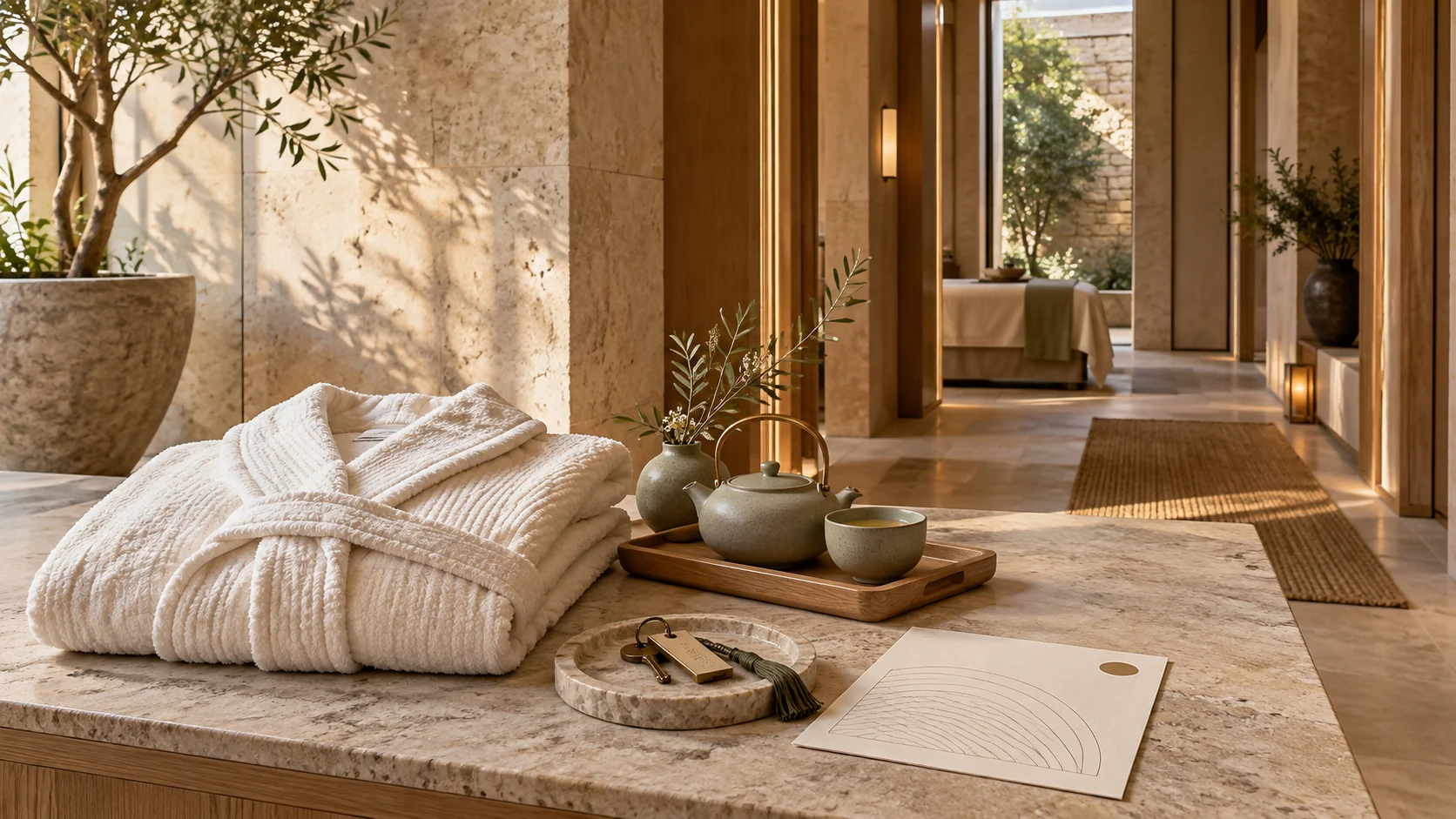
Visual note: both photographs in this article are original AI-generated editorial illustrations. They depict fictional settings and people and do not represent a named spa, hotel, institution, brand or destination.
Frequently asked questions
Are luxury spa packages always cheaper than booking separately?
No. A package may offer a genuine saving, but it may instead charge for convenience, privacy, hosting or reserved capacity. Compare current like-for-like component prices when a saving is claimed, and decide whether every included element has value for your visit.
What should a spa package show before payment?
It should show the total payable price, principal components, hands-on treatment time, total visit estimate, facility access, important service windows, material restrictions, substitution options and cancellation or rescheduling terms. Mandatory charges should not appear only at the final step.
How should a spa measure package performance?
Track completed visits, contribution after direct costs, treatment-hour and shared-facility capacity, unused components, substitutions, reschedules, refunds, complaints, staff breaks and repeat choice. Sales value alone cannot show whether the package was clear, deliverable or worth repeating.
Can I swap an element in a spa package?
Only if the operator offers a substitution and has the skills, time and facilities to deliver it. Ask before paying. A good package states which elements are flexible, which alternatives carry a supplement and which parts are fixed because they define the experience.
Do online spa packages always have a 14-day cancellation period?
No. Consumer rights depend on jurisdiction, seller, service and whether capacity is reserved for a specific date or period. Some dated leisure services may be exempt from cooling-off rules. Read the applicable terms before payment and seek local advice for a dispute.
Sources and further reading
- Spa Business: the 19 October 2026 lead report on package share, booking devices, timing and RevPATH benchmarks within Trybe's platform dataset, including its methodology caveat. Read the lead report.
- Cornell University eCommons: Sheryl E. Kimes and Sonee Singh's spa revenue-management framework, including revenue per available treatment hour. Read the research record.
- Journal of Hospitality & Tourism Research: Sarah Tanford, Mehmet Erdem and Seyhmus Baloglu's study of price transparency and consumer evaluation in bundled vacation offers. Read the abstract and study record.
- UK Competition and Markets Authority: current price-transparency guidance on total prices, mandatory charges, drip pricing and partitioned pricing. Read the guidance.
- Advertising Standards Authority and Committee of Advertising Practice: UK guidance on “free” claims and package offers. Read the guidance.
- UK Department for Business: implementing guidance on consumer-contract information and cancellation, including the specific-date leisure-services exemption. Read the guidance.