Before the Marble: How to Test a Luxury Wellness Concept Before You Build
Wellness projects are unusually easy to fall in love with. A mineral pool catches the light. A treatment suite promises privacy. A menu combines ancient practice, new diagnostics, sleep, movement and nutrition in a language that appears both timeless and current. By the time the renderings arrive, the concept can feel inevitable.
That is precisely when discipline matters. A beautiful idea is not yet a viable operation, and a fast-growing market is not proof that a particular facility, in a particular place, can earn trust, attract the right demand, recruit the right team and cover its full cost. The most luxurious decision may be to simplify, phase, relocate or stop before irreversible capital is committed.
This is a pre-design test, not another pricing guide. It complements our analysis of dynamic spa pricing and the work-design obligations in our staff wellbeing standard. Here, the question comes earlier: what evidence should exist before a wellness concept earns the right to be built?

The current signal: wellness needs a business case, not only a story
A current Spa Business feature asks operators, consultants and investors what turns a wellness idea into a durable commercial proposition. Across different viewpoints, a common pattern emerges: define the need before the design, understand the complete operating model, test long-term relevance, involve the people who will deliver the service and measure value beyond treatment revenue alone.
The feature is expert opinion, not a universal formula or an audited sample of project outcomes. Its contributors work in and around the sector, so their perspectives should be read as informed practice rather than neutral proof that a given concept will succeed. Its editorial value lies in naming a familiar risk: wellness can be treated as an aesthetic layer when it actually requires capital, systems, specialist labour, maintenance, governance and a credible route from promise to repeatable service.
Growth can intensify that risk. The Global Wellness Institute estimates that 201,861 spas generated US$157.4 billion worldwide in 2024, up 14.6 per cent from 2023. It also estimates that hotel and resort spas were the largest spa category by revenue, at US$78.85 billion. These are market estimates, not a forecast for an individual development. The report cautions that part of the recent increase reflects better data availability and more hotel and resort listings identifying spa facilities on booking platforms, rather than new construction alone.
The US picture is also positive but more measured. The International Spa Association's 2026 headline statistics, commissioned from PwC, put 2025 US spa revenue at US$23.5 billion, visits at 191 million and locations at 22,060. Revenue rose 4.2 per cent while locations rose 0.4 per cent. Those figures describe an established national market. They do not reveal whether a new urban bathhouse, resort spa or longevity club has the right catchment, service mix or cost base.
Market momentum is context, not permission
A large market can support good investment and still produce poor projects. Sector growth may attract more capable operators, but it also invites imitation, crowded positioning and cost assumptions borrowed from businesses with different labour markets, climates and guest patterns. A concept should therefore begin with a falsifiable proposition: who needs this offer, why here, why this format, and what evidence would show that the answer is no?
Aggregate revenue is especially easy to misuse. It combines countries, currencies and multiple spa categories. A day spa with a local membership base does not face the same demand rhythm as a destination retreat; a thermal complex carries different engineering and maintenance obligations from a treatment-led hotel spa. Even the same concept can behave differently in a dense capital city, a seasonal resort and an isolated nature destination.
Benchmarks are useful when their definitions match. Compare treatment-room utilisation only with businesses that count available hours in a similar way. Compare payroll only after checking which benefits, taxes, contracted practitioners and management costs are included. Compare average spend only after separating resident guests, local members, day visitors, retail and bundled packages. A number without its denominator, time period and operating boundary can make a weak model look precise.
Early research should also search for inconvenience, not merely enthusiasm. Interview people who chose a competitor, stopped visiting spas, rejected a membership or found a concept confusing. Observe travel time, booking lead time, cancellation, seasonality, accessibility and what customers already substitute for the proposed service. Positive reactions to a mood board are weak evidence of willingness to pay repeatedly.
A five-case feasibility test for luxury wellness
HM Treasury's 2026 Green Book is written for public spending, not private spa investment, and it should not be presented as hospitality law or a mandatory template for commercial operators. Its Five Case Model nevertheless offers a useful discipline: examine a proposal from strategic, economic, commercial, financial and management perspectives rather than allowing a single persuasive forecast to carry the decision.
1. The strategic case: define the problem before the treatment menu
The strategic case asks what should change and why this concept is a proportionate response. “Wellness is growing” is not a problem statement. A stronger proposition might be that a resort has high shoulder-season occupancy but low daytime engagement; that a city catchment lacks a quiet, accessible bathing offer; or that existing hotel guests repeatedly leave the property for services the hotel could deliver credibly.
Write the target guest narrowly enough to make decisions. “Affluent wellness traveller” is too broad. Trip purpose, residence, available time, prior experience, accessibility needs, party composition, booking channel and frequency all affect the model. A traveller seeking one restorative afternoon behaves differently from a resident considering a twelve-month membership. The concept may serve both, but not with identical hours, pricing, circulation and acquisition costs.
Define outcomes without making medical promises. A hospitality spa can aim for reliable service, calm, privacy, repeat visitation, local relevance and an experience guests judge worth the time and price. If the offer crosses into diagnosis, regulated treatment or clinical monitoring, the strategic case must name the accountable healthcare model, jurisdiction and evidence standard. Medical language cannot be added late as a positioning device.
Finally, test strategic fit with place. Climate, water, energy, transport, culture, existing skills, housing pressure and local use patterns are not background. They shape what can be operated responsibly. A copied concept may photograph consistently across markets while behaving irrationally in each one.
2. The economic case: compare real alternatives
The economic case should prevent the proposed concept from competing only with a blank page. Compare a full build with smaller and phased options: renovating existing rooms, partnering with a qualified local provider, launching a limited programme, building a prototype, or improving sleep, landscape and movement across the hotel before adding a major wet area. Include the option to do nothing now and collect better evidence.
Assess benefits and harms across the guest, operator, workforce, owner and place. A hydrothermal circuit may increase dwell time and room appeal, but it also creates water, energy, ventilation, cleaning, supervision and renewal obligations. A highly personalised programme may support a higher price while reducing throughput and increasing dependence on scarce specialists. The best option is not automatically the one with the most features.
Demand research needs more than a top-line survey. Use relevant booking data, rejected enquiries, competitor observation, local demographics, origin markets, seasonality, price testing and small paid pilots. Stated interest should be separated from observed behaviour. Where historical data is weak, present a range rather than a false point estimate, and record which assumption would most change the decision.
Options should be compared on consistent boundaries and over a realistic period. If one option includes plant replacement, staff development and marketing while another counts only construction, the appraisal is theatre. Include disruption during works, ramp-up, maintenance cycles and the residual value or removal cost of specialised equipment.
3. The commercial case: prove the service can be bought and delivered
The commercial case examines the market around the concept: suppliers, partners, contracts, licences, insurance, data systems, practitioner availability and the bargaining power created by proprietary equipment or consumables. A feature is commercially fragile if one vendor, one charismatic expert or one imported product is the only route to delivery.
Map every promised service to a qualified role, room, equipment set, preparation task, cleaning standard, booking rule and escalation route. Include the work guests do not see: laundry, stock, calibration, water treatment, records, maintenance, consent, waste and response to contraindications or equipment failure. If the concept cannot be translated into an ordinary Tuesday roster, it is not yet an operating model.
Workforce supply should be tested before the opening date is announced. Count locally available qualifications, language needs, visa or mobility constraints, training time, pay expectations, management depth and the physical load of the menu. Contractors may add flexibility but do not erase responsibilities for guest safety, scope, privacy and consistent service. A labour model that works only at perfect occupancy is not resilient.
Contracts should preserve exits and substitution. Review service levels, data ownership, interoperability, maintenance response, consumable pricing, warranty, training, change control and what happens if the vendor withdraws. “Exclusive” can mean distinctive; it can also mean locked in.
4. The financial case: model cash, not atmosphere
The financial case asks whether the preferred option is affordable and sustainable for the actual investor. Construction is only the visible beginning. Include design and professional fees, approvals, finance, pre-opening recruitment, training, uniforms, software, insurance, opening stock, launch marketing, energy, water, laundry, maintenance, calibration, replacement reserves, management time and the working capital needed while demand builds.
Revenue should be built from capacity and behaviour, not from the desired return. Model available treatment hours, bookable wet-area capacity, realistic opening days, service duration, reset time, no-shows, maintenance closure, guest mix, achieved price, discounts, packages and staff availability. A ten-room spa does not have ten rooms of saleable capacity when the team, turnaround or demand supports six.
Cornell's spa revenue-management research popularised revenue per available treatment-hour, or RevPATH, as a way to consider utilisation and average treatment spend together. It remains a useful operating measure, but it is not profit, cash flow, worker wellbeing or guest outcome. A concept can improve RevPATH while increasing labour strain, utilities, commissions or maintenance faster than revenue.
Build at least downside, base and upside cases, with assumptions that can be traced to evidence. Stress the variables that matter most: opening delay, lower local membership, slower hotel ramp-up, specialist vacancies, energy prices, foreign exchange, maintenance downtime and a weaker shoulder season. Show the month of maximum cash exposure, not only the year in which a spreadsheet eventually turns positive.
Funding should match the concept's learning curve. If every pound or dollar is committed to the final design before a pilot, the project has no affordable way to change its mind. Stage capital around evidence: concept validation, prototype, limited opening, performance review and expansion. A deliberate pause is a financial control, not an admission of failure.
5. The management case: show who can make it real
The management case addresses delivery, governance and evaluation. Name the accountable owner for guest experience, clinical boundaries where relevant, operations, people, finance, engineering, sustainability, data and safety. Define which decisions remain open, who can stop the project and what evidence is required at each gate.
Bring operators, therapists, attendants, housekeeping, engineering, security, accessibility expertise and front office into design reviews. Their questions often reveal the costly gap between a beautiful plan and a workable day: where used linen crosses the guest route, whether a trolley turns, who observes a pool, how a practitioner summons help and how a mobility device reaches the treatment room.
Create a benefits and measurement plan before opening. Decide what success means at three, six, twelve and twenty-four months; establish baselines where possible; and separate leading indicators from outcomes. Enquiries, trial conversion and training completion may signal progress. Repeat visits, contribution, staff retention, incidents, downtime and guest-reported value say more about durability.
Governance should include closure and change. A service that cannot meet its evidence, safety, staffing or financial threshold should be adapted or withdrawn without protecting it for prestige. Luxury is not the refusal to edit. It is the ability to protect quality from sunk-cost pride.
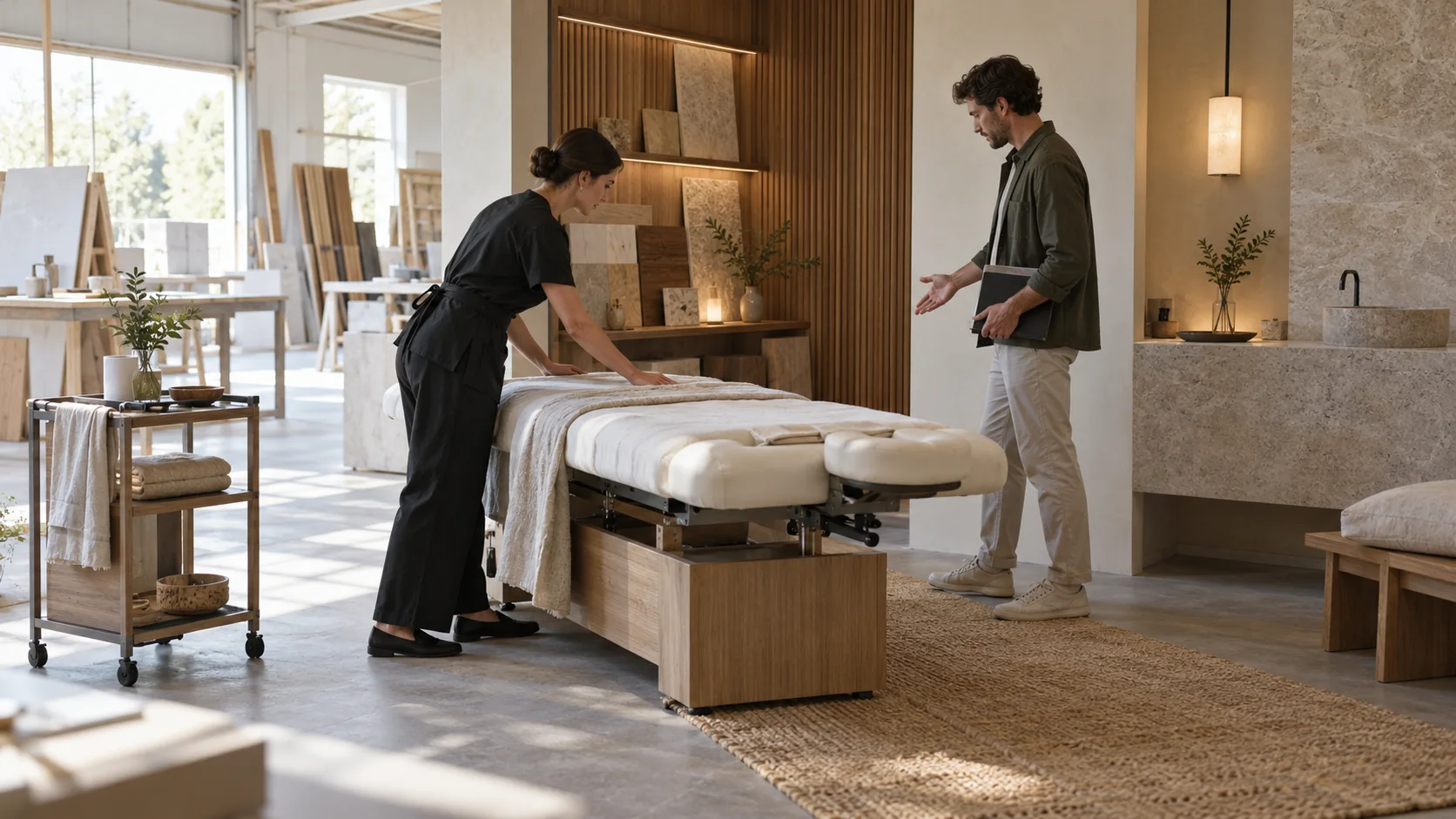
Prototype the work before polishing the story
A full-scale mock room can answer questions a rendering cannot. Put in the actual table, stool, trolley, linen, lighting controls and door swing. Ask different practitioners to set up, deliver a simulated service without a guest, clear down and reset. Test privacy, sound, reach, cleaning, accessibility, emergency access and the route to laundry and storage. Time the complete cycle, not just the treatment.
Prototype the booking and arrival journey too. Can a guest understand what is included, choose appropriately and disclose relevant constraints without being asked for unnecessary health data? Can reception explain a delay, a contraindication or a sold-out facility without improvising? Can the system distinguish hotel guests, day visitors and members without creating two classes of courtesy?
A pilot should use real prices and real operational limits where lawful and safe. Free trials produce goodwill but weak evidence of repeatable demand. A limited paid programme, temporary room or partner delivery can reveal acquisition cost, conversion, timing, service recovery and whether people return when novelty fades. The pilot should be small enough to change and complete enough to expose the actual work.
Record what failed without treating failure as disloyalty. If guests love the idea but resist the duration, if therapists need longer reset time, or if a signature device creates repeated downtime, that is valuable pre-capital evidence. Change the concept while change is still inexpensive.
The decision dashboard: measures that can challenge the project
A feasibility dashboard should not be designed to make approval inevitable. Pair market indicators with delivery constraints: qualified applicants per role, training time, energy and water intensity, plant redundancy, maintenance response, accessible capacity, peak and off-peak demand, conversion at tested prices, contribution by service, cash runway, guest recovery events and staff feedback from the prototype.
Distinguish facility economics from whole-property value. A hotel spa may influence room choice, length of stay, resident engagement or brand positioning even when the spa department alone does not show the entire return. Those effects should be measured rather than assumed. Use booking questions, controlled offers, guest behaviour and comparable periods where possible, and avoid attributing every change in room revenue to the spa.
Set thresholds before reviewing results. Examples might include minimum paid conversion, maximum acceptable staff travel time, required maintenance coverage, an accessibility condition that cannot be traded away, or a downside cash requirement the owner will not exceed. Pre-agreed thresholds reduce the temptation to reinterpret weak evidence after money and reputation have become attached.
The output should be a decision, not merely a deck: proceed, proceed with conditions, pilot again, redesign, phase, partner or stop. Each condition needs an owner, date and evidence source. Ambiguity is expensive once construction begins.
What sophisticated travellers should notice
Travellers rarely see a feasibility study, but they experience its omissions. Confusing inclusions, beautiful facilities that are always full, a signature service available only on certain days, rushed consultations, inaccessible circulation and unexplained maintenance closures are often symptoms of a concept designed around the image rather than the operating day.
Before booking, look for specificity: facility hours, access rules, reservation requirements, practitioner roles, service duration, age and accessibility information, cancellation terms and the difference between wellbeing hospitality and regulated healthcare. Precision does not diminish romance. It protects the time and trust on which luxury depends.
A smaller offer can be the more serious one. One excellent circuit, a coherent treatment menu and enough skilled people may create more value than a catalogue of fashionable modalities. The traveller's test is not how many concepts appear in the brochure, but how reliably the promises become an unhurried, safe and intelligible experience.
Red flags before capital approval
- The target guest is defined only by wealth or a generic interest in wellness.
- The forecast begins with sector growth and works backwards to the required revenue.
- Demand evidence comes mainly from complimentary trials, social engagement or supplier presentations.
- The design is fixed before staffing, cleaning, maintenance, accessibility and service recovery are mapped.
- Clinical language appears without an accountable licensed model and jurisdiction-specific review.
- A single personality, vendor or imported consumable is essential and has no viable substitute.
- The base case assumes near-perfect opening, occupancy, recruitment and equipment availability.
- Payroll counts treatment time but not preparation, consultation, reset, records, training and breaks.
- Whole-hotel or brand benefits are claimed without a measurement plan.
- No named decision-maker has authority to phase, simplify or stop the project.
The World Luxury Spa verdict
The wellness economy is large and growing, but growth rewards discernment as well as ambition. Market momentum cannot choose a location, recruit a therapist, clean a wet area, maintain a device or make a guest return. Those outcomes belong to the specific operating system behind the concept.
A credible project earns its design through five connected cases. It solves a defined need; compares real alternatives; can secure the people, partners and permissions it requires; remains affordable under plausible pressure; and has accountable leadership capable of learning after approval. None of these cases should dominate the others. Strong demand with weak delivery is fragile. Beautiful delivery with no repeatable demand is expensive theatre.
The wisest sequence is evidence, prototype, decision and then permanence. Marble can wait. Once the concept has survived difficult questions, realistic scenarios and the ordinary work of a full day, beauty stops being camouflage and becomes what luxury design should be: a precise expression of something that can last.
Visual note: both photographs in this article are original AI-generated editorial illustrations. They depict fictional adults, interiors and projects and do not represent a named spa, hotel, institution, employee or development.
Frequently asked questions
What is a wellness concept feasibility study?
It is a structured test of whether a proposed spa or wellness offer solves a defined need and can be delivered, staffed, funded and sustained in its intended location. It should compare alternatives, document assumptions, model downside scenarios and produce a decision—not simply justify a concept that has already been chosen.
Does a growing wellness market prove that a new spa will succeed?
No. Global and national growth data describe broad sectors, not the demand, competition, costs or workforce available to one project. A development still needs place-specific evidence, tested prices, realistic capacity, a full cost model and a clear reason guests will choose and repeat the offer.
Which numbers matter most before building a luxury spa?
Useful measures include paid conversion at tested prices, realistic available treatment hours, achieved spend, contribution by service, staffing and training requirements, maintenance downtime, energy and water demand, acquisition cost, seasonality, working-capital need and downside cash exposure. No single utilisation or revenue metric is sufficient.
Should a hotel spa be judged only on its department profit?
No. A spa may also influence room choice, length of stay, guest spend, resident use and repeat visitation. Those wider effects can matter, but they should be measured and not assumed. Operators should show both the spa's direct economics and credible evidence of its contribution to the whole property.
When should an owner stop or simplify a wellness project?
Pause, phase or redesign when core assumptions fail: insufficient paid demand, unavailable qualified staff, unresolved safety or licensing issues, unaffordable downside cash needs, excessive resource use, fragile supplier dependence or an operating prototype that cannot deliver the promise calmly and consistently. Stopping before irreversible capital is spent is a successful control.
Sources and further reading
- Spa Business: Ask an Expert — commercial success — the current editorial lead on strategy, operating depth, metrics and long-term viability.
- Global Wellness Institute: Global Wellness Economy Monitor 2025 — global spa-establishment, revenue, category and methodology data; PDF.
- International Spa Association: 2026 US Spa Industry “Big Five” — headline US revenue, visit, location, spend and employment indicators.
- HM Treasury: The Green Book 2026 — official appraisal guidance on objectives, options, costs, benefits, risk and evaluation.
- HM Treasury: Guidance on developing business cases — the Five Case Model and staged business-case process.
- Cornell Hospitality Quarterly: Spa Revenue Management — repository record and abstract for the capacity, average spend and RevPATH framework.
- Research in Hospitality Management: Can a luxury hotel compete without a spa facility? — interview-based research on the contingent role and economics of hotel spas; PDF.