From Trend to Statute: What South Korea’s Healing Tourism Law Changes
Wellness tourism is usually governed indirectly. Hotels follow hospitality rules, hot springs follow water and facility rules, health professionals follow clinical regulation, and marketing claims sit under consumer law. South Korea has taken a different step: it has created a national legal framework that recognises healing tourism as an industry in its own right.
The move matters well beyond one destination list. It turns a loose promise of restoration into a field with definitions, registration, workforce development, research, certification and regional planning. For spa leaders, it offers a case study in how government can make a fragmented sector more legible. For travellers, it raises a more exacting question: when a programme is described as “healing”, what has actually been checked?
This is not a story about a law proving that a forest walk, hot spring or meditation session treats illness. It is about building public systems around experiences that may support wellbeing. That distinction should sit beside both Thailand’s wellness-economy ambition and our standard for trustworthy wellness claims: recognition can improve accountability, but it does not convert atmosphere into evidence.
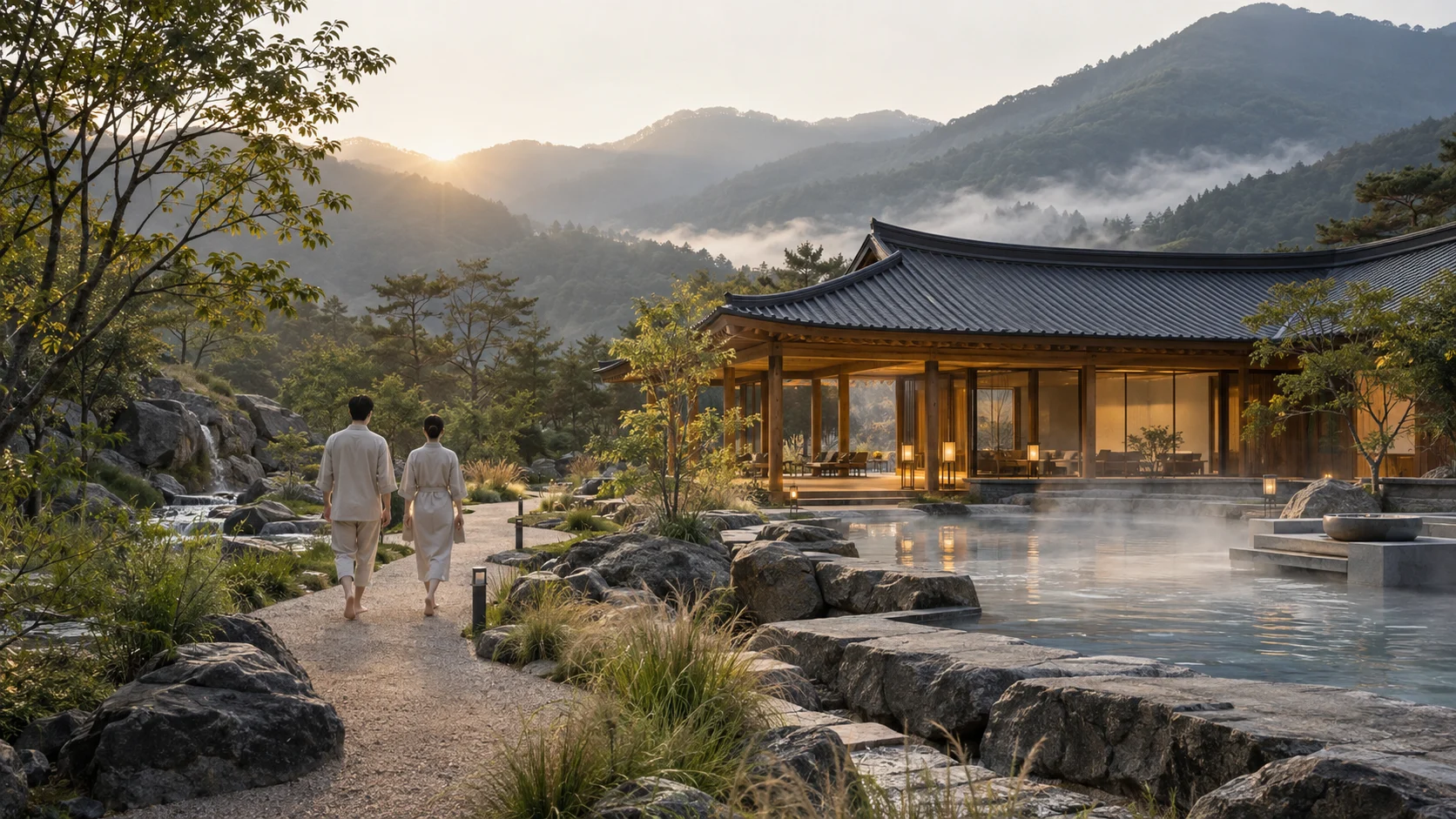
The signal: wellness tourism has entered statute
Spa Business reported on 22 September 2026 that South Korea had put wellness tourism on a statutory footing. The official record is more precise. The Act on the Promotion of the Healing Tourism Industry was enacted in April 2025 and came into effect on 9 April 2026. Its subordinate regulations followed on 21 April. The Ministry of Culture, Sports and Tourism, or MCST, has said that implementation will include a master plan, operator registration, professional training, industry surveys and designated healing-tourism districts.
The timing is significant because Korea was not starting from zero. MCST and the Korea Tourism Organization have selected “Excellent Wellness Tourism Destinations” since 2017. In June 2026 the ministry announced additional international-visitor support for 20 places chosen from an existing portfolio of 88. That programme is promotional and developmental; the Act is the deeper institutional layer. It creates the vocabulary and mechanisms through which a national wellness-tourism sector can be planned, counted and supervised.
The OECD’s 2026 tourism policy review describes the law as part of a broader effort to create regional destinations and an industrial foundation. It highlights collaboration, business registration, surveys, statistics, specialised personnel and healing-tourism zones. Those are not the glamorous parts of wellness travel. They are the infrastructure that determines whether a promise remains a campaign or becomes an accountable service category.
What the law actually puts inside “healing tourism”
The Korean statute defines healing tourism around the use of resources to support recovery and health and to pursue quality of life. The implementing decree identifies landscapes, hot springs, food and barefoot walking trails, then broadens the resource set to crafts, meditation, dance, art, music and sport. That range is revealing. It places spa and thermal experiences within a wider ecosystem of nature, culture, movement and hospitality rather than treating wellness tourism as a collection of treatment rooms.
There is an opportunity in that breadth. A destination can design a coherent journey linking landscape, local food, quiet movement, bathing, craft and rest. It can support small providers rather than concentrating all value in one resort. It can also offer travellers several levels of participation instead of forcing every guest into an intensive retreat schedule.
There is a risk too. A category that wide can become a marketing umbrella under which almost any pleasant activity is called healing. The answer is not to reduce wellness to clinical intervention. It is to describe each element accurately. A garden walk can offer sensory pleasure and time outdoors. A tea practice can communicate culture and attention. A hot spring can provide bathing and rest. Any specific claim about treating disease, changing biomarkers or producing a durable psychological outcome needs its own evidence and, where relevant, properly authorised healthcare oversight.
Six systems behind the new category
1. A five-year direction and annual implementation
The Act provides for a national master plan every five years and annual implementation plans. This matters because a destination strategy should connect funding, workforce, access, infrastructure, data and local development. A one-off campaign can fill a calendar; a planning cycle can identify whether the underlying visitor experience is becoming safer, more inclusive and more useful to the region.
2. Registration of healing-tourism businesses
The implementing rules require an applicant to submit a business plan that includes the operating plan for its healing-tourism programme, along with evidence concerning relevant training and, where applicable, tourism-business or facility status. The decree distinguishes programme-led businesses from businesses that provide facilities. Its official summary says the former must operate at least one programme on an ongoing basis and the latter at least two, alongside other requirements.
3. Certification of excellent facilities
The framework also provides for certification of excellent healing-tourism facilities. Registration and certification should not be collapsed into one badge. Registration establishes that a business has met the applicable entry conditions. Certification is a separate quality signal with its own procedure. Neither should be presented as a government guarantee of every health claim, every practitioner or every future guest outcome.
4. Professional workforce development
The law and regulations provide for specialist training and designated training institutions. That is potentially more important than any destination campaign. A beautiful programme still depends on people who can explain its purpose, understand scope, welcome different bodies, recognise risk, refer appropriately and deliver the same standard on a busy day as on a press visit.
5. Research, information and statistics
The framework includes surveys, statistics and a comprehensive information system. Better category data can reveal where demand, jobs and investment are growing. It can also expose weak assumptions. Counts of registered businesses, visits or spending should not be mistaken for measures of safety, accessibility, cultural benefit or wellbeing. A mature information system needs both scale indicators and quality indicators.
6. Regional healing-tourism districts
Designated districts create the possibility of planning wellness tourism at destination scale. That can connect transport, trails, bathing facilities, accommodation, public space, training and local enterprise. It can also produce a branded zone with little coordination. The difference will be visible in governance: who helps set priorities, who receives the economic value, how environmental limits are managed and whether residents gain useful amenities rather than only visitor-facing infrastructure.
Registration is a floor, not a verdict
Regulation often becomes confusing at the guest-facing level. A logo appears on a booking page, and several different ideas merge: the business is legal, the facility is safe, the programme is effective, the practitioner is qualified, and the experience is suitable for this particular guest. Those propositions require different evidence.
A responsible operator should identify the exact status it holds, the authority behind it and the scope of that status. If it is a registered healing-tourism business, say so. If a facility has a separate excellence certification, name it accurately. If a clinician provides a regulated service, disclose the person’s professional role and responsibility. If the property has only been selected for marketing support, do not imply that the selection is clinical approval.
This clarity protects good operators as much as guests. It prevents careful, qualified programmes from being grouped with vague “healing” packages that borrow official language without meeting the same requirements. It also lets luxury emerge where it should: in thoughtful delivery, privacy, access, calm transitions, skilled hosting and honest boundaries.
The most important boundary: wellbeing is not diagnosis
The English word healing can carry a stronger medical suggestion than a destination intends. Travellers may read it as recovery from illness, while an operator may mean rest, reconnection or support for general wellbeing. Translation makes exact service descriptions essential.
A programme should separate hospitality and spa components from regulated healthcare. If the itinerary includes meditation, bathing, walking, food education and massage, each can be explained on its own terms. If it adds diagnostic tests, treatment of a condition, prescription decisions or clinical monitoring, the responsible licensed provider and the applicable healthcare framework should be explicit. A national tourism registration does not replace professional licensing or informed medical consent.
The same discipline applies to outcomes. Guest satisfaction, feeling calmer after a session and enjoying better sleep during a quiet holiday are meaningful experiences. They are not automatically proof of lasting therapeutic benefit. Operators should avoid cure, detoxification and guaranteed-recovery language, and they should not turn the statutory purpose of a law into evidence for a specific commercial programme.
What sophisticated travellers may gain
A clearer identity for the operator
Registration can make it easier to distinguish an accountable programme business from an informal collection of activities. Travellers should be able to find the registered entity, facility address, contact point and the nature of the programme before paying. This is especially valuable when several hotels, guides, bathhouses and cultural venues are assembled into one itinerary.
More legible programmes
The application process requires an operating plan. The guest-facing expression should be equally clear: what happens, who leads it, how long it lasts, how strenuous it is, which elements are optional, what is included in the price and what happens if weather or health changes the plan. A premium itinerary should reduce uncertainty rather than use mystery as a luxury device.
Better workforce signals
Training requirements can improve consistency, but the label “trained” still needs detail. A guest may need a licensed massage therapist, a movement professional, a cultural facilitator, a medical practitioner or simply a skilled host. One credential cannot cover all roles. Ask who is delivering the exact service and which competence is relevant.
Stronger regional journeys
If districts are planned well, travellers could experience a destination as a connected whole instead of moving between isolated premium compounds. Clear transport, accessible public routes, resident-run businesses, local food, nature stewardship and transparent booking can make a region feel coherent. That is a more durable form of luxury than adding another branded treatment to a resort menu.
Accessibility should be part of the operating standard
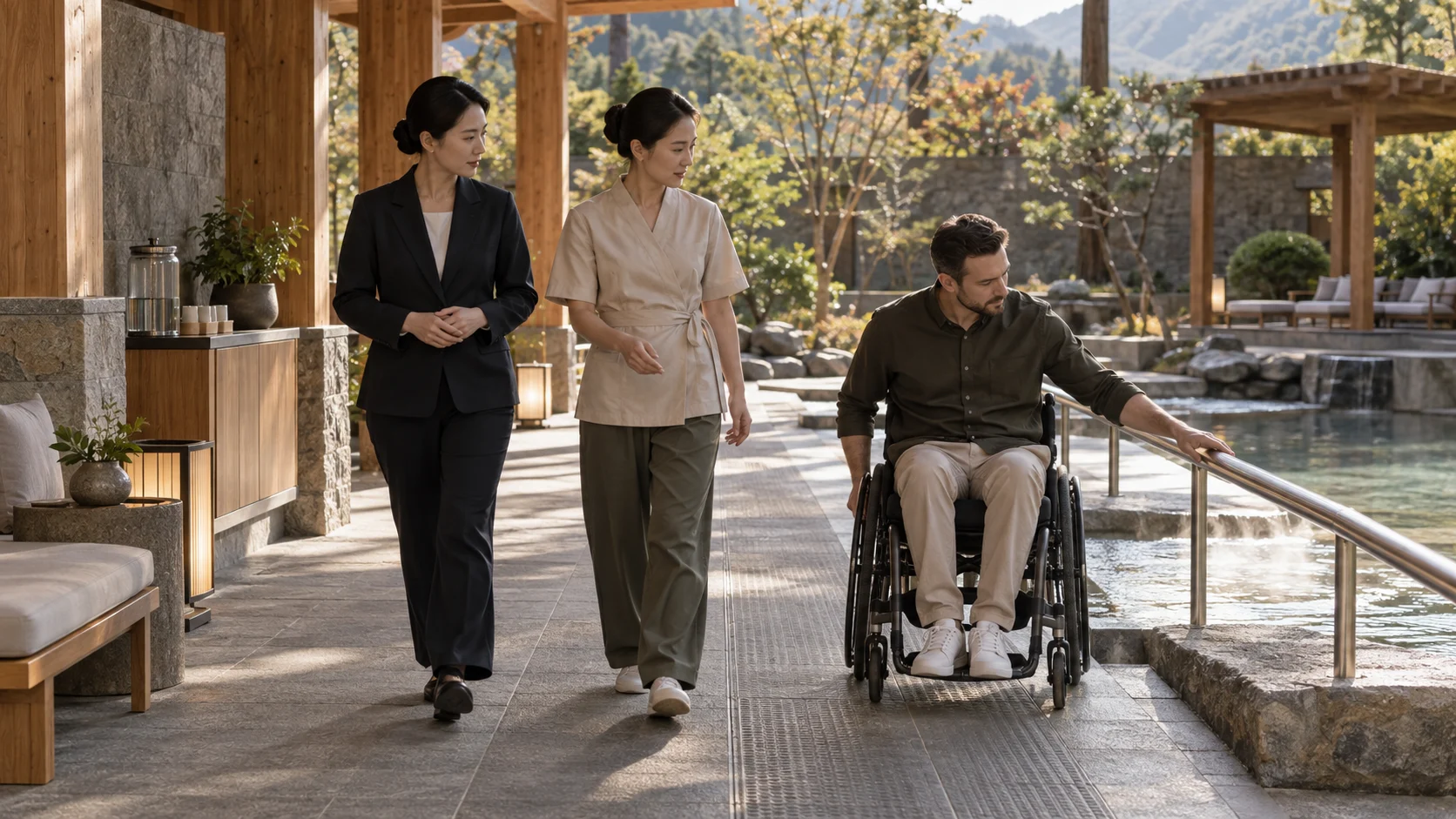
Spa and nature programmes often describe themselves as restorative while presenting avoidable barriers: steep wet steps, low seating, tiny changing areas, unclear wayfinding, rigid group pacing and no useful information about distance or terrain. Legal recognition creates an opportunity to treat access as a quality question rather than an afterthought.
Operators should publish practical details before booking. These include step-free routes, gradients, surfaces, handrails, transfer arrangements, seating, accessible toilets and changing space, lift dimensions where relevant, water-entry options, sensory conditions, quiet alternatives, companion policies and how staff can adapt a programme. “Contact us for accessibility” is not enough when the guest must reveal personal information simply to learn whether the front door works.
Accessibility is also operational. A route that exists on a plan may be blocked by linen carts. A pool lift may be uncharged. A guide may move too quickly for the advertised level. Training, maintenance and daily checks turn design intent into actual access.
Cultural resources are not interchangeable décor
The decree’s list includes craft, meditation, dance, art and music. These can anchor a Korean wellness proposition in living local practice instead of importing a generic retreat template. They can also be flattened into mood-setting: a borrowed costume, a simplified ritual, a silent artisan placed in the background of a luxury package.
Responsible integration begins with named relationships. Who holds the knowledge? How were the programme and language developed? Is participation voluntary and accurately explained? Is the practitioner paid fairly? Does the activity create continuing local value? What has been adapted for visitors, and what has not been offered because it is private, sacred or unsuitable?
Authenticity does not require freezing culture. Contemporary Korean designers, chefs, artists, movement teachers and spa professionals can create new work. The standard is not antiquity; it is authorship, consent, specificity and benefit. A programme becomes more credible when it can explain where its elements came from and who shaped them.
A practical blueprint for spa and hospitality leaders
Map every status and claim
Create a register of the business, facility, practitioner, programme and marketing statuses that apply. Record the issuing authority, scope, renewal date and evidence owner. Review every use of “registered”, “certified”, “medical”, “therapeutic” and “healing” so the guest sees the same distinction the legal team sees.
Build a programme dossier
For each experience, document its purpose, sequence, duration, staff roles, capacity, accessibility, contraindication process, emergency response, cultural source, environmental requirements, evidence level, cancellation alternative and aftercare. The dossier is not guest copy. It is the operating source from which accurate guest copy and staff training can be produced.
Design handovers, not just activities
A multi-provider itinerary fails in the gaps. Decide who holds the guest’s essential preferences, how consent and privacy travel, who explains delays, how dietary and mobility needs are confirmed, and who responds when a traveller cannot complete the next step. Luxury is often the absence of repeated explanations.
Measure value without manufacturing proof
Track satisfaction, complaints, incidents, repeat visits, staff retention, local procurement, resident participation, resource use and access failures. If wellbeing measures are collected, use a proportionate method, explain why the data is needed and avoid turning a small, self-selected guest survey into a clinical claim. Regional districts should publish both economic benefits and pressures on water, land, housing and public access.
Give the frontline permission to be precise
Train staff to say what a programme is not. “This is a relaxation and cultural experience, not medical treatment” can increase trust. So can “this certification applies to the facility, not every practitioner” or “we do not yet have evidence for that outcome”. Precision is not anti-luxury. It is the confidence to let the experience stand without exaggeration.
Questions to ask before booking
- Status: Is the business registered under the Healing Tourism Industry Act, does the facility hold a separate certification, or is it part of a promotional destination list?
- Programme: What exactly is included, who leads each element, what is optional and how demanding is the schedule?
- Scope: Which services are hospitality or spa experiences, and which—if any—are regulated healthcare?
- Access: What are the actual routes, surfaces, changing facilities, water-entry options and sensory conditions?
- Culture: Who developed the cultural elements, how are practitioners credited and paid, and what has been adapted for visitors?
- Evidence: Which outcomes are experiential, which are measured, and what limits does the operator state?
- Accountability: Who handles safety concerns, complaints, privacy requests and follow-up after the visit?
Editorial verdict
South Korea’s law is important because it acknowledges that wellness tourism has become too large and too interconnected to remain a purely promotional idea. Registration, training, data and district planning can make the category easier to understand and govern. They can also help a destination build value around its own landscapes, practices and people.
The test will be implementation. A credible system will keep registration distinct from excellence, wellness distinct from medical treatment, and visitor growth connected to resident benefit and environmental limits. The finest result would not be a louder claim to healing. It would be a quieter, more legible industry in which travellers know who is responsible, staff know their scope and places can prove that tourism is strengthening what makes them worth visiting.
Visual note: the photographs in this article are original AI-generated editorial illustrations. They depict fictional people and places and do not represent a named Korean property, institution or government programme.
Frequently asked questions
What is South Korea’s Healing Tourism Industry Act?
It is a national law that took effect on 9 April 2026 and creates a framework for developing healing tourism through planning, business registration, facility certification, workforce development, research, information systems and designated industry districts. Detailed requirements also sit in its enforcement decree and rules.
Does a registered healing-tourism programme count as medical treatment?
No. Registration under a tourism-industry framework does not by itself make a service medical treatment or prove a health outcome. Any clinical service should identify the appropriately licensed provider, regulatory basis, evidence, risks, consent and follow-up separately.
Is excellence certification the same as business registration?
No. Registration establishes that a business meets the applicable entry requirements for its category. Certification of an excellent healing-tourism facility is a separate quality mechanism. Travellers should check the exact status, scope, issuing authority and current validity rather than relying on a generic badge.
How could the Act affect luxury spas and resorts?
It can encourage clearer programme plans, trained personnel, stronger regional partnerships and more consistent information. It does not replace spa safety rules, professional licensing, consumer protection or evidence for treatment claims, so operators still need a complete compliance and claims-governance system.
What should travellers verify before booking a Korean wellness programme?
Verify the operator’s exact status, programme sequence, practitioner roles, accessibility, price and cancellation terms, health screening, data use and complaint route. Ask which elements are hospitality or spa services and which, if any, are regulated healthcare.
Sources and further reading
- Spa Business: the 22 September 2026 report that brought South Korea’s new statutory wellness-tourism framework into the international spa news cycle. Read the lead report.
- Republic of Korea National Law Information Center: the Act on the Promotion of the Healing Tourism Industry, enacted as Act No. 20920 and effective from 9 April 2026. Read the Act.
- Republic of Korea National Law Information Center: the enforcement decree defining healing-tourism resources and detailing registration, certification, training and district mechanisms. Read the enforcement decree.
- Republic of Korea National Law Information Center: the enforcement rules covering registration documents and administrative procedures. Read the enforcement rules.
- Korean Ministry of Culture, Sports and Tourism: the official English-language release on implementation, the 20 internationally focused destinations and planned sector measures. Read the ministry release.
- OECD: the Korea chapter of Tourism Trends and Policies 2026, including its policy summary of the Act and the wider tourism-governance context. Read the OECD profile.