Beyond the Fold: A Circular Textile Standard for Luxury Spas
A towel is one of the most ordinary objects in a spa and one of the most revealing. It is purchased in volume, washed repeatedly, handled by several teams, judged by every guest and eventually removed from service. Yet many sustainability statements begin only at the final bin: a collection partner is found, a recycling claim is made and the years of decisions that determined the textile's useful life disappear from view.
A circular approach starts much earlier. It asks whether the fibre, construction, colour and finish suit the real laundry process; whether the item survives its intended use without creating unnecessary weight or chemical demand; whether staff can inspect and repair it; and whether the operator knows what happens after collection. Recycling is one possible destination, not the definition of the system.
This article proposes a practical standard for towels, robes, sheets, slippers and treatment linen in luxury spas. It is not a claim that one fibre, supplier or technology solves every impact. It is a way to connect procurement, hygiene, guest experience, worker safety, measurement and verified end-of-life routes so that “responsible linen” means more than a soft label.
The current signal: take-back has reached the spa linen room
In October 2026, Spa Business reported that textile supplier BC SoftWear and repurposing company Avena Group had introduced a collection route for used spa and hospitality textiles. The reported scheme accepts items such as towels, robes, slippers and linen, with material directed to applications including insulation, sound board, geotextiles and fibre-reinforced concrete where possible. It also addresses the removal of identifiable branding.
The initiative is a useful industry signal, not proof that every collected item becomes a new textile or that one commercial programme is the answer for every property. The article describes a supplier partnership and includes company claims; it does not publish a comparative life-cycle assessment, a universal recovery rate or an independently audited destination for each load. A responsible editorial reading therefore asks a broader question: what must an operator control before a take-back service can be called circular?
That question is timely. The European Commission's textile strategy describes a direction towards products that are durable, repairable and recyclable, supported by reuse and repair services and greater producer responsibility. The European Environment Agency says a systemic shift requires higher quality, longer use, reuse, repair and recycling. Its 2025 briefing also warns that exported used textiles can pass through complex chains of sorting, reuse, recycling, landfilling, burning or dumping. A collection receipt is the start of evidence, not the end.
The United Nations Environment Programme reaches a similar conclusion at global scale. Its textile value-chain roadmap organises change around consumption, improved practices and infrastructure, and explicitly says the examples in the report should not be read as endorsements or as a finished model of circularity. For spas, the lesson is useful: the object cannot be separated from the system that purchases, uses, washes, transports and retires it.
Why linen deserves its own operating standard
Textiles sit at the meeting point of luxury and logistics. Guests experience weight, absorbency, temperature, freshness, drape and touch. Therapists depend on consistent dimensions, secure draping and enough stock to reset rooms without rushing. Attendants and laundry teams lift wet loads, move carts, sort stains, fold repetitive volumes and protect clean and used flows from crossing. Procurement sees unit price; finance sees replacement; engineering sees heat and water; sustainability teams see materials and waste. If these functions make separate decisions, a supposedly premium item can create avoidable cost and impact at every stage.
The Global Sustainable Tourism Council's current Hotel Standard is deliberately broader than spa linen, but its structure is relevant. It treats sustainability as a management system and provides performance indicators rather than declaring that a single purchase achieves the goal. Its hotel guidance draws attention to environmentally preferable purchasing, efficient use of consumables and major waste streams including linens and uniforms. That supports a whole-cycle approach: policy, records, targets, staff involvement and property-level evidence.
Luxury also changes the risk of superficial decisions. A very heavy towel may look impressive on a buying table while requiring more energy to dry, more storage, greater cart capacity and more strenuous handling. A pale neutral may hide fading but show certain stains. A complex blend may feel resilient yet limit the recovery routes available locally. Embroidery can protect brand assets while making repair, reuse or fibre separation harder. None of these features is automatically wrong. Each should be chosen with its full operating consequence visible.
This is where the textile standard connects to a broader carbon cost per spa visit. Laundry energy, purchased linen, chemicals, transport and waste may sit inside different accounting categories, but operational decisions connect them. The goal is not to optimise one indicator at the expense of hygiene, staff or product life. It is to find the durable service design that performs across them.
The seven-part circular textile standard
1. Map the textile system before changing the product
Begin with an inventory by item type, fibre composition, size, weight, supplier, purchase date, unit cost and intended use. Add annual purchases, stock in circulation, items withdrawn, the reason for withdrawal and their destination. Record whether laundering is on site or outsourced, how many kilometres are travelled, how loads are scheduled and who owns damaged or lost stock under the contract.
Do not wait for perfect item-level tracking. A monthly count by product family can reveal whether face cloths disappear, robes fail at belts and cuffs, coloured towels fade or treatment sheets are retired because stains cannot be removed. Sample inspections can distinguish normal wear from avoidable damage. The baseline should separate guest-facing textiles, staff uniforms, cleaning textiles and single-use items because their hygiene rules, life and recovery routes differ.
Assign ownership. Procurement can specify evidence, but operations must confirm that the item works. Laundry teams should report failure patterns. Therapists and attendants can explain where dimensions or storage create waste. Facilities can supply energy and water data. Finance can calculate cost per use rather than purchase price alone. Sustainability staff can verify downstream claims. No one department can see the complete loop.
2. Buy for verified service life, not a green adjective
Write a performance brief before requesting samples. It should state the use, laundering method, expected finish, dimensions after washing, acceptable shrinkage, colourfastness, absorbency, seam strength, repairability and any required chemical or fibre certification. Ask the supplier which claims are product-specific, which are facility-level and which rely on a chain-of-custody or mass-balance model. “Natural”, “recycled”, “responsible” and “biodegradable” do not explain durability, processing chemistry or the actual end-of-life route.
Run a controlled trial through the real laundry, not a domestic machine or showroom demonstration. Number the samples, wash them with the approved process and inspect at agreed intervals for dimensional change, edge failure, lint, handle, absorbency, stains and colour. Include the people who fold, store and use the item. A lighter product that survives well may outperform a heavier one; a higher purchase price may be economical if service life is demonstrably longer. The comparison needs equivalent function and actual cycles, not impressions after one wash.
Design choices should preserve options. Standardised dimensions can reduce fragmented stock. Replaceable belts or fasteners may extend robe life. Removable brand elements can simplify reuse. Limiting unnecessary trims and difficult fibre combinations may help some recyclers, although the operator must confirm local acceptance rather than assume that a mono-material label guarantees recovery. Keep fibre and care information in the asset register even if the physical label becomes unreadable.
3. Launder to a validated hygiene and quality specification
A circular programme cannot lower hygiene standards to save a cycle. Define soil categories, segregation, wash programmes, detergent dosing, temperature or disinfection requirements, drying, finishing, clean storage and rejected-load handling with competent laundry and infection-control advice appropriate to the service and jurisdiction. A treatment table, wet-area towel, staff uniform and cleaning cloth do not necessarily belong in the same process.
At the same time, “hotter and longer” is not a universal quality strategy. Over-dosing, unnecessary rewashing, poor water quality, overloaded or underloaded machines and excessive drying can damage fibres as well as consume resources. Track rewash rate, reject rate, load utilisation and the main causes of staining or damage. Calibrate dosing equipment, maintain filters and heat systems, and give the laundry enough information about oils, clays, waxes or treatment products that are difficult to remove.
A 2024 BMJ Open life-cycle assessment of a large hospital laundry found that energy use, manufacturing and transport all affected the result, and that the modelled reusable items had substantially lower per-use greenhouse-gas emissions than single-use alternatives. A hospital laundry is not a luxury spa, and its hygiene requirements, scale, grid and logistics cannot simply be transferred. The study is valuable because it demonstrates the method: measure the actual process, state the boundary, test scenarios and resist universal claims from one facility.
4. Protect product life through everyday handling
Useful life is often decided between the treatment room and the laundry. Provide closed, correctly sized containers for used linen; keep wet items from sitting compressed for long periods; prevent oils and chemicals from being thrown into mixed loads without guidance; and design a route that avoids dragging bags or overflowing carts. Set par levels from occupancy, treatment mix, laundry turnaround and contingency needs rather than filling stores without visibility.
Worker safety belongs inside circularity. The UK Health and Safety Executive's manual-handling guidance says employers should avoid hazardous handling where reasonably practicable, assess operations that cannot be avoided and reduce injury risk. Local law will differ, but the principle travels: wet linen is heavier than dry linen, awkward bags and high shelves create risk, and a sustainability project should not depend on staff lifting more or sorting waste by hand without suitable equipment.
Use carts, shelf heights, bag sizes, routes and staffing that fit the work. Schedule enough turnover time for correct sorting. Invite laundry and locker teams into trials and incident reviews. This is one practical extension of the magazine's spa staff wellbeing standard: resource efficiency is not responsible when hidden labour absorbs the strain.
5. Inspect, repair and cascade only when fit for purpose
Create objective condition grades. A guest-facing towel might require intact edges, consistent colour, absorbency and a finish appropriate to the brand. A robe with a loose belt loop may be repairable; one with degraded fabric or a hygiene concern may not be. Minor repairs should be recorded so recurrent construction faults become procurement evidence. Repairs need to withstand the same laundering process and should not create rough seams, weak attachments or an improvised appearance.
Cascading an item to a lower-demand use can extend life, but it is not a licence to move every problem backstage. Define which textiles may become cleaning cloths, protective wraps, training samples or maintenance material, and make the new purpose visually unmistakable. Do not use an item for a task that creates chemical, infection or cross-contamination risk. Count cascaded stock so “reuse” does not become an unmeasured cupboard of material that will later be discarded.
Donation requires the same discipline. Send only clean, functional items that a recipient has requested and can use. Confirm whether branding should be removed, who owns the goods, whether transport and import rules apply and what happens to rejects. Sending damaged linen to another community does not preserve value; it transfers sorting and disposal costs.
6. Apply the waste hierarchy and verify the next destination
UK government guidance describes a hierarchy of prevention, preparation for reuse, recycling, other recovery and disposal. The legal details are jurisdiction-specific, but the order is a strong operating test. First avoid premature replacement. Then repair or prepare suitable items for direct reuse. Recycle when the item no longer performs and a credible process exists. Recovery and disposal remain lower options.
Before signing a collection contract, ask what compositions and contamination levels are accepted, whether trims must be removed, how loads are weighed, where processing occurs, what proportion is rejected and what outputs are actually produced. Distinguish closed-loop textile-to-textile recycling from open-loop uses such as insulation or composite material. Open-loop recovery can be useful, but it should not be described as a new towel when the fibre does not return to textiles.
Request transfer records and periodic destination evidence. If material crosses borders, verify the applicable waste classification, duty of care and receiving facility. Protect branded assets without destroying reusable value unnecessarily. A secure destruction service may manage reputation risk, but shredding a serviceable robe is not automatically the best environmental outcome. Design for removable identity from the beginning.
7. Report the evidence, including what the operator does not know
A useful dashboard can be compact: items purchased by category, average cost per use where measurable, withdrawal reasons, repair and reuse quantities, kilograms collected by destination, contractor rejects, rewash rate and the energy, water or emissions boundary used for laundry. Report absolute quantities as well as percentages. A 90 per cent diversion rate can hide rising purchases; a longer life claim means little without a defined baseline and comparable item.
Keep supplier declarations, test results, invoices, collection weights and destination statements. Separate independently certified information from supplier assurance and internal estimates. If the recycler cannot report what happened after aggregation, say so. If only the hotel-wide waste total is known, do not present it as spa-specific. The strongest claim may be modest: “We measured twelve months of towel retirement, repaired this quantity and sent this documented load to this verified process.”
A procurement brief that can survive the sales meeting
For each proposed towel, robe or sheet, request the exact fibre composition, manufacturing location, product weight, finishes, restricted-substance controls, care instructions, independently verified certifications, recycled-content accounting method and test data relevant to commercial laundering. Ask for repair options, spare components, minimum order quantities, packaging, lead times and the supplier's policy for imperfect or returned stock.
Then ask the operational questions. Has the product been tested in the property's water, machinery and chemistry? Does it dry within the available cycle? Does lint affect filters or guest perception? Can the towel be folded and stored in the existing system? Is the robe inclusive across the promised size range? Does a textured surface trap treatment product? Will the supplier accept the item at end of use, and is that route available in the property's country rather than only at headquarters?
Score evidence separately from performance. A recognised certification may give assurance about a defined attribute, but it does not prove fit for a particular spa. Conversely, a durable sample is not enough if labour, chemistry or chain-of-custody questions remain unanswered. The buying decision should show how material impacts, usable life, guest experience, laundry demand, staff handling, availability and end-of-life route were balanced.
What sophisticated travellers can look for
Guests do not need a lecture beside the robe hook. They do deserve accurate information when a property makes a sustainability claim. Specific language is more credible than a leaf icon: a named standard, a dated reduction, a clear laundry boundary or an explained repair and collection programme. A claim that towels are “recycled” should say whether that refers to recycled content, collection after use or the material produced downstream.
Guest choice can reduce unnecessary hotel-room linen changes, but spa operations are different. A used treatment towel should not be left in circulation because a sustainability card suggests reuse. Hygiene, treatment protocols and local rules determine when an item must be changed. The operator should reduce impacts through product design, efficient validated laundering and longer service life rather than shifting responsibility or uncertainty onto the guest.
Visible wear is not proof of virtue, and immaculate linen is not proof of waste. The meaningful signs are behind the presentation: staff who have suitable equipment and time, procurement that tests durability, repairs that meet the service standard, and evidence for what leaves the property. Quiet competence is more luxurious than a dramatic claim.
The World Luxury Spa verdict
A circular textile programme is not a bin in the loading bay. It is a chain of decisions that begins before the first purchase and continues until the operator can account for the last useful destination. The best programme will buy fewer unsuitable items, keep good products in service longer, protect hygiene and workers, recover value without disguising downcycling, and publish evidence proportionate to the claim.
For spa leaders, the test is simple: can the business explain why this item was chosen, how it performs, why it was retired and where it went? If any link depends on a slogan, a supplier brochure or an undocumented hand-off, the loop is still open. For travellers, responsible luxury is not a rough towel or an instruction to accept less. It is the confidence that comfort has been engineered with consequences in mind.
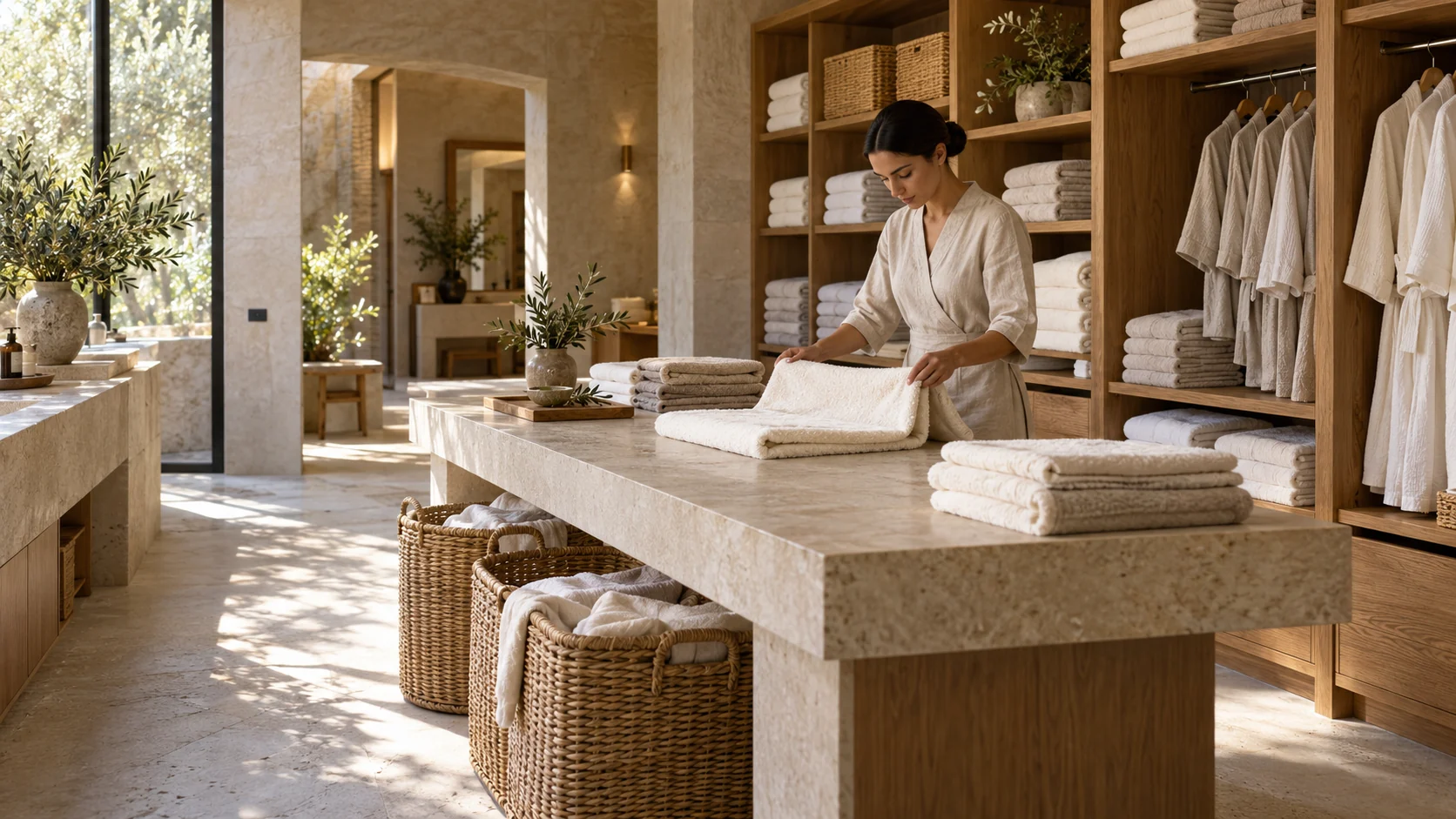
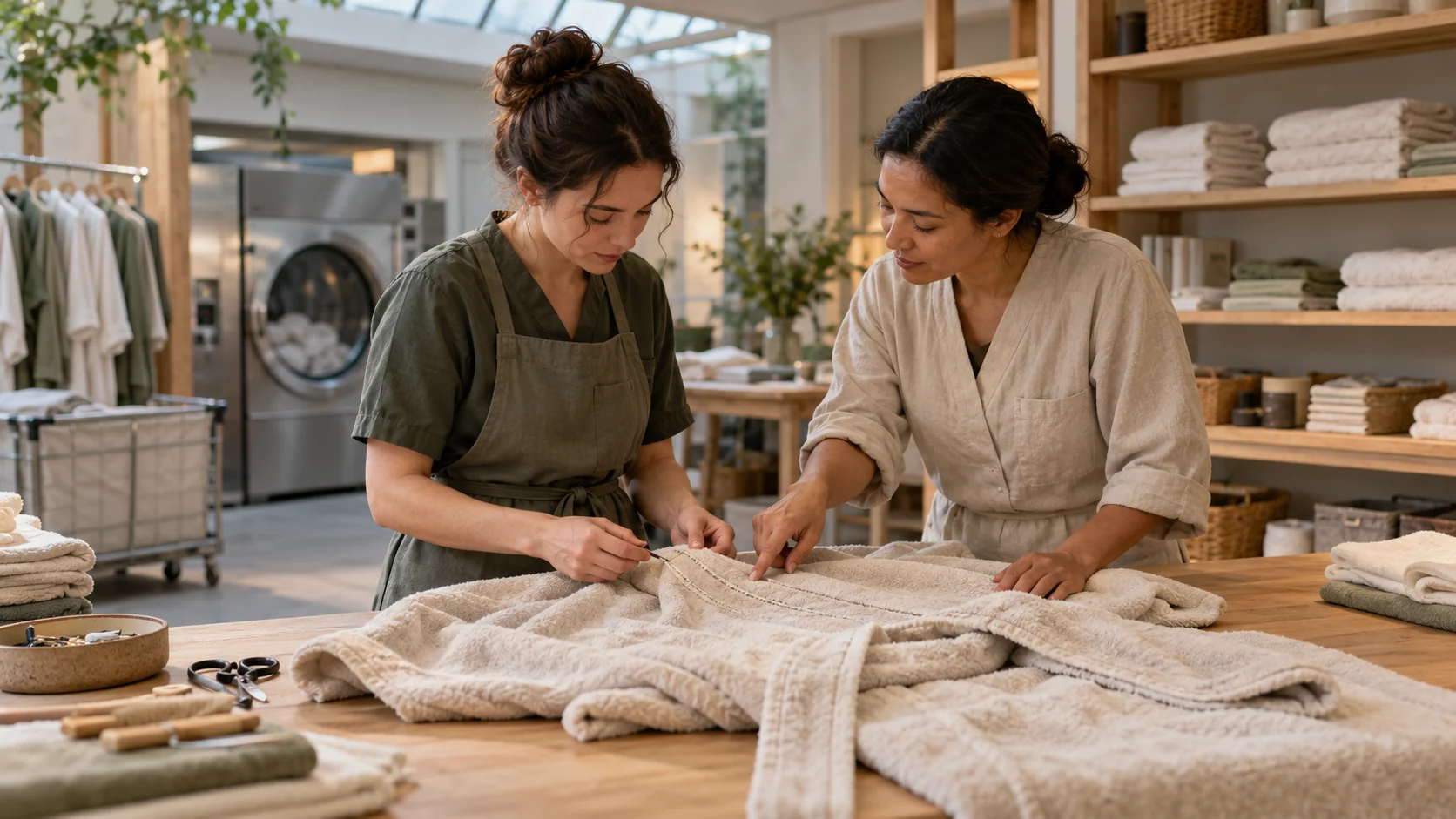
Visual note: both photographs in this article are original AI-generated editorial illustrations. They depict fictional settings and people and do not represent a named spa, hotel, laundry, supplier, institution or brand.
Frequently asked questions
What does a circular textile programme mean for a spa?
It means managing towels, robes, sheets and related items across their full service life: buying for verified durability and safe laundering, tracking performance, preventing avoidable damage, repairing or reusing suitable items and sending retired material to a documented next use. Recycling alone does not make the system circular.
Are recycled fibres always the most sustainable choice for spa linen?
No. Recycled content can reduce demand for virgin material, but the result also depends on fibre source, processing, durability, laundering performance, chemical controls, transport and what happens after use. Compare equivalent products with product-specific evidence and a trial in the real operation.
How long should luxury spa towels and robes last?
There is no universal number of washes. Useful life varies with construction, weight, treatment products, water, wash chemistry, equipment, drying, handling and the property's condition standard. Operators should track actual cycles or time in service, withdrawal reasons and cost per use rather than publish an unsupported lifespan.
Can a spa donate all of its old linen?
No. Donation is suitable only for clean, functional items that a recipient has requested and can safely use. The spa should address ownership, branding, transport, local rules and rejected items. Damaged, contaminated or unusable textiles need an appropriate verified recovery or disposal route.
What should a traveller ask about a spa's textile sustainability claim?
Ask whether the claim concerns recycled content, laundering, longer use, repair, take-back or the final recycling process; which items and properties it covers; what period was measured; and whether collection weights and destinations are documented. A specific, bounded answer is more useful than a general eco-friendly label.
Sources and further reading
- Spa Business: the October 2026 product-news report on a take-back and repurposing partnership for spa and hospitality towels, robes, slippers and linen. Read the lead article.
- European Commission: the EU Strategy for Sustainable and Circular Textiles, covering durability, repairability, recyclability, producer responsibility and textile lifecycle policy. Read the strategy overview.
- European Environment Agency: the 2025 briefing on textile circularity, longer use, reuse, repair, recycling, collection gaps and the uncertain destinations of some used-textile exports. Read the circularity briefing.
- United Nations Environment Programme: the global roadmap for sustainability and circularity across the textile value chain. Read the roadmap.
- Global Sustainable Tourism Council: the current Hotel Standard and performance-indicator framework for sustainability management, purchasing, resource use and major waste streams. Read the hotel standard overview.
- UK Department for Environment, Food & Rural Affairs: business guidance on applying the waste hierarchy from prevention and reuse to recycling, recovery and disposal. Read the waste-hierarchy guidance.
- UK Health and Safety Executive: manual-handling guidance on avoiding hazardous handling, assessing unavoidable operations and reducing injury risk. Read the worker-safety guidance.
- BMJ Open / PubMed: John and colleagues' 2024 life-cycle assessment of a large hospital laundry, including process boundaries, energy, manufacturing, transport and reusable-versus-single-use scenarios. Read the study record and abstract.