The Space Between Plans: Why Luxury Wellness Travel Needs Freedom by Design
The modern wellness itinerary can arrive with the density of a board meeting: sunrise movement, breakfast protocol, consultation, treatment, workshop, guided walk, dinner and sleep ritual, each arranged with admirable precision. The paradox is that a guest may have travelled to escape demands only to inherit a more beautiful version of the calendar.
Freedom in luxury wellness does not mean abandoning people to organise everything themselves. It means giving them enough control to choose a pace, change their mind, spend time with others or be alone, and encounter a place without turning every hour into a task. The strongest resorts make that freedom easy to use. They remove logistical friction, explain the possibilities and preserve meaningful blank space.
This is a design and operating discipline, not a promise that a holiday will repair burnout, transform a relationship or produce a particular emotional outcome. Travel can support rest, pleasure, perspective and connection, but responses vary. A credible luxury property creates favourable conditions while leaving the guest in charge of what the stay means.
The current signal: travellers want relief from pressure, not simply more activity
A 1 November 2026 Spa Business report provides a useful market signal. It describes an OpinionWay survey commissioned by ALL Accor and supplemented by NellyRodi analysis, covering 7,019 travellers in seven markets in August 2026. Among the reported findings, 44 per cent primarily sought freedom from everyday demands, 43 per cent associated travel with unwinding after an intense period at work and 25 per cent wanted time away without having to plan everything themselves.
The same report says 56 per cent identified nature and exceptional scenery as important to a successful trip, 47 per cent selected immersion in local culture, 46 per cent selected unusual experiences and 42 per cent selected lasting memories with loved ones. These figures do not prove that one resort format produces wellbeing. They report stated preferences from a commercially commissioned survey released alongside an Accor campaign, and the public coverage does not name the seven markets or publish a complete questionnaire and weighting table. They are best read as directional evidence, not a universal map of traveller behaviour.
The more interesting message is the combination. People can want freedom and support, novelty and calm, personal time and connection. A property that translates the survey into “add more experiences” misses that tension. The opportunity is to build a stay that offers depth without density: experiences worth choosing, enough context to choose them well and no penalty for leaving part of the day unscheduled.
What independent research adds—and what it does not
Academic research gives the autonomy argument a more careful foundation. A 2020 study of 509 US respondents examined recovery mechanisms in leisure travel and found that autonomy was important in the relationship between travel experiences and life satisfaction. It also reported different patterns for shorter and longer holidays. This is useful, but it remains a survey-based study in one country; it does not establish a single ideal itinerary for every traveller.
An integrative review by Nanxi Yan, Jessica de Bloom and Elizabeth Halpenny, first published online by the Journal of Leisure Research in 2023, assembled evidence on vacations and subjective wellbeing. It identifies mechanisms including recovery from work, novelty, autonomy, relationships and meaningful activity, while also showing that the field contains varied definitions, methods and outcomes. The reasonable conclusion is not that a spa holiday causes lasting happiness. It is that choice, detachment, enjoyable challenge and social context can influence how a vacation is experienced.
A 2023 systematic review of 70 tourism articles similarly describes meaningful experiences as multidimensional, involving personal, emotional, relational and behavioural elements. A 2026 Scientific Reports study found an association between memorable tourism experiences, positive emotion and subjective wellbeing, with psychological resilience considered as a moderating factor. Like much tourism research, it depends substantially on self-report and modelling. Memorable is not a treatment category, and positive association is not an individual guarantee.
For spa leaders, the evidence supports a bounded principle: protect agency and create conditions in which guests can engage voluntarily. For travellers, it supports a practical question: will this place let me shape the experience after I discover how I actually feel on arrival?
Autonomy is not abandonment
There are two poor extremes. At one end, the guest receives a rigid programme in which every meal, movement session and treatment is treated as essential. At the other, the guest receives a long menu, an app and the instruction to curate a perfect stay. The first removes control; the second transfers the operator's work to a person who may already be tired of deciding.
Freedom by design sits between them. The property does the difficult preparation: it maps realistic timings, communicates access and safety conditions, coordinates practitioners, holds capacity and understands which choices can be changed. The guest then makes a small number of meaningful decisions. A host might ask whether the desired rhythm is quiet, social or active; whether mornings should remain protected; and which one experience feels important. That is more useful than asking a newcomer to optimise twenty-seven options.
Support should stay optional. A host can recommend without diagnosing, and a programme can have a coherent sequence without pretending that deviation represents failure. Guests should be able to decline a group ritual, shorten an activity or replace it with rest without being shamed, upsold or warned that the “results” will be lost. In a non-clinical spa setting, comfort and agency are part of responsible service.

Five design moves that create supported freedom
1. Begin with anchors, not a complete timetable
Some elements genuinely require advance coordination: a scarce practitioner, a tide-dependent activity, airport transport, an accessible room setup or a dietary conversation. Confirm those anchors, then show the open space around them. A simple arrival plan with one assured treatment and one optional orientation can feel more luxurious than a pre-filled day that assumes energy, appetite and weather will behave as forecast.
The booking journey should distinguish what is included, what is reserved, what is optional and what carries a cancellation charge. Our guide to booking a hotel for the whole wellness programme explains why the surrounding stay matters as much as the treatment list. Freedom is credible only when the guest knows which choices remain genuinely available.
2. Protect transition time
A sixty-minute treatment rarely occupies only sixty minutes. Guests need time to arrive, change, ask questions, drink water, recover their bearings and move to the next place. If a schedule ignores those transitions, the property manufactures hurry. Build buffers into treatment capacity and transport promises rather than relying on the guest to race elegantly.
Blank space should be designed, not merely left over. Shade, comfortable seating, clear wayfinding, water, weather protection, changing facilities and quiet areas make unscheduled time usable. A beautiful garden is not restorative if entry is unclear, every bench is in full sun or a guest must cross a crowded lobby in a robe.
3. Offer a small number of legible pathways
Choice becomes easier when options are organised around experience rather than claims. A property might describe three adjustable rhythms: quiet restoration, active exploration and shared discovery. Each pathway can show the approximate effort, social intensity, duration, environment, accessibility considerations and freedom to leave. It should not label one pathway as more virtuous or medically appropriate.
Menus need plain language. “Guided coastal walk, 75 minutes, uneven ground, conversational pace, return transport available” is more useful than “transformational nature immersion”. Precision reduces uncertainty without scripting emotion. It also lets the host adapt responsibly when weather, mobility or group composition changes.
4. Make changing one's mind operationally possible
A flexible promise is meaningless if every attractive alternative is full. Resorts need capacity rules, release times and a transparent approach to substitutions. Not every reservation can be changed without cost, particularly where a practitioner or private vehicle has been committed. The luxury standard is to explain the boundary before payment and offer reasonable choices inside it.
Staff need authority as well as empathy. A host who can move a booking, arrange a quiet meal table or suggest a shorter route prevents small friction from becoming the story of the stay. That authority should operate within documented limits so that flexibility does not depend on status, persistence or a guest's comfort with confrontation.
5. End with reflection, not a performance score
Ask what the guest enjoyed, what felt difficult and what they would choose next time. Do not turn a holiday into a before-and-after contest unless a clearly defined, consented and appropriate assessment is part of the service. Mood scores collected for programme improvement should not be repackaged as proof that a retreat treats stress, anxiety, sleep disorders or another health condition.
A useful departure note might record a preferred massage pressure, a favourite walking route or a recipe the guest requested. It should not prescribe a lifestyle overhaul. The goal is to extend practical value while respecting privacy and the difference between hospitality follow-up and healthcare.
Connection must include permission to separate
Meaningful connection is often presented as a universal good, yet travellers differ in social appetite, culture, language, neurotype, relationship dynamics and simple mood. A couple may want parallel activities. A solo guest may welcome a communal table one evening and prefer anonymity the next. Friends can value time together without sharing every treatment.
The practical standard is consent at each social threshold. Say whether an experience is private, shared, hosted, conversational or silent. Explain group size and whether guests can leave early. Do not surprise a solo traveller with enforced intimacy or assume that people sharing a room share health information, treatment preferences or a desire for paired rituals.
Families need particular care because “free choice” can conceal who performs the coordination. A schedule is not genuinely spacious if one adult must manage childcare, meals, transport and everyone else's bookings. Our analysis of family wellness resort design considers how shared, parallel and individual time can be offered without quietly transferring the work to one caregiver.
Nature and culture should be relationships, not scenery packages
The Accor-commissioned survey's interest in nature and local culture is commercially attractive, but these categories require more than programming. Access to a landscape should account for heat, weather, biodiversity, mobility, land rules and local use. “Freedom” does not mean unrestricted access to fragile areas, private land or places with cultural significance.
Local culture should not be reduced to a decorative ritual selected for its photogenic qualities. A responsible experience identifies who created it, who has authority to share it, how contributors are paid, what guests may photograph and which elements are not for tourist adaptation. The option to participate must coexist with the obligation to follow community and environmental boundaries.
Meaning cannot be manufactured by intensifying the spectacle. A quiet walk led by someone with deep knowledge of a place may offer more than an itinerary of disconnected “authentic” moments. The operator's role is to create respectful access and accurate context. The traveller decides whether the encounter becomes memorable.
The operating model behind an unhurried stay
Spaciousness for the guest depends on discipline behind the scenes. Capacity planning must include buffers, not only billable minutes. Staffing must cover orientation, transitions and recovery from disruption. Information has to move between reservations, spa, food and beverage, transport and housekeeping with appropriate consent and data minimisation.
Leaders can test the model with a few direct measures: the proportion of the programme that can be changed after arrival; the percentage of guests who receive inclusions and restrictions before payment; wait time caused by internal hand-offs; use of optional activities; reasons for declined activities; and qualitative feedback on pace and clarity. High participation is not automatically success. A guest who confidently chooses an afternoon alone may be evidence that the system worked.
Commercial design matters too. If every flexible choice is an expensive add-on while the rigid timetable is prepaid, the economic architecture contradicts the promise. Packages can still protect revenue by including a credit, a limited set of bookable anchors and clear release conditions. The guest receives room to shape the stay; the property receives a forecast it can staff responsibly.
Finally, protect employees from becoming the shock absorbers of a vague flexibility policy. Staff should know which changes they can approve, when to involve a manager and how to explain a boundary without conflict. Supported freedom for guests cannot depend on unpaid overtime, skipped breaks or practitioners waiting indefinitely for a decision.
A booking test for sophisticated travellers
Before reserving, ask to see a sample day and identify what is fixed. Check how much unscheduled time remains after travel, meals, changing and transfers are counted. Ask whether treatments can be selected after arrival, what happens if weather changes and whether thermal or relaxation areas require timed access. If rest is important, verify room noise, blackout, housekeeping choices and the distance between accommodation and activities.
For shared trips, discuss the shape of the day before comparing facilities. Does everyone want the same level of activity? Is there an easy meeting point if people separate? Can one guest decline a paired experience without losing the full value? A property should help coordinate different preferences without demanding private explanations.
Look for language that respects uncertainty. “Choose your pace” should be supported by operating details, while “return transformed” asks the traveller to buy an outcome no hotel can guarantee. The most persuasive luxury is specific: clear timings, excellent hosting, comfortable alternatives and the freedom to enjoy less than everything on offer.
The World Luxury Spa verdict
Wellness travel does not need an emptier programme so much as a more intelligent relationship with choice. Guests need enough structure to feel held and enough agency to feel that the stay is theirs. That balance will vary by person, trip purpose and day; designing for adjustment is therefore more credible than declaring one ideal rhythm.
The best luxury resort will not compete to fill every hour. It will curate a small number of worthwhile possibilities, make their demands legible, preserve transitions, respect social consent and maintain the operational capacity to respond. It will treat nature and culture as relationships with boundaries, not raw material for an itinerary. And it will measure whether guests felt informed and able to choose, rather than whether they completed the programme.
Freedom by design is quiet. It appears in the treatment that can move, the host who asks one useful question, the shaded chair that needs no reservation and the afternoon that remains open without feeling neglected. In a market crowded with experiences, the space between them may be the most valuable luxury of all.
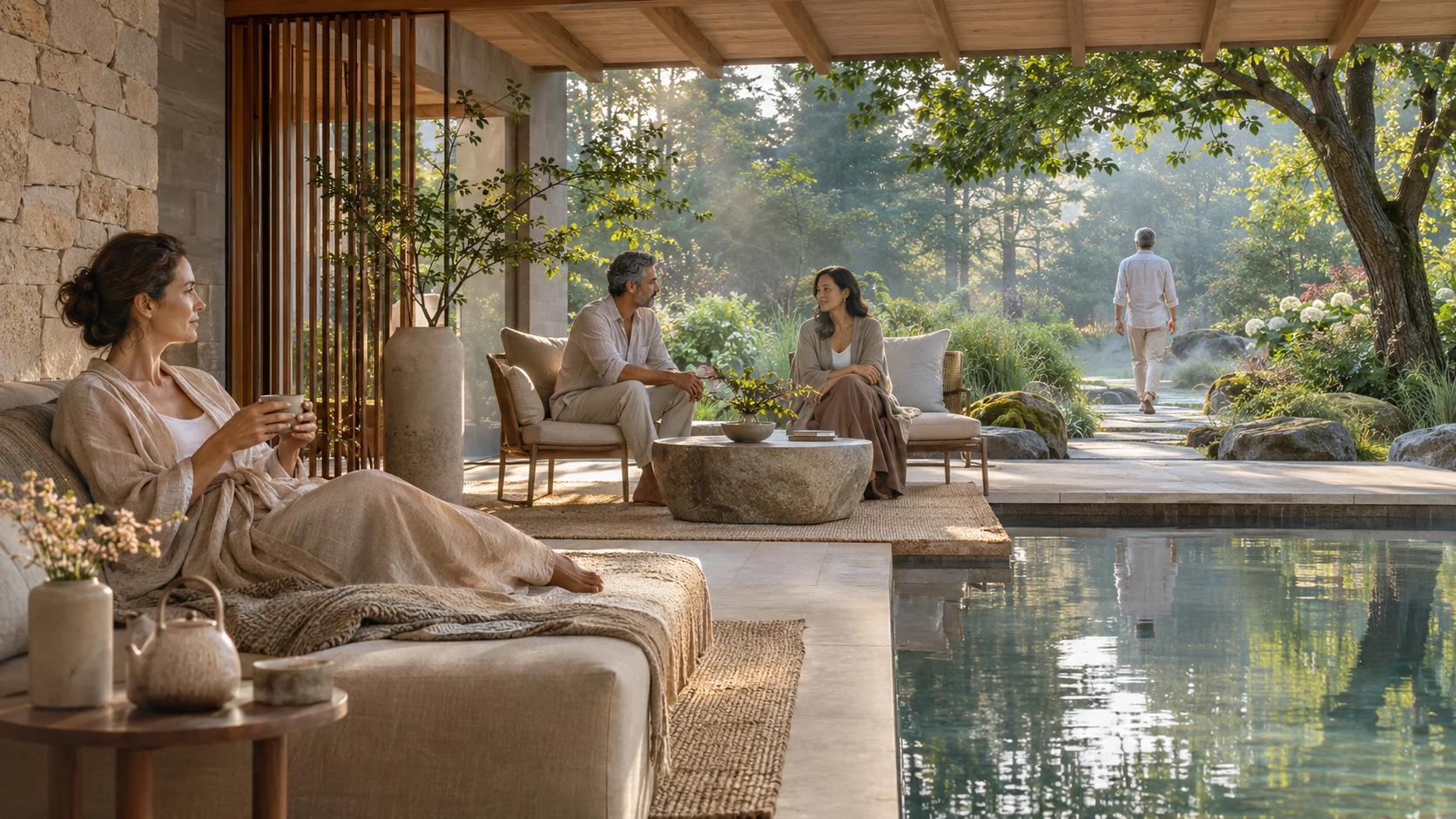
Visual note: both photographs in this article are original AI-generated editorial illustrations. They depict fictional settings and people and do not represent a named spa, hotel, institution, destination or person.
Frequently asked questions
What does freedom by design mean in wellness travel?
It means the property prepares the difficult logistics while preserving meaningful guest choice over pace, participation, social contact and rest. Options, timings, costs and constraints are clear, and changing course is possible within explained limits.
Is an empty itinerary always more restorative?
No. Some guests value structure, and excessive choice or planning can create more work. A better standard is supported flexibility: a few well-chosen anchors, usable unscheduled time and optional guidance that the guest can accept or decline.
How much of a spa-resort programme should be planned before arrival?
Reserve only the elements that are scarce, safety-sensitive or important to the purpose of the trip, then confirm which choices can wait. The right balance depends on length of stay, accessibility needs, season, practitioner capacity and the traveller's preference for certainty.
Can a resort guarantee a meaningful or restorative experience?
No. A resort can provide skilled service, comfortable environments, respectful access to place, social options and room for choice, but it cannot guarantee a particular emotion, relationship outcome or health benefit. Individual responses and circumstances vary.
What should travellers ask before booking a flexible wellness stay?
Ask what is fixed, what is optional, when choices must be made, which changes carry a fee, whether attractive alternatives usually have capacity, how weather disruptions are handled and whether quiet, social and active pathways are genuinely available.
Sources and further reading
- Spa Business: the 1 November 2026 report on the OpinionWay survey commissioned by ALL Accor, including reported preferences around freedom, nature, culture, connection and planning. Read the lead article.
- ALL Accor and Globetrender: the separate Experiential Travel Trends 2026 report and methodology, published in January 2026, used here as commercial context rather than independent proof. Read the report overview.
- Journal of Travel & Tourism Marketing: Chen, Zou and Gao's study of autonomy, travel experiences, vacation length and life satisfaction. Read the study record.
- Journal of Leisure Research: Yan, de Bloom and Halpenny's integrative review of vacations and subjective wellbeing, including recovery, novelty, autonomy, relationships and meaningful activity. Read the review.
- European Journal of Tourism Research: Câmara and colleagues' systematic review of 70 articles on meaningful tourism experiences and related psychological constructs. Read the systematic review.
- Scientific Reports: Hu, Li and Liu's 2026 study of memorable tourism experiences, positive emotion, subjective wellbeing and psychological resilience. Read the open-access study.